Best Pedal Board Power Supply by Outputs and Voltage

Ten isolated outputs, a 500mA high-draw tap, and a body light enough to velcro under any board: the Donner DP-1 is the pedal board power supply most players should default to. Here's when to pick something else.

By Frederick CameronUpdated 16 min read
On this page
- Best pedal board power supply at a glance
- How I narrowed the field from forty listings to six
- What actually decides a pedal board power supply?
- 1. Donner DP-1 — Best overall
- 2. RVONE RPS-20 — Runner-up
- 3. Camola Mosky — Best premium
- 4. RVONE Guitar Pedal Board with Power Supply — Best for heavy use
- 5. LEKATO BCUS-2868 — Best for beginners
- 6. D'Addario PW-CT-9V — Best budget pick
- Isolated outputs vs daisy chains: does it really matter?
- How many milliamps does your board actually need?
- What the listings quietly leave out
- The verdict
- FAQ
The best pedal board power supply for most players is the Donner DP-1, a 10-output isolated brick with a dedicated 500mA tap and 9V, 12V and 18V options in a 6.9 oz body. The Camola Mosky is the better buy when your board is heavy on digital pedals that each pull 300 to 500mA. Most players compare bricks on output count. That is not what decides it. The mix of voltages and current per output is.
Best pedal board power supply at a glance
| Pick | Outputs | Voltage taps | Price |
|---|---|---|---|
Best overall Donner DP-1 |
10 isolated (1× 500mA) |
9V, 12V, 18V | Check Price |
Runner-up RVONE RPS-20 |
10 isolated + USB |
9V, 12V, 18V | Check Price |
Best premium Camola Mosky |
10 isolated + USB |
9V, 12V, 18V (2× 500mA) |
Check Price |
Best for heavy use RVONE Pedal Board |
10 isolated (board included) |
9V (claim) | Check Price |
Best for beginners LEKATO BCUS-2868 |
10 isolated + USB |
9V, 12V, 18V | Check Price |
Best budget pick D'Addario PW-CT-9V |
1 (single) | 9V only | Check Price |


How I narrowed the field from forty listings to six
The screening was criteria-first, and the criteria mattered more than any single feature bullet.
First criterion: isolation. A pedal board power supply that daisy-chains every output shares ground across your whole signal chain, which is the fastest route to hum and hiss. Five of the six picks here publish "isolated" on the listing. The sixth, the D'Addario PW-CT-9V, is a single-output adapter, so isolation is not the question for it.
Second criterion: voltage flexibility. If your board has one 18V drive or a 12V analogue delay, a rigid 9V-only brick is a wasted purchase. Four of the six picks list 9V, 12V and 18V taps.
Third criterion: a real 500mA output. Modern digital pedals, especially reverbs and loopers, pull far more than the 100mA a vintage overdrive needs. I cut listings that offered ten outputs at 100mA each and called it a day.
Fourth criterion: a URL I could point at and specifications I could copy. Listings with mystery weights, mystery dimensions, and marketing bullets in place of numbers were dropped. Six survived. They ranged from a 1.76 oz single-output adapter to a 1.68 lb aluminium multi-output brick, and they cover every band from entry to premium in this set.
What actually decides a pedal board power supply?
Most guides compare bricks on output count. Ten outputs sounds like more than eight, so ten outputs wins. That is the wrong test.
Two figures decide the purchase. The first is current per output, measured in milliamps. A ten-output brick where every port is 100mA can only power ten analogue pedals; plug in a Strymon reverb pulling 300mA and the pedal browns out or hums. The Donner DP-1 lists 7× 9V 100mA, 1× 9V 500mA, 1× 12V 100mA and 1× 18V 100mA. The Camola Mosky lists 7× 9V 300mA, 1× 9V 500mA, and two adjustable outputs at 500mA. Same output count, very different capacity.
The second is voltage taps. If you never plan to run a pedal above 9V, a single-tap unit is fine. The moment you add a Fulltone OCD at 18V or an analogue delay at 12V, a 9V-only supply is a doorstop.
Everything else, from LED brightness to the aluminium finish, is secondary. Buy for the current draw of the pedals you own, then add roughly 30% headroom for the pedals you will own next year.
1. Donner DP-1 — Best overall
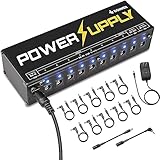
The DP-1 is the pedal board power supply most players should default to: ten isolated outputs, three voltages, and one genuine high-draw tap in a 6.9 oz body.
Best for: a mixed 9V/12V/18V board with one high-draw digital pedal Skip it if: your whole rig is a single 9V tuner and a fuzz
The DP-1's output map is the reason it leads this set. Seven 9V outputs at 100mA cover the ordinary drives, boosts, filters and analogue chorus a working board leans on. The eighth output is 9V at 500mA, which is where a digital reverb, delay or looper lives. The ninth is a 12V tap. The tenth is 18V. That is the exact spread most real boards need, in one 6.9 oz brick that fits under nearly any pedalboard.
Donner says each output has independent short-circuit protection, so a single dead pedal will not take the rest of the board down. A blue LED sits on top for board lighting and short-circuit indication. Ten power cables are listed as included.
Where it loses ground to the Camola Mosky is high-draw slot count. The DP-1 has one 500mA output. If your board runs two or three digital pedals at once, you will run out of headroom on the DP-1 before you run out on the Mosky.
Pros:
- Ten isolated outputs across three voltages
- Dedicated 9V 500mA tap for one digital pedal
- Only 6.9 oz, easy to velcro under a board
- Blue LED doubles as short-circuit indicator
- Sells faster than any other multi-output brick here
Cons:
- Only one output is above 100mA
- Published dimensions read oddly on the listing
- Two sellers list it, so cart availability varies
2. RVONE RPS-20 — Runner-up
The RPS-20 hits the same ten-output, three-voltage brief as the DP-1 in a 3.17 oz body, and adds a USB tap for a phone tuner.

Best for: gigging players who need a light brick with a USB tap for a phone tuner Skip it if: you want a stated dimension list before you buy
At 3.17 oz, the RPS-20 is the lightest multi-output brick in this set, less than half the weight of the DP-1 and roughly a fifth of the LEKATO. RVONE lists ten isolated DC outputs covering 9V, 12V and 18V pedals, plus a USB port for charging a phone or running a phone-based tuner. The manufacturer describes 100mA and 500mA outputs in the mix, so the current spread is broadly comparable to the DP-1.
The case is a black metal shell. RVONE claims a built-in noise filter chip and per-output indicator LEDs, and the listing publishes a one-year warranty. That is one of only three warranties in the set, and it matters on gear that spends its life in a gig bag.
The trade-off is documentation. RVONE lists the size as "portable" rather than in inches, and the dimensions in the feature text read as fragments. If you plan a build around exact millimetres of clearance under a Pedaltrain, the DP-1's numbers are easier to work with.
Pros:
- Lightest multi-output brick here at 3.17 oz
- Ten isolated outputs plus USB
- 9V, 12V and 18V taps for mixed rigs
- One-year warranty published
- Neon green case is easy to spot in a gig bag
Cons:
- Full dimensions not cleanly listed
- Only one seller stocks it
- The colour will not suit every board
3. Camola Mosky — Best premium
The Mosky is the pick for boards that lean hard on digital pedals: seven 9V 300mA outputs, one 9V 500mA, and two adjustable 500mA taps.

Best for: boards leaning hard on 500mA digital pedals across multiple slots Skip it if: you like to see full published specs before ordering
The Mosky's output map is what puts it above the DP-1 for busier rigs. Where the DP-1 gives you one high-current slot, the Mosky publishes 7× 9V 300mA, 1× 9V 500mA, and two adjustable outputs switchable between 9V, 12V and 18V at 500mA. That is three 500mA slots and seven 300mA slots. A board with a reverb, a delay and a looper drawing 300 to 500mA each will run inside this brick's headroom where a 100mA-per-port supply cannot.
Mosky adds independent short-circuit and over-voltage protection per channel, a built-in noise filter, and a polarity-reversing adapter for Line 6 and similar tip-positive pedals. Each output has an LED that goes dark on a short, which is a useful diagnostic when you are troubleshooting during soundcheck.
This is the most expensive pick here, and the listing is thinner on hard specifications than any other brick in the set. There is no published weight or dimension, and the model field on the listing reads like a placeholder. You are buying on the output map, not the datasheet.
Pros:
- Three 500mA outputs for digital-heavy boards
- 9V, 12V and 18V on the adjustable taps
- Polarity-reversing adapter included
- Per-output LED with short-circuit indication
- Built-in noise filter chip
Cons:
- No published weight or dimensions
- The most expensive pick in this set
- Only one seller lists it
4. RVONE Guitar Pedal Board with Power Supply — Best for heavy use
Buy this one when you want the board, the brick and the carry bag in a single box, at a 14.5"x5.2" footprint sized for a compact rig.

Best for: a first pedalboard where the supply, board and bag arrive together Skip it if: you already own a board and just need a brick
This is the odd one in the set, and it is here because "pedal board power supply" is often shorthand for "everything that gets my pedals powered on a board". RVONE builds the ten-output isolated supply into an aluminium alloy pedalboard at 14.5" by 5.2", ships a padded carry bag, and includes hook-and-loop tape for pedal mounting. If you are starting from an empty desk, this is one purchase instead of three.
RVONE lists ten isolated DC channels and says a failed output will not affect the others. The board is aluminium, which is the same material used in the standalone bricks here, and the listing publishes a one-year warranty. It is dated as a 2025 release.
Two trade-offs. The published voltage detail is thinner than the standalone Mosky and DP-1, so if your board needs a mix of 12V and 18V pedals, confirm the tap layout with the seller before buying. And you are paying for the board and bag as well as the supply, so if you already own a Pedaltrain, the DP-1 is a leaner buy.
Pros:
- Board, supply and carry bag in one box
- Ten isolated outputs on an aluminium chassis
- 14.5"x5.2" fits most small setups
- One-year warranty listed
- Released 2025, so a current design
Cons:
- Voltage tap detail is thin on the listing
- Bundles you into a specific board size
- Redundant if you already own a pedalboard
5. LEKATO BCUS-2868 — Best for beginners
A heavier, chunkier take on the ten-output isolated brick, with published dimensions and a one-year manufacturer warranty for buyers who want the full spec sheet.

Best for: first-time buyers who want a heavy metal case and a clear USB tap Skip it if: weight on your pedalboard is a real constraint
The LEKATO reads like the most documented listing in the set. Weight is 1.68 lb. Dimensions are 1.34 x 6.77 x 2.76 in. The warranty is one year, manufacturer. Model number is stated. For a first-time buyer trying to work out whether a brick will fit under a specific pedalboard, that clarity is the point.
The output map is ten isolated DC ports plus a USB port for phone charging or a phone tuner. Two of the ten ports are adjustable between 9V, 12V and 18V, and LEKATO says each channel has separate short-circuit and over-current protection. The case is aluminium alloy, and every output has an LED indicator.
The catch is weight. At 1.68 lb, this is the heaviest brick in the set, roughly eight times the weight of the RVONE RPS-20 and almost four times the weight of the Donner DP-1. On a small board, that is a real chunk of the total load. And it sits at the premium end of the pricing in this set, without the three-slot 500mA layout the Mosky uses to justify its position.
Pros:
- Fully published weight and dimensions
- One-year manufacturer warranty stated
- Ten isolated outputs plus USB
- Two adjustable 9V/12V/18V ports
- Heavy aluminium case with per-port LEDs
Cons:
- Heaviest brick in this set at 1.68 lb
- Sits at the top of the pricing without a three-slot 500mA layout
- Sells slower than the Donner DP-1 in this category
6. D'Addario PW-CT-9V — Best budget pick
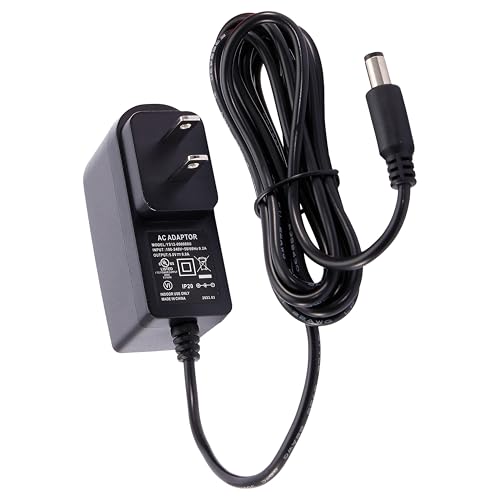
A single-output 9V, 800mA wall adapter for the player whose "pedalboard" is one pedal, or who needs a spare adapter in the gig bag.
Best for: a small board of analogue 9V pedals with a single power input Skip it if: you run more than one pedal, or anything at 12V or 18V
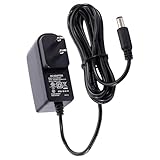
This is not a ten-output brick and it is not pretending to be. The PW-CT-9V is a single 9V DC adapter rated at 800mA maximum current, weighing 1.76 oz and measuring 1.57 x 4.72 x 3.15 in. D'Addario markets it as a battery replacement for a single pedal, or a supply for a tip-negative pedal or a tip-negative keyboard.
Two things earn it a place here. The first is that this is the cheapest of the six, and by a real margin. The second is that it is the one buyers choose most often in this category by a wide gap: its sales rank is roughly five to thirty times lower (better) than every other pick here, because a lot of players do genuinely need one 9V pedal powered, not ten.
The trade-off is obvious. There is no isolation because there is nothing to isolate. There is no 12V or 18V tap. The listed warranty is "replaced if defective" rather than a stated year. If your board grows to three pedals, you will outgrow it. But as a starter supply or a backup adapter in a case pocket, it earns its place.
Pros:
- Cheapest of the six by a clear margin
- 800mA rating covers most single pedals
- 1.76 oz body barely adds to gig-bag weight
- The one buyers choose most often in this category
- Published dimensions and model number
Cons:
- Single output only
- 9V only, no 12V or 18V
- Warranty is "replaced if defective" rather than a stated term
Isolated outputs vs daisy chains: does it really matter?
Isolated outputs matter the moment your board mixes pedal types. Here is the mechanics, plain.
A daisy chain shares a single ground across every pedal on the chain. Any noise on that ground, whether from a switching power supply, a nearby dimmer, or a badly shielded pedal, travels straight into every other pedal downstream. You hear it as a steady 60Hz hum or as a high-pitched whine that tracks the strings.
An isolated pedal board power supply gives each output its own transformer winding and its own ground reference. Noise on one pedal does not travel to the others. Five of the six picks here list isolated outputs. The sixth is a single-pedal adapter, so the question does not apply.
Two conditions where isolation matters most:
- You mix digital and analogue pedals. A digital reverb and an analogue fuzz sharing a ground is a classic hum recipe.
- You mix voltages. Any board running one 18V pedal alongside a 9V chain needs isolation by definition.
If your entire board is three analogue 9V pedals from the same manufacturer, a daisy chain can survive. Anything busier, and isolation pays for itself in the first rehearsal.
How many milliamps does your board actually need?
Add up the current draw of every pedal on your board. The number lives on the back of each pedal, or in the manual, in milliamps.
- Most analogue overdrives, boosts, fuzzes and buffers: 5 to 25mA.
- Analogue chorus, flanger, phaser: 20 to 60mA.
- Digital delays: 100 to 300mA.
- Digital reverbs, especially the popular shimmer types: 200 to 500mA.
- Loopers and multi-effects: 300 to 800mA.
Now compare against the picks. The Donner DP-1 offers one 500mA slot; the Camola Mosky offers three. If your total draw is under 700mA and only one pedal needs a 300mA-plus slot, the DP-1 covers you. If you have a reverb at 300mA, a delay at 300mA and a looper at 500mA, the Mosky is the honest fit.
Add roughly 30% headroom on top of the total. Power supplies run cooler and quieter below their rated maximum, and pedals sometimes spike briefly above their stated draw at power-on.
What the listings quietly leave out
Six things the listings on this page do not tell you, and that you have to work out yourself before buying a pedal board power supply.
- Whether the supply is linear or switching. The listings say "noise filter" but do not commit to a topology. Linear supplies are heavier and quieter under most conditions; switching supplies are lighter and cheaper. You can often guess from the weight.
- Cable polarity per output. Standard guitar-pedal polarity is centre-negative, but a handful of vintage-style pedals want centre-positive. The Mosky lists a polarity-reversing adapter; the others do not.
- How the outputs are grouped internally. "Isolated" on the box sometimes means "isolated in pairs" rather than "isolated per output". The listings here say isolated per output. Verify at unbox.
- Whether cables are included, and how many. The DP-1 listing says ten cables. The others are quieter on this.
- The wall-plug type and voltage input. The DP-1 lists AC 100V to 240V input. Confirm on the others if you travel.
- Actual noise floor in dB. Nobody publishes this. It is why comparing on outputs, current and voltage taps is the honest test.
The verdict
The Donner DP-1 is the pedal board power supply I would recommend by default. Ten isolated outputs, a real 500mA tap, and 9V, 12V and 18V options in a 6.9 oz body cover the shape of most working pedalboards. Independent short-circuit protection and included cables make it a one-purchase answer.
If your board leans hard on digital pedals, the Camola Mosky is the better buy. Three 500mA outputs and seven 300mA outputs give you the current headroom the DP-1 cannot match, and the two adjustable 9V/12V/18V taps mean any pedal in your rack will find a home. It is the most expensive here, and the listing is thinner on specifications, but the output map is the honest reason to choose it.
The cutoff sits at your total pedal current draw. Under about 700mA total with one high-draw pedal, the DP-1 wins on weight, price position and documentation. Above that, or with two or more 300mA-plus pedals, the Mosky wins on capacity. The D'Addario PW-CT-9V remains the right answer for a single-pedal setup and nothing more.
FAQ
Do I really need an isolated pedal board power supply?
You really need isolation as soon as your board mixes digital and analogue pedals, or mixes voltages. Sharing a ground across a fuzz and a digital reverb produces the hum most players blame on cables. Five of the six picks here publish isolated outputs. If your rig is three analogue 9V pedals from one maker, a daisy chain can survive; otherwise, isolation is the fix.
Can the Donner DP-1 power a Strymon or similar 300mA pedal?
The Donner DP-1 can power one 300mA-class pedal cleanly, on its 9V 500mA tap. Its other 9V outputs are rated at 100mA each, which is not enough for a Strymon reverb, an Eventide box or a busy digital delay. If your board carries two or more such pedals, the Camola Mosky, with three 500mA outputs and seven 300mA outputs, is the honest fit.
Is the Camola Mosky worth the extra over the Donner DP-1?
The Camola Mosky is worth the extra when your board runs multiple high-draw digital pedals. You are paying for three 500mA outputs and seven 300mA outputs against the DP-1's single 500mA slot. If your rig is analogue-heavy with one digital reverb, the DP-1 wins on price position and weight. If it is reverb, delay and looper together, the Mosky earns the premium.
What about the D'Addario PW-CT-9V for a small board?
The D'Addario PW-CT-9V works for a small board of one pedal, or as a spare adapter for the gig bag. It is a single 9V output at 800mA, weighing 1.76 oz. It is the cheapest of the six and the one buyers choose most often in this category. It does not offer isolation, multiple outputs, or 12V and 18V taps, so it will not scale as your board grows.
What pitfalls should I watch for when buying a pedal board power supply?
The main pitfall is buying on output count alone. A ten-output brick where every port is 100mA cannot power a modern digital reverb. Check the current per output, not just the total. Check whether 12V and 18V are on offer if you own or plan to own those pedals. Confirm polarity: the Camola Mosky includes a polarity-reversing adapter, most others do not.
The right next step is a two-minute audit of your own board. Write down every pedal, its voltage and its current draw. Total it. Add 30%. If the answer sits under 700mA with one high-draw pedal, the Donner DP-1 covers you cleanly, and its 6.9 oz weight barely registers on the board. If the answer is higher, or three of your pedals live above 200mA, the Camola Mosky's three-slot 500mA layout is why it earns the premium. Either way, an isolated pedal board power supply is the single upgrade that removes the most noise from a working rig.