Best Multi Room Receiver for Wired Zone Control

Zone count, not wattage, decides which multi-room amp fits your house. Six picks compared on channels, published power claims, rack depth and warranty, with the profile each one actually suits.

By Frederick CameronUpdated 18 min read
On this page
- Best multi room receiver at a glance
- Zones or channels: which number matters?
- How I weighted the criteria for a multi room receiver
- 1. Donner Bluetooth 5.0 Stereo Audio Amplifier Receiver — Best overall
- 2. Rockville Rock Zone 8 Channel Multi Room Home Bluetooth — Best for families
- 3. Rockville Home Matrix 4-Zone 8-Channel 600W Multi-Room — Best upgrade
- 4. JUKE AUDIO Juke-6 | 6 Zone Audio Amplifier — Best premium
- 5. Denon AVR-S570BT 5.2 Channel AV Receiver — Best for heavy use
- 6. Pyle 4 Multi-Zone Stereo Amplifier — Most versatile
- Will it fit your rack or cabinet?
- Wired zones or wireless speakers: which multi room receiver route?
- What more money buys across these six
- The verdict
- FAQ
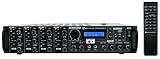
The best multi room receiver here is the Donner MAMP5, a four-channel unit with 440W peak power in an 8.27 x 13.8 x 3.54 in chassis and a 1 year warranty. If you need more than two rooms running separately, the Rockville Rock Zone 8 splits eight channels into eight independent zones instead.
This guide isn't for someone building a single home theater around one couch. If you want Atmos height channels and 8K passthrough for one room, most of these picks are the wrong tool, and the Denon AVR-S570BT is the only one that speaks that language. Everyone else here is trying to get audio into a kitchen, a patio and a bedroom at the same time, with different volume in each. That's a distribution problem, not a surround problem, and the hardware that solves it looks different.
Best multi room receiver at a glance
| Pick | Zones / channels | Published power | Price |
|---|---|---|---|
| 4 channels, independent control |
440W peak (spec) | Check Price | |
Best for families Rockville Rock Zone 8 Channel Multi Room Home Bluetooth |
8 zones, 8 channels |
1000W RMS claim | Check Price |
| 4 zones, 8 channels |
600W RMS claim | Check Price | |
Best premium JUKE AUDIO Juke-6 6 Zone Audio Amplifier |
6 zones, 12 channels |
Not published | Check Price |
Best for heavy use Denon AVR-S570BT 5.2 Channel AV Receiver |
5.2 channels, 1 room |
70W x 5 claim | Check Price |
Most versatile Pyle 4 Multi-Zone Stereo Amplifier |
4 zones, 8 channels |
8000W max claim | Check Price |




Zones or channels: which number matters?
Channel counts get printed in big type. Zone counts decide whether the system actually works the way you want.
A channel drives one speaker. A zone is a group of channels you can control separately: its own volume, sometimes its own source. Two speakers in the kitchen wired as a stereo pair are two channels and one zone. That's the distinction the marketing copy blurs, and it's the one that determines whether your partner can turn the patio down without touching the kitchen.
Look at what that means across these six:
- The Pyle PT8000CH and the Rockville Home Matrix both have 8 channels. The Pyle splits them into 4 zones; the Home Matrix also runs 4 zones, at 150W per zone by the listing's claim.
- The Rock Zone 8 takes 8 channels and gives each one its own zone, with a mono/stereo selector per zone. Eight mono rooms or four stereo pairs.
- The Juke-6 claims 12 speaker channels across 6 zones, which is stereo in every zone with no compromise.
- The Donner MAMP5 has 4 channels the listing describes as independently controlled, which in practice is two stereo pairs or four mono runs.
- The Denon AVR-S570BT is 5.2 channels in one room. Zones aren't its job.
So count rooms first. Then decide whether each room needs stereo. Multiply. That number is your channel requirement, and the zone count has to match your room count or you're wiring rooms together whether you like it or not.
How I weighted the criteria for a multi room receiver
I ranked these on three things, in this order.
- Independent zone control, weighted heaviest. A multi room receiver that can't set different volumes in different rooms is just an amplifier with a lot of terminals. Every pick here except the Denon publishes some form of per-zone or per-channel control.
- Published, checkable specifications, weighted second. Dimensions, weight, warranty, model number. These are the figures you can verify against your cabinet and your expectations before the box arrives. The Pyle and the Juke-6 both go without a published warranty figure, and that cost them.
- Input flexibility, weighted third. Bluetooth, USB, optical, FM, mic. Useful, but you can add a streamer to any RCA input for very little, so a missing input is a smaller problem than a missing zone.
Why that order? Because the failure mode people actually describe with these systems isn't insufficient power. It's discovering that the kitchen and the bedroom share a volume knob. Wattage claims across this set range from a 440W peak figure to an 8000W maximum figure, and those numbers are measured under wildly different conditions by different marketing departments. Zone architecture is structural. You can't add a zone later with a firmware update.
The Donner won on a different axis: it's the cheapest of the six, it's the one buyers choose most often here, and it publishes a full spec sheet including a 1 year warranty. For a two-room job, that combination is hard to argue with.
1. Donner Bluetooth 5.0 Stereo Audio Amplifier Receiver — Best overall
The Donner MAMP5 is the sensible default for anyone wiring two or three rooms, because it's the cheapest of the six, the fastest seller in the set, and it publishes a complete spec sheet down to the warranty.
Best for: a two-room setup on a tight budget Skip it if: you need more than four speaker channels
Four channels is the smallest zone count in this group, and that's the whole reason it's affordable. Donner rates it at 440W peak power and describes the four channels as independently controlled, so a kitchen pair and a patio pair can run at different levels from one box. Bluetooth 5.0 is built in, alongside USB up to 32GB, an SD slot up to 16GB, two pairs of RCA inputs and FM with the antenna included.
The physical numbers matter more than the wattage. At 8.27 x 13.8 x 3.54 in and 9.15 lb, this is the only pick that sits comfortably on a bookshelf. The Rock Zone 8 weighs 26 lb. The Pyle weighs 50.6 lb. If your plan involves a cupboard rather than a rack, that gap decides it.
Two 1/4-inch mic jacks with echo are an odd inclusion for a house, though they make sense in a small studio or a party room. The trade-off against the rest of the set is simple: fewer channels, no optical or coaxial input, and no per-zone source assignment. You get one source at a time, everywhere.
Pros:
- Cheapest of the six picks here
- Sells faster than every other pick in this set
- 9.15 lb and 8.27 in wide, shelf-friendly
- Published 1 Year warranty and MAMP5 model number
- Bluetooth 5.0, USB, SD, FM and dual RCA
Cons:
- Four channels is the lowest count in this set
- No optical or coaxial digital input
- One source feeds all channels, no per-zone source switching
- Mic and echo features are wasted in most homes
2. Rockville Rock Zone 8 Channel Multi Room Home Bluetooth — Best for families
The Rock Zone 8 is the only pick here that gives eight rooms eight separate volume knobs, which is exactly the argument-ending feature a busy household needs.

Best for: a whole house with eight separate listening areas Skip it if: your cabinet can't take 26 lb and 21 inches of width
Rockville claims 1000W RMS across 8 channels, working out to 125W per channel at 4 ohms or 90W at 8 ohms. More useful than the power figure: each of the 8 zones gets its own volume, its own mono/stereo selector and its own EQ. Set the bathroom to mono, the living room to stereo, and leave the garage muted.
Released in 2024, it's the newest design in this group. Inputs cover Bluetooth, two RCA pairs, optical, coaxial, USB playback up to 32GB, FM with presets and a mic input that feeds every zone at once. There's an RCA subwoofer output and a record output, plus banana and bare-wire terminals, so adding a powered sub or a second amp later doesn't mean replacing this.
The catch is physical. Shipping weight is listed at 26 lb and the dimensions run 8.5 x 21 x 15.4 in, though Rockville's own copy quotes a 16.92 x 12.67 x 3.81 in build with removable rack brackets. Either way it's a rack component, not a shelf one. It's also the second-cheapest of the six, which is remarkable for eight zones, and it's the slowest-moving pick here.
Pros:
- Eight independent zones, the most in this set
- Per-zone mono/stereo selector and EQ
- Second-cheapest pick despite the highest zone count
- Optical, coaxial, USB, FM and Bluetooth inputs
- Subwoofer and record outputs for later expansion
Cons:
- 26 lb listed weight needs proper support
- Warranty listed only as "Manufacturer" with no term
- Slowest seller of the six here
- Only one seller lists it
3. Rockville Home Matrix 4-Zone 8-Channel 600W Multi-Room — Best upgrade
The Home Matrix is the pick for four rooms that each need their own source, not just their own volume, and it's the shallowest rack unit in the group at 10.4 in deep.

Best for: four zones with per-zone source switching Skip it if: you want the receiver hidden and never touched
Rockville publishes 600W RMS total, split as 75W RMS per channel across 8 channels, or 150W per zone. The headline capability is source assignment: the listing states you can give each of the 4 zones a different source and a different volume. Bluetooth in the office while FM plays in the workshop, from one chassis.
That's the step up from the Donner, which distributes one source everywhere. Inputs run Bluetooth, USB, optical, coaxial, RCA, FM and mic, and the mic side adds volume, EQ, echo, delay and a priority function that ducks the music when someone speaks. Line outs per zone feed subwoofers or additional amplifiers.
Dimensions are 3.5 x 10.4 x 19 in with a listed weight of 27.3 lb, and it's the only pick offered in white or silver rather than black, which matters if it's going somewhere visible. Warranty is published as 1 YEAR. The honest trade-off against the Rock Zone 8: half the zones for a higher price position, and 75W per channel against Rockville's own 125W claim on the bigger unit. You're paying for source flexibility, not power.
Pros:
- Different source assignable to each of 4 zones
- 3.5 x 10.4 x 19 in, only 10.4 in deep
- Published 1 YEAR warranty
- White or silver finish, unique in this set
- Mic priority ducking for announcements
Cons:
- Half the zone count of the cheaper Rock Zone 8
- 75W RMS per channel is the lowest published per-channel figure
- 27.3 lb listed weight for a 4-zone unit
- Front-panel operation means it can't be fully hidden
4. JUKE AUDIO Juke-6 | 6 Zone Audio Amplifier — Best premium
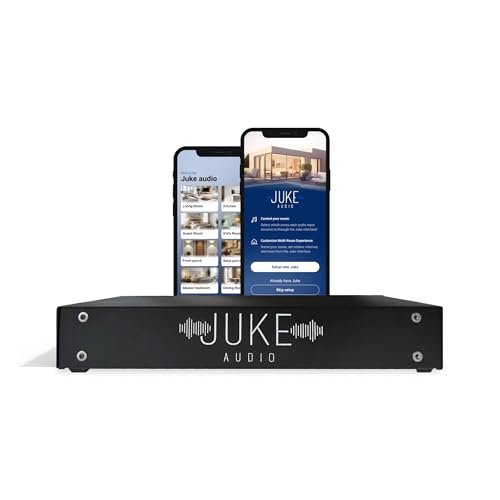
The Juke-6 is the only pick here built to disappear, running 6 zones from a 6.5 lb, 3-inch-tall box you control entirely from your phone.
Best for: AirPlay 2 households with in-ceiling speakers Skip it if: you need FM, USB or a physical front panel
Juke Audio says the Juke-6 amplifies up to 12 speaker channels across 6 audio zones, which is stereo in all six rooms. The distinguishing claim is how it appears to your devices: each zone shows up individually inside AirPlay 2 and Spotify, so choosing a room happens in the same menu where you choose the music. The listing also states it supports simultaneous streams from different users across zones, so one person's playlist in the den doesn't stop another's in the kitchen.
Physically it's the outlier. 3 x 15 x 8 in and 6.5 lb, the lightest unit here by a wide margin, next to 26 lb and 27.3 lb for the two Rockvilles. There's no LED panel to read and nothing to reach for, which is the point. Juke suggests an Apple TV adapter to route television audio into the system wirelessly.
It's the most expensive pick here, and the listing publishes no warranty term and no wattage figure, which is a real gap when every other pick quotes something. There's also no FM, no USB slot and no optical input in the published feature set. Compatibility with DLNA, Bluetooth and Spotify Connect is stated, so streaming isn't the concern. Physical media and radio are.
Pros:
- 12 speaker channels across 6 zones, stereo everywhere
- 6.5 lb and 3 in tall, hides in a closet
- Each zone appears separately in AirPlay 2 and Spotify
- Simultaneous streams from different users across zones
Cons:
- Most expensive pick in this set
- No published warranty term
- No published power rating per channel or zone
- No FM, USB or optical input listed
- Only one seller lists it
5. Denon AVR-S570BT 5.2 Channel AV Receiver — Best for heavy use
The Denon AVR-S570BT is the pick if one room does the heavy lifting, with four 8K HDMI 2.1 inputs and the only 2 year warranty in this group.

Best for: one main room with 8K video switching Skip it if: your priority is independent audio in several rooms
This is the odd one out, and it's here because plenty of people searching for a multi room receiver actually want a main-room receiver that can also push audio elsewhere. Denon lists 70W x 5, four HDMI 2.1 8K inputs, one HDMI output and eARC up to 40 Gbps. Format support covers Dolby Vision, HDR10+, HLG, Dynamic HDR, DTS HD Master and Dolby TrueHD, plus VRR and QFT for gaming.
The multi-room claim is thinner than the others. Denon says built-in Bluetooth lets you play from various sources and "create an integrated multi-room audio system," which is a capability statement rather than a zone count. Treat it as a movie and gaming receiver with streaming, not as a distribution amp.
Two things stand out on the spec sheet. It carries a 2 years warranty, the longest published term here, and it's a 2022 design with an on-screen setup assistant and a Denon Remote app for iOS and Android. Dimensions are 6 x 17.1 x 13 in. The trade-off is stark: 5.2 channels serving one seating position, where the Rock Zone 8 serves eight rooms for less. Buy it for the HDMI board, not the zones.
Pros:
- Four HDMI 2.1 inputs with 8K support and eARC
- Longest published warranty here at 2 years
- Second-fastest seller in this set
- On-screen setup assistant plus iOS and Android app
- Dolby TrueHD and DTS HD Master decoding
Cons:
- No published zone count or per-zone volume control
- 5.2 channels covers one room, not several
- Premium price position for single-room coverage
- Listed weight of 11 g is clearly a listing error
6. Pyle 4 Multi-Zone Stereo Amplifier — Most versatile
The Pyle PT8000CH is the pick for a rack install where you want bridgeable channels and daisy-chain outputs, provided you never need Bluetooth.

Best for: a rack install driving eight bridgeable channels Skip it if: you need Bluetooth or any streaming input
Pyle publishes 100W per channel across 8 channels with a maximum 8000 watts total figure, 5-way binding posts that take banana plugs, and bridgeable channel switches. There's a pass-through output for daisy-chaining an external amplifier, speaker selectors with volume control, an LED audio level display and built-in low impedance protection on individual channels.
That protection matters in a distribution system. Wire enough parallel speakers off one channel and you can drop the load below what the amplifier tolerates. The Pyle is the only pick that names per-channel impedance protection in its published features.
Now the caveats, and they're substantial. The published features list no Bluetooth, no USB, no FM and no optical input. Every source has to arrive on an analogue connection, so a streamer or a preamp is a separate purchase. It weighs 50.6 lb, nearly double the Rockville units and almost eight times the Juke-6, and the dimensions run 21 x 21.9 x 9.7 in for a 19-inch rack. No warranty term appears in the specs, and the Count field reads 2, which is worth clarifying before you order. Set against a mid price position, that's a lot of gaps for a 2021 design.
Pros:
- 100W per channel across 8 bridgeable channels
- Per-channel low impedance protection
- Pass-through output for daisy-chaining another amp
- 5-way binding posts accept banana plugs
Cons:
- No Bluetooth, USB, FM or optical input listed
- 50.6 lb, the heaviest pick by a wide margin
- No published warranty term
- Second-slowest seller in this set
Will it fit your rack or cabinet?
Measure before you buy. This is the most common avoidable mistake in the category, and the published dimensions make it a two-minute check.
Depth is the killer. A shallow media cabinet is often 12 to 14 inches inside, and cables need room behind that. Here's how the six compare:
- Donner MAMP5: 8.27 x 13.8 x 3.54 in, 9.15 lb. Fits a bookshelf.
- Juke-6: 3 x 15 x 8 in, 6.5 lb. Slimmest and lightest, closet-friendly.
- Rockville Home Matrix: 3.5 x 10.4 x 19 in, 27.3 lb. Shallowest rack unit here.
- Denon AVR-S570BT: 6 x 17.1 x 13 in. Standard AV receiver footprint.
- Rock Zone 8: 8.5 x 21 x 15.4 in listed, 26 lb.
- Pyle PT8000CH: 21 x 21.9 x 9.7 in, 50.6 lb.
Two practical notes. Anything over 25 lb wants a shelf rated for it, not a floating bracket, and the Pyle at 50.6 lb genuinely wants rack rails. Second, ventilation isn't in the specs but it's real: multi-channel amplifiers driving several rooms at once produce heat, so leave clearance above and don't stack a streamer directly on top.
Wired zones or wireless speakers: which multi room receiver route?
There's a fork in the road here that nobody mentions until the drywall is already open.
A multi room receiver drives passive speakers over speaker wire. That means in-ceiling and in-wall drivers, outdoor speakers, and any pair you already own. The wire is the work. The payoff is that the speakers never need firmware, never lose a network, and never stop being supported.
The alternative is powered wireless speakers, one per room, each on your Wi-Fi. No wire pulling. But you're buying an amplifier in every room and trusting an app ecosystem indefinitely.
Choose wired zones when:
- You're renovating, or the ceiling is already accessible.
- You want speakers outdoors, where power outlets are scarce.
- You already own passive speakers worth keeping.
- You want one box to service instead of six.
Choose wireless when the walls are finished and staying that way.
Within the wired route, the picks split again. The Juke-6 leans hardest into streaming as the only interface, with AirPlay 2 and Spotify Connect naming each zone. The two Rockvilles keep front-panel knobs and add FM, USB and optical for people who don't want their music to depend on a phone. The Donner sits in between at four channels.
What more money buys across these six
The pattern here isn't more watts as you climb. It's more independence.
At the entry positions, the Donner MAMP5 and the Rock Zone 8 both distribute a single source. The Donner gives you four channels with independent level control. The Rock Zone 8, remarkably, gives you eight zones with per-zone EQ and mono/stereo switching for the second-lowest price in the set. On zones-per-dollar it's the standout, and the compromise is bulk and a warranty listed without a term.
In the middle, the Rockville Home Matrix and the Pyle PT8000CH both offer 8 channels in 4 zones. The Home Matrix spends its budget on per-zone source assignment and digital inputs. The Pyle spends it on amplifier hardware: bridgeable channels, binding posts, impedance protection, 100W per channel, no streaming at all.
At the premium end, the split is sharpest. The Denon buys you HDMI 2.1 with 8K, a 2 year warranty and one excellent room. The Juke-6 buys you six stereo zones, simultaneous streams from different users, and a 6.5 lb chassis you never look at again. Neither publishes what the other publishes: Denon states 70W x 5 with no zone count, Juke states 6 zones with no wattage.
So the money doesn't buy loudness. It buys either video processing or independent per-user streaming, and you need to know which one you're actually after.
The verdict
Three tiers, three different buyers.
Entry tier. The Donner MAMP5 is the right multi room receiver for a two-room or three-room job. It's the cheapest here, the fastest-moving of the six, 9.15 lb, and it publishes a 1 Year warranty and a full dimension set. Four channels is the ceiling, and one source feeds them all. For a kitchen and a patio, that's not a limitation you'll notice. If you need more rooms at the same budget, the Rock Zone 8 is the anomaly of this group: eight independent zones with per-zone EQ at the second-lowest price, paid for in 26 lb of chassis and a warranty listed without a term.
Middle tier. The Rockville Home Matrix earns the step up if different rooms need different sources at the same time. 75W RMS per channel, 4 zones, digital inputs, 10.4 in deep, 1 YEAR warranty. The Pyle PT8000CH is the choice only when the rack matters more than the streaming: 100W per channel, bridgeable, impedance-protected, 50.6 lb, and no wireless input of any kind.
Premium tier. The Juke-6 for a finished, app-driven house: 6 zones, 12 channels, 6.5 lb, AirPlay 2 per zone. The Denon AVR-S570BT for one room that also does 8K video, with the longest warranty here at 2 years. Pick by what your house is asking for.
FAQ
What is the best multi room receiver for most homes?
The best multi room receiver for most homes is the Donner MAMP5, because most homes are wiring two or three areas rather than eight. Four independently controlled channels, 440W peak power by Donner's spec, 9.15 lb and a published 1 Year warranty cover that job without a rack. Move to the Rock Zone 8 once your room count passes four.
Is a multi room receiver worth it over wireless speakers?
A multi room receiver is worth it when your walls are open or your speakers are already passive. One chassis serves every room, so there's a single point of maintenance instead of six, and passive in-ceiling or outdoor speakers never need a firmware update. If the drywall is finished and staying finished, powered wireless speakers save you the wiring labour.
How many channels do I need for four rooms?
For four rooms in stereo you need eight channels, since each room takes a left and a right. The Rockville Home Matrix and the Pyle PT8000CH both provide 8 channels across 4 zones. If some rooms can run mono, a bathroom or a hallway for instance, the Rock Zone 8 lets you switch individual zones to mono and stretch coverage further.
Rock Zone 8 or Home Matrix: which Rockville should I buy?
Between the Rock Zone 8 and the Home Matrix, choose by whether rooms need different music. The Rock Zone 8 gives 8 zones and a claimed 125W per channel at 4 ohms, but distributes one source. The Home Matrix drops to 4 zones and 75W RMS per channel, and lets each zone select its own source. Rooms versus independence.
What mistake do first-time multi-zone buyers make?
The mistake first-time buyers make is shopping on wattage. Claims across this set run from 440W peak to 8000W maximum, measured under conditions nobody publishes, so they aren't comparable. Zone architecture is what you can't change later. Count your rooms, decide which need stereo, then check depth and weight against the cabinet before ordering.
Start with a floor plan and a pen. Write the room name next to every speaker location, mark which ones need stereo and which can survive on mono, and total the channels. That number, not a wattage figure, tells you which of these six belongs in your cabinet. The Donner MAMP5 is the default because most people's list stops at three rooms, and it covers that with a full published spec sheet, a 1 Year warranty and a 9.15 lb body that doesn't need rack rails. When your list runs longer, the Rock Zone 8 waits at the next zone count up.