Best Budget Stereo Amplifier by Power and Size
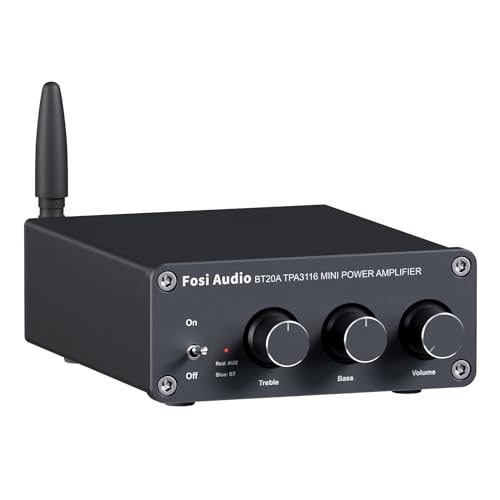
The Fosi Audio BT20A leads a field of six, but a 17.1 lb Sony receiver and a karaoke-ready Pyle change the answer for the right buyer. Here's how they split.

By Frederick CameronUpdated 14 min read
On this page
- Best budget stereo amplifier at a glance
- How I ranked these six
- Amp or receiver: which one do you actually need?
- What does the wattage number really tell you?
- 1. Fosi Audio BT20A Bluetooth Stereo Amplifier — Best overall
- 2. Sony STRDH190 2-ch Home Stereo Receiver — Best for families
- 3. WOOPKER AK45Pro Stereo Audio Amplifier — Best warranty
- 4. Daakro AK45 Stereo Audio Amplifier — Best budget pick
- 5. Pyle Home Stereo Receiver with Bluetooth — Most versatile
- 6. Yamaha R-S202BL Stereo Receiver — Best premium
- Watch out for the missing spec
- When a heavier pick wins
- The verdict
- FAQ
The best budget stereo amplifier is the Fosi Audio BT20A, a 1.25 lb Class D unit that drives passive speakers from a body just 5.2 inches wide. If you own a turntable and want radio, the 17.1 lb Sony STRDH190 with its phono input is the better buy instead. Pick the wrong one and you end up with a box that can't take your record player, or a component too big for the shelf you bought it for. That mistake is the whole game here.
Best budget stereo amplifier at a glance
| Pick | Type | Weight | Price |
|---|---|---|---|
Best overall Fosi Audio BT20A |
Class D amp | 1.25 lb | Check Price |
Best for families Sony STRDH190 |
Receiver | 17.1 lb | Check Price |
Best warranty WOOPKER AK45Pro |
Compact amp | 1.96 lb | Check Price |
Best budget pick Daakro AK45 |
Compact amp | 1.92 lb | Check Price |
Most versatile Pyle PDA77BU |
4-ch receiver | 10.9 lb | Check Price |
Best premium Yamaha R-S202BL |
Receiver | 14.8 lb | Check Price |


How I ranked these six
I compared the published specifications side by side and weighted three things: what the unit actually connects to, how much space it eats, and whether the maker stands behind it in writing. Price position mattered less than fit. A cheap box that can't take your source is a bad buy at any figure.
Here's how the weighting shook out:
- Connectivity and inputs, weighted heaviest. An amplifier lives or dies by what you can plug into it. A phono input, a mic jack, or an SD slot changes who the unit is for.
- Footprint, weighted second. These range from a 1.25 lb Fosi that hides behind a monitor to a 17.1 lb Sony that needs real shelf depth. That gap decides more than power ever does.
- Warranty, weighted third. The Fosi's 24-month coverage is the longest here. Two of the six list no warranty term I could confirm.
Why those weights? Because a best budget stereo amplifier buyer already knows the price is low. What they don't know is whether it fits their room and their gear. So I ranked on the answers that aren't on the price tag. The compact amps cluster tight on weight, between 1.25 and 1.96 lb. The receivers stand apart on inputs and heft. That split runs through the whole list.
Amp or receiver: which one do you actually need?
This is the fork in the road, and it decides more than any spec sheet. An amplifier takes a signal and drives your speakers. A receiver does that too, but adds a radio tuner and usually more input jacks.
- Choose an amp if you stream from a phone or feed it from one source. The Fosi BT20A and the two AK45 units are pure amps. Small, light, focused.
- Choose a receiver if you own a turntable, listen to FM or AM, or want to switch between several sources. The Sony, the Yamaha, and the Pyle are receivers.
The Sony STRDH190 is the only pick here with a phono input, per its listing, which matters if you play vinyl. The Yamaha R-S202BL lists 40 station FM/AM preset tuning. If radio is part of your day, the pure amps simply can't do it. This one decision cuts the field in half before you look at anything else.
What does the wattage number really tell you?
Less than the box wants you to think. The listings quote figures like 200W, 300W, 400W, and even 800W. Those are almost all peak or maximum numbers, not sustained ones.
Two examples from the data make the point:
- The WOOPKER AK45Pro lists 400W+400W peak but names RMS 50WX2 rated power. The honest, continuous figure is one-eighth of the headline.
- The Sony lists 100 watts x 2 at 8 ohms, 1 kHz. A plain, testable spec.
RMS is the watts an amp holds steady. Peak is a brief burst. When you compare a best budget stereo amplifier against another, line up RMS against RMS, or you're comparing a sprint to a marathon. The Pyle's 800W is a peak claim. The Fosi lists 100Wx2 maximum. None of that tells you loudness on its own, because speaker sensitivity and impedance matter just as much. Read the small print, not the big number.
1. Fosi Audio BT20A Bluetooth Stereo Amplifier — Best overall
The BT20A wins because it does one job cleanly, fits anywhere, and carries the longest warranty in the set.
Best for: desktop and bookshelf setups where space is tight Skip it if: you want a phono input or radio tuner
At 1.25 lb and 1.42 x 5.2 x 3.54 in, this is the smallest and lightest pick here by a wide margin. It hides behind a monitor or tucks onto a crowded shelf. Fosi says the BT20A puts out 100Wx2 maximum through a Class D circuit, and takes both Bluetooth and RCA inputs. That covers the two ways most people feed an amp: a phone over the air, or a wired source.
What sets it apart in this group is the 24-month manufacturer warranty, the longest of the six. The compact amps around it match its size but not its coverage. It sits at a mid price position, third of six, so you're not paying premium money for it.
The trade-off is focus. There's no phono stage, no tuner, no SD slot. Against the Sony or Yamaha, it does less on paper. But for a straightforward passive-speaker setup, doing less is the point.
Pros:
- Lightest pick at 1.25 lb
- Smallest footprint, 5.2 in wide
- 24-month warranty, longest here
- Bluetooth and RCA inputs both listed
- Mid price, not premium
Cons:
- No phono input for turntables
- No radio tuner
- Power figure is a maximum, not RMS
- Single seller listing
2. Sony STRDH190 2-ch Home Stereo Receiver — Best for families
The Sony is the only pick with a phono input and A/B speaker switching, making it the household hub of this group.

Best for: households that want a turntable, radio, and two speaker zones Skip it if: your shelf is small or you hate bulk
This is a real receiver, not a compact amp, and it shows in the spec sheet. Sony lists a phono input, 4 stereo RCA audio inputs, a 3.5 mm input, and stereo RCA output. It rates 100 watts x 2 at 8 ohms, a plain figure you can trust more than a peak claim. It also connects up to 4 speakers with A/B switching, so you can run one pair inside and another on the patio.
At 17.1 lb and 5.2 x 11 x 17 in, it's the heaviest pick here. That heft is the price of the extra jacks and the power supply behind them. It sits at a premium price position, fifth of six, and carries a 1 year warranty. Released in 2018, it's the oldest design in the set.
The weakness is obvious: it's big. It needs a proper shelf, and it dwarfs the desktop amps. But nothing else here plays vinyl and radio and drives two zones. For a family living room, that flexibility is worth the space.
Pros:
- Only pick with a phono input
- A/B switching for two speaker zones
- Four RCA inputs plus 3.5 mm
- Honest 100W x 2 at 8 ohms rating
- Built-in Bluetooth streaming
Cons:
- Heaviest and bulkiest at 17.1 lb
- Premium price position in this set
- Oldest design, dates to 2018
- Only a 1 year warranty
3. WOOPKER AK45Pro Stereo Audio Amplifier — Best warranty
The WOOPKER packs a mic input and SD slot into a small body, and lists the clearest RMS figure among the compact amps.

Best for: shoppers who want a mic input and SD card slot cheaply Skip it if: you need documented RMS clarity above 50W per channel
Among the small amps, this one earns its keep on inputs. WOOPKER says the AK45Pro supports USB stick or SD card input, a microphone, and Bluetooth 5.0, along with bass, treble, and master volume knobs. That's more source flexibility than the Fosi in a body just 2.56 x 5.43 x 7.09 in and 1.96 lb. It's the second-cheapest pick of the six.
Credit where due: WOOPKER lists RMS 50WX2 rated power alongside the 400W peak claim. That RMS figure is the honest one, and naming it is more than the Daakro does. The unit carries a 1 Year warranty.
The award name reflects that it does state a warranty term where the budget Daakro's is unclear, but note the Fosi's 24-month coverage still beats it outright. The trade-off against the Fosi is polish: more knobs and slots, but a shorter warranty and a slightly bulkier shell. If you want karaoke or card playback on a tiny amp, this is your pick.
Pros:
- Mic input and SD card slot listed
- RMS 50WX2 rated power stated plainly
- Second-cheapest of the six
- Bluetooth 5.0 and USB support
- Bass and treble control knobs
Cons:
- 1 Year warranty, shorter than the Fosi
- 50W RMS per channel is modest
- Peak 400W claim overstates real output
- Single seller listing
4. Daakro AK45 Stereo Audio Amplifier — Best budget pick
The Daakro is the cheapest of the six and covers the basics with bass and treble control.

Best for: the tightest wallet running a pair of passive speakers Skip it if: you need published dimensions before buying
This is the entry-price pick, first of six on cost, and it's built for a simple job. Daakro lists volume, treble, and bass control knobs for tuning the sound by hand. It weighs 1.92 lb, right in line with the other small amps. The listing quotes 300W+300W RMS power in its color field, though I'd treat any headline wattage here with caution.
What you're buying is the lowest entry into a stereo amp. It drives passive speakers, it takes Bluetooth 5.1, and it gives you tone control. For a garage or a spare-room setup where you just want music, that's enough.
The gaps are real. The listing publishes no dimensions, so you can't confirm it fits before it arrives. The warranty field reads simply "1" with no clear unit, and there's no mic or card input like the WOOPKER has. It's the least-documented pick in the set. Against the WOOPKER, one step up in price, you lose inputs and clarity. Buy it when price is the only line that matters.
Pros:
- Cheapest pick of the six
- Bass and treble control knobs
- Light at 1.92 lb
- Bluetooth 5.1 for wireless streaming
Cons:
- No published dimensions
- Warranty term unclear in the listing
- No mic or SD card input
- Least-documented pick here
5. Pyle Home Stereo Receiver with Bluetooth — Most versatile
The Pyle stacks dual mic inputs, USB, SD, and FM radio into one box built for hosting.

Best for: karaoke nights and multi-source garage systems Skip it if: you only ever stream from a phone
If your setup needs to do everything, this is the pick. Pyle lists dual 1/4-inch microphone jacks with independent controls, USB-A input with an MP3 player, an SD card slot, FM radio, RCA in and out, and Bluetooth 5.0. That's the widest input list of any pick here. It's a 4 channel design in a 3.5 x 13.8 x 9.8 in body weighing 10.9 lb, and it was released in 2023, the newest unit in the set.
Pyle quotes 800W peak power, the biggest headline number here, but remember that's a peak figure, not sustained output. The front panel has a digital LED display for switching sources.
It sits at a mid price position, fourth of six. The downside is that all those features add nothing if you only stream from a phone, and the karaoke focus means you're paying for mic circuitry you may never touch. There's also no published warranty term. Against the Sony, it trades a phono input for mic jacks and card playback. For a party or a busy garage, nothing else here matches its range.
Pros:
- Dual mic inputs for karaoke
- USB, SD card, and FM radio
- Newest design, released 2023
- LED display and front-panel control
- Mid price position
Cons:
- 800W is a peak, not RMS, figure
- No published warranty term
- Mic circuitry wasted if you only stream
- Heavier than the compact amps at 10.9 lb
6. Yamaha R-S202BL Stereo Receiver — Best premium
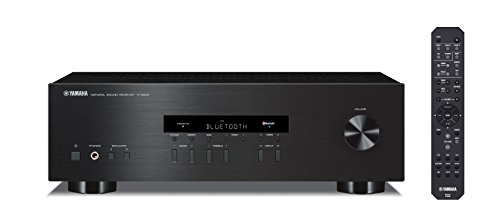
The Yamaha pairs a proper 40-station tuner with a brushed aluminum build, for buyers who want a classic receiver.
Best for: buyers who want a proper tuner and brushed metal build Skip it if: you're chasing the lowest price in this set
This is the most expensive pick here, sixth of six on cost, and it reads like a traditional hi-fi component. Yamaha lists 40 station FM/AM preset tuning, a speaker selector for 2 systems, a headphone terminal, and an auto power standby function. It quotes a frequency response of 10Hz to 100kHz. The finish is brushed aluminum, per the listing, which feels a cut above the plastic budget boxes.
At 14.8 lb and 5.5 x 12.6 x 17.1 in, it's a full-size receiver that needs shelf space. It carries a 1 year manufacturer warranty and streams over Bluetooth to music services.
The catch is the price. It's the priciest unit here and, oddly, doesn't list a phono input the way the cheaper Sony does. So if vinyl is your reason to buy a receiver, the Sony beats it for less. What the Yamaha offers is the widest tuner preset count and the most refined build. Buy it if you value FM presets and a metal faceplate over saving money.
Pros:
- 40 FM/AM presets, most in this set
- Brushed aluminum finish
- Speaker selector for two systems
- Wide 10Hz to 100kHz response listed
- 1 year manufacturer warranty
Cons:
- Most expensive pick of the six
- No phono input, unlike the cheaper Sony
- Full-size 14.8 lb body
- Slowest seller in this group
Watch out for the missing spec
The single biggest trap in this category is a listing that hides the number you need. Two examples from this set show it clearly.
The Daakro AK45 publishes no dimensions at all. If your shelf slot is fixed, you're gambling that it fits. The Pyle and the Daakro both skip a clear warranty term, so you can't compare coverage the way you can with the Fosi's plain 24-month figure.
Before you buy any budget stereo amplifier, check for these three:
- Dimensions, so you know it fits your space
- RMS power, not just the peak headline
- A stated warranty term with a real unit
When one is missing, don't assume the best. Assume the maker left it out for a reason, and lean toward the pick that prints it.
When a heavier pick wins
The Fosi wins by default, but three concrete conditions flip that.
- You own a turntable. Only the Sony STRDH190 lists a phono input. Vinyl means Sony, full stop.
- You host karaoke or events. The Pyle PDA77BU and the WOOPKER AK45Pro both take microphones. The Fosi does not. Mic need means one of those two.
- You listen to FM radio. The Yamaha R-S202BL lists 40 station FM/AM preset tuning, the most here. Radio means Yamaha.
Each of these is checkable against your own habits in a few seconds. If none apply, the small, light, well-warrantied Fosi is the safe default.
The verdict
The best budget stereo amplifier for most people is the Fosi Audio BT20A. It's the lightest pick at 1.25 lb, the smallest at 5.2 inches wide, and it carries the longest warranty in the group at 24 months. It does one thing, driving passive speakers from a Bluetooth or RCA source, and it does it without demanding shelf space or premium money. For a desktop, a bedroom, or a bookshelf setup, nothing here fits better.
Two conditions change the answer. If you play vinyl, buy the Sony STRDH190 instead. It's the only pick with a phono input, it rates an honest 100 watts x 2 at 8 ohms, and its A/B switching runs two speaker zones. That's worth the 17.1 lb bulk for a family living room. And if you host karaoke, the Pyle PDA77BU brings dual mic inputs the Fosi can't match.
The Sony's exact advantage over the Fosi is inputs: a phono stage, four RCA jacks, and dual-zone switching the compact amp simply lacks. But it costs more, weighs fourteen times as much, and needs real shelf depth. For the buyer who just wants clean sound from a pair of speakers in a small space, the Fosi is the smarter budget stereo amplifier.
FAQ
Is a budget stereo amplifier worth it over a soundbar?
A budget stereo amplifier is worth it when you already own or plan to buy passive speakers. Units like the Fosi BT20A drive real bookshelf speakers for wired, room-filling sound a soundbar can't match on stereo separation. If you want the simplest single-box setup, a soundbar wins. For proper two-channel listening, the amp is the better spend.
What does the wattage rating on these amplifiers mean?
The wattage rating splits into two numbers you must separate. Peak power, like the Pyle's 800W or WOOPKER's 400W, is a brief burst. RMS, like the WOOPKER's 50WX2, is sustained output and the honest figure. Compare RMS to RMS across picks. The Sony's 100 watts x 2 at 8 ohms is a plain, testable spec worth trusting.
Which is better, the Fosi BT20A or the Sony STRDH190?
Better between the Fosi BT20A and the Sony depends on your sources. The Fosi wins on size at 1.25 lb and on its 24-month warranty. The Sony wins on inputs: it's the only one with a phono stage, plus four RCA jacks and A/B zone switching. Stream from a phone, pick Fosi. Play vinyl, pick Sony.
Can these budget amplifiers connect to a turntable?
These budget amplifiers connect to a turntable only if they carry a phono input. In this set, just the Sony STRDH190 lists one. The compact amps and the Yamaha do not publish a phono stage, so you'd need a separate phono preamp between the turntable and the amp. For plug-and-play vinyl, the Sony is the clear choice here.
What is the biggest mistake buying a cheap amplifier?
The biggest mistake buying a cheap amplifier is trusting the peak wattage headline and ignoring the missing specs. A box quoting 300W or 800W peak may deliver a fraction as sustained RMS. Worse, the Daakro publishes no dimensions, so it might not fit your shelf. Check RMS power, physical size, and the warranty term before you commit.
Start by answering one question: do you play vinyl or listen to radio? If yes, you need a receiver, and the Sony or Yamaha is your lane. If no, you need a clean, compact amp, and the Fosi BT20A is the one to open first. It's the pick that asks the least of your space and gives you the longest warranty to fall back on. For the buyer who just wants a pair of speakers to sing without a big box on the shelf, the Fosi is the right default, and everything else in this list is a specific exception to it.