Best Low Cost Stereo Amplifiers by Power and Inputs

A ranked shortlist of seven affordable stereo amplifiers, sorted by inputs, cabinet size and published warranty, with the Fosi Audio V1.0G leading the field.

By Frederick CameronUpdated 17 min read
On this page
- The deciding specification most buyers miss
- Best low cost stereo amplifier at a glance
- How I screened the field
- 1. Fosi Audio V1.0G — Best overall
- 2. ARRAROWN ZK-1002T RPO — Best upgrade
- 3. Joengoep AK50 — Best warranty
- 4. ARRAROWN AK-380 — Best minimal setup
- 5. XMSJSIY 12V HiFi — Best budget pick
- 6. Pyle PDA77BU — Best premium
- 7. Fosi Audio BT20A — Best for pros
- Bare board or finished chassis: which fits your build?
- How many inputs do you actually need?
- What the listings do not tell you about wattage
- The verdict
- FAQ
The best low cost stereo amplifier for most rooms is the Fosi Audio V1.0G, a 1 x 5 x 3 in class D unit backed by a 24-month manufacturer warranty and shipped with its own power adapter. If you need Bluetooth 5.0 and a remote, step up to the Joengoep AK50 at 2.55 x 7 x 5.5 in, which adds mic inputs and USB, SD and FM playback in one chassis.
The deciding specification most buyers miss
Most best low cost stereo amplifier guides lead with wattage. That is not what decides it. Peak power figures on entry-level listings are marketing headroom, not sustained output, and every pick in this set will drive an ordinary bookshelf pair loud enough for a small room. What actually decides the buy is the input list and the cabinet.
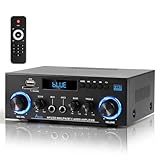
Look at what feeds the amp. If your source is a phone, you need Bluetooth. If it is a turntable through a preamp, you need RCA. If it is a USB stick full of MP3s or an SD card from your car, you need those slots on the front panel. The Fosi Audio V1.0G takes RCA only. The Pyle PDA77BU takes almost everything. That is a bigger real-world gap than any wattage figure between them.
Cabinet size decides the second half. A 1.42 x 5.2 x 3.54 in Fosi BT20A tucks behind a monitor. A 3.5 x 13.8 x 9.8 in Pyle needs a proper shelf. Measure first, then shop.
Best low cost stereo amplifier at a glance
| Pick | Inputs | Size | Price |
|---|---|---|---|
Best overall Fosi Audio V1.0G |
RCA only | 1 x 5 x 3 in | Check Price |
Best upgrade ARRAROWN ZK-1002T RPO |
Bluetooth 5.0, USB, AUX | 0.78 x 4.4 x 2.75 in board | Check Price |
Best warranty Joengoep AK50 |
Bluetooth 5.0, USB, SD, FM, AUX, mic | 2.55 x 7 x 5.5 in | Check Price |
Best minimal setup ARRAROWN AK-380 |
Bluetooth 5.0, USB, SD, FM, AUX | 1.72 lb chassis | Check Price |
Best budget pick XMSJSIY 12V HiFi |
RCA/AUX, 12V | 1.57 x 4.48 x 2.7 in | Check Price |
Best premium Pyle PDA77BU |
Bluetooth 5.0, USB, SD, FM, RCA, dual mic | 3.5 x 13.8 x 9.8 in | Check Price |
Best for pros Fosi Audio BT20A |
Bluetooth, RCA | 1.42 x 5.2 x 3.54 in | Check Price |




How I screened the field
I built this best low cost stereo amplifier shortlist by cutting on three grounds before I compared anything. First, listings that would not publish a chassis dimension went out. If a maker will not tell you how big the box is, you cannot plan the shelf. Second, anything without at least one common analogue input was cut, because a Bluetooth-only unit strands anyone with a turntable. Third, anything without a plainly stated channel count was cut.
What survived split into two groups. Four are finished chassis with volume knobs and a case: the Fosi V1.0G, the Joengoep AK50, the ARRAROWN AK-380 and the Pyle PDA77BU. Two are compact class D units in the Fosi style: the V1.0G again and the BT20A. One is a bare amplifier board meant for a DIY enclosure: the ARRAROWN ZK-1002T RPO at 0.78 x 4.4 x 2.75 in. The XMSJSIY sits between the two groups, a small aluminium chassis wired for 12V.
That split matters because a bare board is not the same product as a finished unit, even if the price positions overlap.
1. Fosi Audio V1.0G — Best overall
The V1.0G wins because it is a finished, warrantied class D amp in a chassis small enough to disappear behind a monitor.
Best for: a passive bookshelf pair in a small room Skip it if: you need Bluetooth or a tuner in the box
Among the seven picks here, the V1.0G is the shortest published chassis at 1 x 5 x 3 in, and it is one of only two units in the set with a published 24-month manufacturer warranty. Fosi says the amplifier is built on Texas Instruments' TPA3116D2 chip, which the listing describes as a class D stereo stage designed for driving passive speakers. That is a manufacturer claim, not a bench figure, but it lines up with what the V1.0G is asking to do: drive a pair of bookshelves in a study or a bedroom without heating a rack.
The package includes the amp, a matched power adapter, an AC cord and a manual, which is the reason it beats a bare board for anyone who does not want to source a supply. What it does not have is Bluetooth, USB or FM. Feed it from a preamp or a headphone output and it is a quietly competent low cost stereo amplifier. Ask it to be your streaming hub and it is the wrong pick.
Pros:
- Smallest published chassis in the set at 1 x 5 x 3 in
- 24-month manufacturer warranty on paper
- Power adapter and AC cord in the box
- Finished aluminium case, not a bare board
- TPA3116D2 chip cited on the listing
Cons:
- No Bluetooth, USB, SD or FM input
- No remote control or front-panel display
- Sits in the premium price position of the seven
2. ARRAROWN ZK-1002T RPO — Best upgrade
The ZK-1002T is a bare Bluetooth 5.0 amplifier board for anyone building the enclosure themselves.

Best for: a DIY enclosure with Bluetooth 5.0 streaming Skip it if: you want a finished, plug-and-play unit
This one is deliberately different from the rest. At 0.78 x 4.4 x 2.75 in, the ZK-1002T RPO is a board, not a boxed amplifier, and it sells at the second-cheapest position in this set. ARRAROWN describes it as a 2.0 channel module with Bluetooth 5.0, USB and AUX inputs, independent treble and bass buttons, and protection circuitry against over-voltage, under-voltage, over-heat and short-circuit conditions. Every one of those points is the maker's claim, worth what a maker's claim is worth.
It sells faster than every other pick here except one, which tells you something about who is buying it: hobbyists dropping the board into a wooden cabinet, a portable speaker build or a workshop rig. If that is you, this is a real upgrade over a plain analogue board because the Bluetooth and the tone controls are integrated. If it is not, and you want to plug in a power cord and be done, buy a finished chassis instead. There is no case and no power supply included by default, so budget for both before you compare against the boxed picks.
Pros:
- Bluetooth 5.0, USB and AUX on one board
- Independent treble and bass buttons
- Protection circuits listed for heat, voltage and shorts
- Very small footprint at 0.78 in thick
- Sells faster than most in this set
Cons:
- Bare board, not a finished chassis
- No published warranty on the listing
- Power supply not included with the board
3. Joengoep AK50 — Best warranty
The AK50 packs Bluetooth 5.0, USB, SD, FM, AUX and dual mic inputs into a 2.55 x 7 x 5.5 in chassis with a stated 1-year warranty.

Best for: karaoke nights and mixed-source living rooms Skip it if: shelf depth under six inches is a constraint
Set the AK50 next to the two Fosi units and the difference is obvious: it wants to be everything at once. Joengoep lists Bluetooth 5.0, USB, SD, FM and AUX inputs on the front, plus MIC input and output with an independent echo knob, plus independent bass, treble, master volume and mic volume controls, plus a remote. That is a lot of decisions on one faceplate, and the 2.55 x 7 x 5.5 in cabinet is where those decisions live.
Against the picks that beat it on size, it beats them on flexibility. It is the only pick in this set with a stated 1-year warranty that is not a Fosi. The trade against the Pyle is size and mic count: the Pyle is bigger and carries two mic inputs, the AK50 stays shelf-friendly and keeps a single mic route. Against the ARRAROWN AK-380, which has a similar input list, the AK50 is the finished, boxed version with a warranty on paper rather than nothing stated.
Pros:
- Bluetooth 5.0, USB, SD, FM and AUX in one box
- Mic input with independent echo control
- Independent bass, treble and master volume knobs
- 1-year warranty stated on the listing
- Remote control included per the listing
Cons:
- 7 in wide and 5.5 in deep, needs proper shelf room
- Feature crowding on a single small faceplate
- Mid price position for the group
4. ARRAROWN AK-380 — Best minimal setup
The AK-380 is a compact 1.72 lb receiver that folds Bluetooth, USB, SD and FM into a small metal case with an LCD.

Best for: a bedroom or workshop with FM radio duty Skip it if: you want a published warranty on paper
The AK-380 is the middle ground between the tiny Fosi units and the full-width Pyle. At 1.72 lb it weighs less than the Pyle by a wide margin, and ARRAROWN lists Bluetooth 5.0, USB, SD, AUX and a built-in FM tuner with an included antenna. The listing describes 40W+40W rated power into 4 to 16 ohm speakers, alongside a peak figure that is exactly the kind of marketing headroom flagged earlier. Treat the 40W+40W rated figure as the useful one.
Where it differs from the AK50 is philosophy. The AK50 gives you a mic input and echo, aimed at karaoke. The AK-380 drops those and leans on the FM tuner and a simple LCD, aimed at a bedside or workshop setup where you want radio and a phone stream from the same box. Against the Fosi picks, the AK-380 trades chassis polish and a published warranty for a much longer input list at a lower price position. That is a fair trade if you know you need FM.
Pros:
- Bluetooth 5.0, USB, SD, AUX and FM in one unit
- 40W+40W rated power stated on the listing
- Speaker compatibility listed as 4 to 16 ohm
- Compact 1.72 lb chassis
- Remote control included per the listing
Cons:
- No published warranty in the specs
- No mic input for karaoke use
- Slowest-selling pick in this set
5. XMSJSIY 12V HiFi — Best budget pick
The XMSJSIY is a 12V two-channel amp in an aluminium alloy shell, aimed at car, workshop and desk use.

Best for: a 12V install in a car, garage or workshop Skip it if: you need Bluetooth or a remote control
This is the cheapest of the seven, and it earns the position by narrowing its job. At 1.57 x 4.48 x 2.7 in, the XMSJSIY is a small aluminium unit built around a single blue-lit volume knob. The listing describes it as compatible with cars, motorcycles, stereos, CD players, TVs and computers, and it runs on 12V, which is why the car use case leads the description. Drop it into a workshop with a 12V bench supply and it does the same job.
There is no Bluetooth, no FM tuner, no USB slot and no remote listed. That is the trade for the price. Everything the amp does, it does over an analogue line in, and everything it does is decided by the one knob on the front. Against the Fosi V1.0G, it loses a published warranty and drops from a wall-adapter to a 12V rail. Against the ARRAROWN board, it gains a finished chassis. That is where its narrow use case lives.
Pros:
- Cheapest of the seven picks here
- Aluminium alloy chassis, not a bare board
- 12V input suits car and workshop use
- Compact 1.57 x 4.48 x 2.7 in footprint
- Analogue signal path, no digital sources to fail
Cons:
- No Bluetooth, USB, SD or FM input
- No remote and no display
- No published warranty in the specs
- Requires a 12V supply, not a wall socket
6. Pyle PDA77BU — Best premium
The PDA77BU is a full-width 4-channel receiver with dual mic inputs and the deepest input list in this set.

Best for: a full living-room stack with dual mics Skip it if: you have less than 14 inches of shelf width
The Pyle is the outlier on size. At 3.5 x 13.8 x 9.8 in and 10.9 lb, it belongs on a hi-fi shelf, not a desk. It is the most expensive pick here, and it earns the position with the deepest input list of the seven: Bluetooth 5.0, USB-A with an MP3 player, SD card, FM radio, RCA in and out, and two 1/4 in mic jacks with reverb and delay controls. Pyle describes the amplifier as a 4-channel design with 800W peak power. That peak figure is a headline number and the same caveat applies as with the ARRAROWN AK-380.
Where the AK50 gives you one mic and echo, the PDA77BU gives you two mics with reverb and delay, which is why it is the pick for anyone who actually hosts karaoke or a small event rather than the occasional song. It is the only pick released in 2023 by the listing's own dates. It is also the only pick with more than one seller on the listing. In this set that is a small point, but worth noting.
Pros:
- Deepest input list of the seven
- Dual 1/4 in mic inputs with reverb and delay
- 4-channel design per the listing
- Front-panel LED display and controls
- Released in 2023 per the listing
Cons:
- 13.8 in wide, needs a full hi-fi shelf
- Heaviest pick here at 10.9 lb
- Highest price position of the seven
- No published warranty in the specs
7. Fosi Audio BT20A — Best for pros
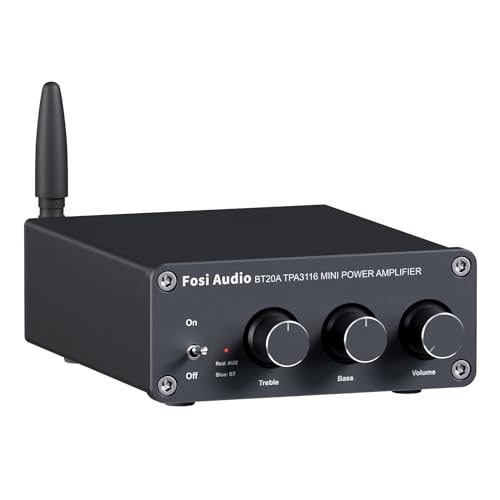
The BT20A is a class D Bluetooth amp built to drive passive speakers in garages, patios and ceiling installs.
Best for: outdoor or ceiling speakers in a garage Skip it if: you rely on FM radio or a USB stick
The BT20A shares the V1.0G's philosophy: finished class D chassis, no clutter on the front, a 24-month manufacturer warranty. It differs in three ways that matter for install work. It adds Bluetooth on top of RCA, so you can stream to it without adding a receiver. It runs 1.42 x 5.2 x 3.54 in at 1.25 lb, which is still small but wider than the V1.0G. And it sells faster than the V1.0G here, which suggests it is what installers actually reach for when the room is already wired for passive speakers.
Fosi describes the BT20A as suited to office, bedroom, living room, garage and patio use, and the compact one-piece case is the reason for the range. There is no display, no FM, no USB and no mic input, and that is the point. It is a small, sealed amplifier for passive speakers. Against the Pyle, it loses every source input except Bluetooth and RCA. Against the V1.0G, it adds Bluetooth and takes a slightly larger footprint.
Pros:
- 24-month manufacturer warranty stated
- Bluetooth and RCA on the same unit
- Compact 1.42 x 5.2 x 3.54 in chassis
- All-black one-piece case for install work
- Light at 1.25 lb
Cons:
- No USB, SD or FM input
- No mic input for karaoke use
- No remote control listed
Bare board or finished chassis: which fits your build?
The single biggest fork in this best low cost stereo amplifier set is whether you buy a bare board or a boxed unit. The ARRAROWN ZK-1002T RPO is the only bare board here, at 0.78 x 4.4 x 2.75 in with the mounting holes visible on the listing image. Everything else arrives in a case with a volume knob you can turn without unscrewing something.
Pick the bare board if you are:
- Building a portable speaker with the amplifier inside the cabinet.
- Retrofitting an old passive speaker into a powered one.
- Comfortable sourcing a matching DC supply and wiring speaker terminals.
Pick a finished chassis if you are:
- Placing the amp on a shelf where you can see it.
- Buying your first amplifier and want it to work out of the box.
- Sharing the system with someone else who does not want to think about it.
The trap is buying a board because it looks cheaper on the listing and then spending the difference on a power supply, an enclosure and a knob. If you would rather not do that, the Fosi V1.0G at 1 x 5 x 3 in is the smallest finished unit in the set and skips the shopping list.
How many inputs do you actually need?
Match the input count to the source count. That sounds trivial, but it is the mistake buyers make with a low cost stereo amplifier more often than any other.
- One source, one input. A turntable through a phono preamp, or a laptop over a 3.5mm cable, needs a single analogue input. The Fosi V1.0G and the XMSJSIY both do this well.
- A phone plus a wired source. Bluetooth plus RCA covers most rooms. The Fosi BT20A is designed for exactly this.
- A phone, a USB stick and radio. Now you need Bluetooth, USB and FM in one box. The ARRAROWN AK-380 and the Joengoep AK50 both cover it.
- A phone, a stick, radio and karaoke. Add mic inputs. The AK50 gives you one, the Pyle PDA77BU gives you two with reverb.
Each step up costs shelf space and buttons on the front panel. Skipping straight to the Pyle for a setup that only feeds it a phone is how a full-width receiver ends up gathering dust with one input in use.
What the listings do not tell you about wattage
Every amplifier in this set publishes a wattage figure, and every figure is easy to misread. A 400W+400W claim on a compact unit is peak power, not the sustained output the amp will deliver into your speakers on a normal evening. Peak is a burst; rated is what you live with.
The ARRAROWN AK-380 is the only pick here that publishes both, listing 40W+40W rated alongside its higher peak. That is useful because the rated figure lets you match the amp to a speaker's continuous power handling. For the others, the listing gives a headline number without telling you which kind of watt it is.
Two practical rules follow. First, do not choose between two of these amplifiers on wattage alone; the honest gap between them is smaller than the numbers make it look. Second, match the amp's rated output, when stated, to the continuous power handling on your speakers, and stay below the speaker figure. Loudness in a small room is almost always limited by the speaker, not the amp.
The verdict
The best low cost stereo amplifier here is the Fosi Audio V1.0G. It wins on three counts that matter more than a wattage headline: a 1 x 5 x 3 in finished chassis, a 24-month manufacturer warranty, and a power adapter in the box so you do not shop twice. If your source is a phone through a preamp, a laptop or a turntable, and your speakers are a bookshelf pair, this is the default answer.
Two conditions flip the recommendation. If you also want to stream from a phone without adding a Bluetooth receiver, step across to the Fosi BT20A, which keeps the same warranty and adds Bluetooth to RCA in a 1.42 x 5.2 x 3.54 in case. If you want everything on one faceplate, including USB, SD, FM and a microphone, take the Joengoep AK50 for its 2.55 x 7 x 5.5 in chassis, independent tone knobs and 1-year warranty.
The Pyle PDA77BU is the right pick only when you have a proper hi-fi shelf and genuine dual-mic karaoke use. The XMSJSIY earns a place in a 12V install where an analogue line in is all you need. Everything else in the set is a variation on those three shapes.
FAQ
Is a low cost stereo amplifier worth buying over a used unit?
A low cost stereo amplifier is worth buying new when you value the published warranty and the matched power supply. The Fosi V1.0G and BT20A both state a 24-month manufacturer warranty; a used unit gives you neither. Used gear can outperform on paper, but you inherit the previous owner's wear, and there is no return path if a channel drops out a month later.
How much power does a small room actually need?
A small room actually needs far less than the peak wattage figures suggest. Peak numbers on these listings are burst power, not sustained output, and any of the seven picks here will drive a bookshelf pair loud enough for a bedroom or study. The ARRAROWN AK-380 is the only one that publishes a rated figure, at 40W+40W into 4 to 16 ohm speakers, which is more useful for matching to speakers.
Fosi V1.0G or Fosi BT20A: which one should I pick?
Between the Fosi V1.0G and the Fosi BT20A, pick the V1.0G if your only source is RCA and you want the smaller 1 x 5 x 3 in chassis on your desk. Pick the BT20A if you also stream from a phone, because it adds Bluetooth to the same 24-month warranty and the same class D approach, in a slightly wider 1.42 x 5.2 x 3.54 in case.
Can these amplifiers drive 8-ohm bookshelf speakers?
These amplifiers can drive most passive bookshelf speakers you would pair with them at this price. The ARRAROWN AK-380 states compatibility with 4 to 16 ohm speakers on its listing, which covers the vast majority of 8-ohm bookshelf pairs. The others do not state impedance ranges explicitly, so check your speaker's rated impedance and stay within it before wiring up.
What is the biggest mistake first-time buyers make?
The biggest mistake first-time buyers make is chasing wattage figures across listings and ignoring the input list and the cabinet size. A 400W+400W claim on a compact board is peak power, not sustained output, and the practical gap between the picks in this set is much smaller. Decide on inputs first, cabinet width second, warranty third, and only then compare the wattage.
Start with the sources you already own. Count them, note whether they are Bluetooth, USB, SD, RCA or a phone jack, and measure the shelf the amp is going on before you open the listing. If that adds up to a phone and a preamp on a narrow shelf, the Fosi V1.0G is the shortest path to music tonight. If it adds up to a stick, a radio, a phone and a microphone on a hi-fi rack, the Pyle PDA77BU is the honest answer. The picks in between exist because most rooms sit between those two shapes, and choosing well is a matter of matching the amp to what you actually plug into it.