Best Bookshelf Speakers: Edifier R1280T Leads
Seven speakers compared on the specs that matter when speech clarity is the goal: tone controls, tweeter size, cabinet mass and how the box actually connects to a TV.
The best bookshelf speakers for hard of hearing listeners are the Edifier R1280T, because bass and treble knobs sit on the side of the powered cabinet and a 13mm silk dome tweeter handles the range where consonants live. If the problem is distance rather than tone, the SIMOLIO SM-961 puts a single speaker beside your chair on a 5.5m cord instead. Not every buyer here should be shopping shelf speakers at all. If you sit six feet from the TV and struggle only with dialogue, a near-ear box does more than a stereo pair will, and two of the seven picks below are exactly that.
Best bookshelf speakers for hard of hearing at a glance
| Pick | Tone adjustment | Powered? | Price |
|---|---|---|---|
| Best overall Edifier R1280T |
Side-panel bass + treble knobs | Yes, powered pair | Check Price |
| Best for pros SIMOLIO SM-961 |
3-level tone switch (claim) | Yes, rechargeable | Check Price |
| Best premium ChairSpeaker CS3 |
Voice enhancing circuit (claim) | Yes, wireless | Check Price |
| Most versatile Polk Audio T15 |
None on cabinet | No, needs receiver | Check Price |
| Best minimal setup MEVOSTO DS19 |
10-level bass + treble (claim) | Yes, 36W RMS | Check Price |
| Best upgrade Saiyin DS6701S |
Remote volume + inputs | Yes, active pair | Check Price |
| Best budget pick RIOWOIS DS6500M |
None on cabinet | No, needs receiver | Check Price |
How I screened these seven listings
I started with the specifications rather than the marketing. Seven speakers, one set, compared field by field.
Five of the seven sit in the bookshelf speaker category. Two, the SIMOLIO SM-961 and the ChairSpeaker CS3, are listed as sound bars and are built for a single listener rather than a stereo pair. I kept both because a search for the best bookshelf speakers for hard of hearing pulls them up, and because for some readers they are the more sensible buy.
Here is what I compared:
- Published tone adjustment. Whether the buyer can lift treble without touching the TV menu.
- Tweeter size. The driver that carries consonant detail, where a figure was published.
- Whether an amplifier is required. Two picks need one, and the listings do not include one.
- Cabinet mass and dimensions. Weight tells you something about the enclosure.
- Published warranty length. Five of seven publish a term.
What that cut: nothing with a missing tweeter figure and no tone control, because such a listing gives you no lever at all. The Polk Audio T15 and RIOWOIS DS6500M survived on driver detail and warranty instead.
Two speakers claim adjustment ranges in levels rather than a knob. That is a claim from the seller, not a measured curve, and I have treated it that way throughout.
Do bookshelf speakers actually help with speech clarity?
Sometimes, and the honest answer is that it depends on why speech is hard for you.
None of these seven listings publishes a hearing-related certification, a measured speech intelligibility figure, or any clinical claim you can check. Amazon's search returned them for a hearing query, but the product data does not confirm the qualifier. So treat "for hard of hearing" as your judgement to make, not a promise any of these boxes carries.
What the data does support is more useful than it sounds. Two things reliably make dialogue easier to follow:
- More treble, less bass. Consonants sit high. Boomy bass masks them. A speaker with its own treble knob lets you change that balance without fighting the TV's audio menu.
- Shorter distance to your ear. Sound falls off fast. A speaker two feet from your head at a low setting can be clearer than a big pair across the room at a loud one.
The Edifier R1280T and MEVOSTO DS19 attack the first problem. The SIMOLIO SM-961 and ChairSpeaker CS3 attack the second. The Polk Audio T15, Saiyin DS6701S and RIOWOIS DS6500M are ordinary good speakers that happen to be in this set.
If you wear hearing aids, ask your audiologist about streaming before you buy any box. That path bypasses room acoustics entirely.
Tone control is the spec that matters most
Most speaker guides lead with watts. For this reader, watts are close to irrelevant.
Loudness is not the problem. Almost any powered speaker goes loud enough to be uncomfortable. The problem is the shape of the sound, and the specification that changes shape is tone adjustment sitting on the hardware where you can reach it.
Three of these picks publish real adjustment. The Edifier R1280T puts bass and treble knobs on the side panel of the powered cabinet, which is the version I trust most because it is a physical control at a fixed position. MEVOSTO claims ten levels each for bass and treble on the DS19. SIMOLIO claims a three-level tone switch on the SM-961 aimed specifically at voice clarity.
Four picks publish none. The Polk Audio T15, RIOWOIS DS6500M and Saiyin DS6701S leave tone entirely to whatever you plug them into. The ChairSpeaker CS3 describes a voice enhancing circuit but no user-adjustable range.
Tweeter size is the second thing worth reading. The best bookshelf speakers for hard of hearing shopping list should note these figures:
- MEVOSTO DS19: dual 1-inch (25.4mm) silk dome tweeters
- RIOWOIS DS6500M: 2-inch tweeter with a 2.75-inch woofer
- Polk Audio T15: 0.75-inch tweeter, 5.25-inch Dynamic Balance driver
- Edifier R1280T: 13mm silk dome tweeter, 4-inch full range unit
- Saiyin DS6701S: 0.5-inch silk dome horn tweeter, 3.5-inch woofer
A bigger tweeter is not automatically better. But a published figure means the seller committed to something, and four of these did.
1. Edifier R1280T Powered Bookshelf Speakers — Best overall
The only pick here with physical bass and treble knobs on the cabinet, which is exactly the control a speech-clarity buyer needs.
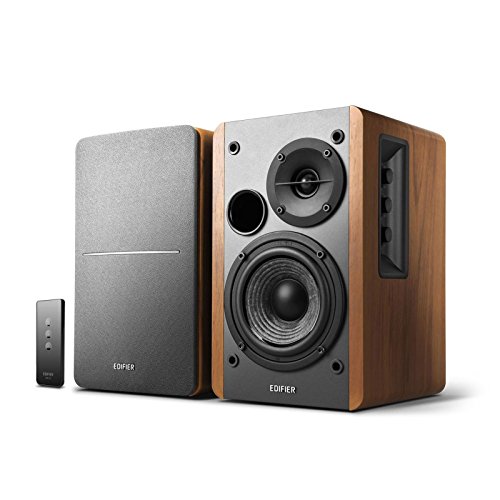
Best for: someone who wants treble control on the cabinet itself, not buried in a TV menu Skip it if: you need the sound moved closer to your chair rather than reshaped
Two things put the R1280T first. The side panel of the powered speaker carries knobs for bass and treble, so you set the balance once by ear and leave it. And at 10.8 lb for the pair, with a 5.8 x 6.9 x 9.5 in cabinet of MDF finished in wood-effect vinyl, it is the heaviest speaker in this set that also powers itself. Mass matters in a cabinet. Edifier lists a 13mm silk dome tweeter alongside a 4-inch full range unit.
Connectivity is the other reason it suits this buyer. Two AUX inputs accept 3.5mm or dual RCA, and Edifier says both can stay connected at once, so a TV and a phone live side by side with no swapping. A remote handles volume from the chair.
Against the rest of the set, the trade-off is reach. The R1280T sits on a shelf and stays there. If the real barrier is ten feet of room between you and the TV, the SIMOLIO SM-961 solves that and this does not. There is no Bluetooth here either, unlike three other picks.
Pros:
- Physical bass and treble knobs on the cabinet side
- Heaviest self-powered cabinet here at 10.8 lb
- Two AUX inputs usable simultaneously
- 2 Year Manufacturer warranty published
- The one buyers choose most often in this set
Cons:
- No Bluetooth, unlike three other picks
- Knobs sit on the side, awkward against a wall
- Fixed on a shelf, so distance to your ear stays the problem
- Only one seller lists it
2. SIMOLIO Wired Speakers for TV with Tone Control — Best for pros
The only pick built and described specifically for hard of hearing TV listening, with a 5.5m cord that lets you park it beside your ear.

Best for: bedside or armchair TV listening where distance from the set is the real barrier Skip it if: you want stereo music from a shelf
This is not a bookshelf speaker and I am not going to pretend it is. It sits in the sound bar category, and it is one box, not a pair. What it does is move the sound to you, which is the other half of the clarity equation.
SIMOLIO publishes a 5.5m cord, which is long enough to run from a TV to a recliner or a bed without an extension. The listing describes a three-level tone switch aimed at boosting voice clarity, plus RCA and 3.5mm connections for both new smart TVs and older sets. SIMOLIO says a three-hour charge supports up to eight hours of playtime, and a sleep timer shuts it off automatically. There is a 3.5mm headphone socket on the unit so you can plug your own headset in late at night.
The honest weakness is scope. One channel, no stereo image, a 1 year warranty that is the shortest here, and no published weight or dimensions at all. It is also the slowest seller of the seven. As a music speaker it is not competitive with the Edifier R1280T. As a dialogue tool beside a chair, nothing else here matches it.
Pros:
- 5.5m cord reaches a chair or bed from the TV
- 3-level tone switch aimed at voice clarity (claim)
- Up to 8 hours playtime from a 3-hour charge (claim)
- Sleep timer and 3.5mm headphone socket
- Second-cheapest pick in this set
Cons:
- Single unit, so no stereo
- 1 year warranty is the shortest published here
- No weight or dimensions listed
- Slowest seller of the seven
3. ChairSpeaker CS3 - Wireless TV Speakers for Hearing — Best premium
Clamps to a recliner and beams sound at your head over infrared, so the room volume stays low while yours does not.

Best for: a recliner user who does not want to raise the volume for the whole room Skip it if: the transmitter cannot see the chair, or you want music from a shelf
The CS3 takes the near-ear idea further than the SIMOLIO does. ChairSpeaker describes ball flex joints that grip almost any recliner or furniture type, positioning the speaker close to your head rather than across the room. That is the whole design argument: focus the sound at one person, leave everyone else alone.
Wireless here means infrared rather than radio. ChairSpeaker specifies Extreme IR with a direct line of sight up to 33 feet, and frames that as an advantage because it avoids interference from other wireless gear in the house. It also means the transmitter and the speaker must see each other, so a sofa back or a doorway breaks the link. RCA and digital optical cables are both in the box, and the listing describes a voice enhancing speaker circuit.
This is the most expensive pick here, and it publishes the least. No weight, no dimensions, no warranty term, no tweeter or woofer figure. Compared with the Edifier R1280T, you are paying more for a placement solution and getting no published specifications to check it against. That is a real trade-off, not a quibble.
Pros:
- Flex joints mount it to almost any recliner (claim)
- Infrared avoids radio interference, 33 ft line of sight (claim)
- RCA and digital optical cables both included
- Voice enhancing circuit described in the listing
Cons:
- Most expensive pick here with the fewest published specs
- No warranty term, weight or dimensions listed
- Infrared needs unbroken line of sight to work
- Single unit, so no stereo playback
4. Polk Audio T15 100 Watt Home Theater Bookshelf Speakers — Most versatile
The only pick shipped as a true pair with a 5 Year Parts and Labor warranty, and the only one designed to grow into a full surround system.

Best for: anyone who already owns a receiver and may add centre and surround channels later Skip it if: you have no amplifier and no plan to buy one
The T15 is the traditional answer, and its warranty is the strongest evidence in this set. 5 Year Parts and Labor is more than double what most of these picks publish, and Polk has been building home speakers for fifty years. Count is 2, so this is a genuine pair rather than a single cabinet.
The driver complement is a 0.75-inch tweeter and a 5.25-inch Dynamic Balance driver, and Polk claims clear, balanced sound with deep bass even at low volumes. That last clause is the interesting one for this reader, because low-volume clarity is precisely the problem. Each cabinet measures 10.7 x 7.3 x 6.5 in and weighs 8.25 lb, and the listing includes wall mounting as an option. Polk maps the upgrade path explicitly: add T50 towers, a T30 centre channel and a subwoofer for 5.1.
Here is the catch that decides it against the Edifier R1280T. These are passive. No amplifier, no sound, and the listing does not include one. There is also no tone control on the cabinet, so every adjustment happens at your receiver. That is fine if you have one and a menu you can navigate. It is a dead end if you do not.
Pros:
- 5 Year Parts and Labor warranty, longest here
- Shipped as a pair, count of 2
- 5.25-inch Dynamic Balance driver, largest published here
- Documented upgrade path to a 5.1 system
- Wall-mountable
Cons:
- Passive, so a receiver is required and not included
- No tone control on the cabinet at all
- Most expensive of the five true bookshelf picks
- 0.75-inch tweeter is smaller than three rivals here
5. MEVOSTO Active Bookshelf Speakers 36W RMS — Best minimal setup
Dual 1-inch silk dome tweeters and a claimed ten levels each of bass and treble, the widest adjustment range published in this set.

Best for: a desk or TV stand where one USB or AUX run does everything Skip it if: you want physical knobs rather than stepped levels
MEVOSTO publishes the biggest driver set among the powered picks: dual 1-inch (25.4mm) silk dome tweeters paired with 5-inch bass speakers, rated 36W RMS. Cabinets measure 9.65 x 6.1 x 5.91 in and the pair weighs 10.1 lb, which puts it within half a pound of the Edifier R1280T. Colour is brown wood grain.
The adjustment claim is what earns its place here. MEVOSTO describes ten levels each of bass and treble, framed for movies, games, news and music. If that range is real, it is finer control than a two-knob setup gives you. Connectivity is the broadest in the set: Bluetooth 5.4, USB digital audio, RCA and AUX, with support for both a USB cable and a flash drive. A 2 Year Manufacturer warranty is published.
Two things keep it below the Edifier. Stepped levels are usually set with a remote or a button sequence, not a knob you can find by feel in a dim room, and for a listener who wants a single permanent setting the knob wins. It is also the second-most expensive pick here and the slowest-selling of the five bookshelf models, which means less shared user knowledge to lean on when setup gets fiddly.
Pros:
- Dual 1-inch silk dome tweeters, largest tweeter figure here
- 5-inch woofers and 36W RMS rating
- Claimed 10 levels each of bass and treble
- Bluetooth 5.4 plus USB, RCA and AUX inputs
- 2 Year Manufacturer warranty published
Cons:
- Stepped levels are harder to set by feel than knobs
- Second-most expensive pick in this set
- Slowest-selling of the five bookshelf models here
- Ten-level range is the seller's claim, not a measured curve
6. Saiyin Powered Bluetooth Bookshelf Speakers — Best upgrade
The only pick here with both optical and coaxial digital inputs, which is the cleanest way to take audio straight off a modern TV.

Best for: connecting a current TV by optical cable with no receiver in between Skip it if: you want a large woofer for movie bass
Digital inputs are the reason this one is on the list. Saiyin builds in optical and coaxial alongside the analogue 3.5mm connection, and that matters because most TVs made in the last decade have an optical output that carries a clean signal. One cable from the TV to the speaker and you are done. Bluetooth 5.3 handles phones, tablets, a Mac or a PC.
The pair pushes a 0.5-inch silk dome horn tweeter and a 3.5-inch woofer, with the active cabinet measuring 5.3 x 6.3 x 8.6 in and the boxed listing giving 8.5 x 6.5 x 10.6 in. A remote covers volume and input switching, which is genuinely useful when the speaker sits across the room. Saiyin publishes a 3 year warranty and says no pre-amp or receiver is needed, though you can feed it from a receiver's line out if you prefer.
Where it loses is driver size and tone control. That 3.5-inch woofer is the smallest published woofer among the powered picks, and the 0.5-inch tweeter is the smallest of the five figures in this set. The remote adjusts volume and inputs, not bass and treble, so the Edifier R1280T and MEVOSTO DS19 both give you more shaping.
Pros:
- Optical and coaxial digital inputs, unique in this set
- Bluetooth 5.3 for phones, tablets and computers
- 3 year warranty published
- Remote handles volume and input switching
- Second-cheapest pick here
Cons:
- 3.5-inch woofer is the smallest among powered picks
- 0.5-inch tweeter is the smallest figure in this set
- No bass or treble adjustment described
- No published weight
7. RIOWOIS Passive Bookshelf Speakers for Home Theater — Best budget pick
The cheapest pick here, with a 2-inch tweeter that is unusually large for a compact cabinet and wall brackets in the box.

Best for: surround duty on a wall bracket alongside a receiver you already own Skip it if: you have no amplifier
The tweeter figure is the surprise. RIOWOIS lists a 2-inch tweeter with a 2.75-inch woofer, and a 2-inch tweeter in a cabinet measuring 6.22 x 9.69 x 7.6 in is a lot of high-frequency driver for the size. High frequencies carry consonants, so that ratio is worth noting for anyone chasing the best bookshelf speakers for hard of hearing on a tight outlay.
RIOWOIS quotes a peak power of 30W and describes cabinet dimensions of 4.3 inches long by 6.6 inches high in the feature copy. Finish is black 3D wood grain. Wall mounting accessories are included in the package rather than sold separately, which is a small saving that adds up. A 3 Years warranty is published, matching the Saiyin and beating four other picks.
The limitation is the same as the Polk's and it is fundamental. These are passive, so they need an amplifier that this listing does not include, and there is no tone control anywhere on the cabinet. The 2.75-inch woofer also means very little low-end weight, so for movies with music and effects you would want a subwoofer alongside. As a rear-channel pair or a small second-room setup fed by an existing receiver, it is the sensible cheap answer.
Pros:
- Cheapest pick in this set
- 2-inch tweeter, large for a compact cabinet
- Wall mounting hardware included in the box
- 3 Years warranty published
- Black 3D wood grain finish
Cons:
- Passive, so an amplifier is required and not included
- 2.75-inch woofer gives very little bass weight
- No tone control on the cabinet
- Sold as count of 1, so check quantity before ordering
Powered or passive: which should you buy?
Five of these seven power themselves. Two do not, and that single split decides more purchases here than driver size ever will.
Powered means the amplifier lives inside the cabinet. You plug the TV or the phone straight in. The Edifier R1280T, Saiyin DS6701S, MEVOSTO DS19, SIMOLIO SM-961 and ChairSpeaker CS3 all work this way. For a buyer who wants one cable and no menus, this is the right side of the line.
Passive means the speaker is just drivers and a box. The Polk Audio T15 and RIOWOIS DS6500M need a receiver or integrated amplifier, and neither listing includes one. That is not a flaw, it is a different purchase. It also means every tone adjustment happens on the receiver, which is a real obstacle if reading small on-screen menus is difficult.
Use these thresholds:
- No amplifier in the house, no interest in buying one? Go powered. The Edifier R1280T is the default.
- Already own a receiver you are comfortable operating? The Polk Audio T15 gives you the 5 Year Parts and Labor warranty and a real upgrade path.
- Adding rear channels to an existing system? The RIOWOIS DS6500M is the cheapest way to do it, brackets included.
One more practical note. Four of these seven list a count of 1 and one lists a count of 2. Check the quantity on the listing before you order, because a stereo pair and a single cabinet are not the same purchase.
What the listings do not tell you
Plenty, and it is worth naming so you know what you are still guessing at.
No frequency response figures. Not one of the seven publishes a range in Hz. That is the number that would tell you where the treble actually rolls off, and it is absent across the board.
No sensitivity ratings. For the two passive picks, sensitivity would tell you how much amplifier power you need. Neither the Polk Audio T15 nor the RIOWOIS DS6500M publishes it.
No decibel output figures. Watts appear (36W RMS on the MEVOSTO, 42W RMS on the Edifier listing, 100W and a 30W peak on the passives) but watts are not loudness.
Two picks publish almost nothing. The ChairSpeaker CS3 lists a colour and a model number. No weight, no dimensions, no warranty term. The SIMOLIO SM-961 lists colour, model and a 1 year warranty, and nothing dimensional. If you need to know a box fits a shelf, those two are a gamble.
No hearing-specific verification anywhere. Two listings use hard of hearing language in their titles and copy. That is the seller describing the intended use, not a tested claim, and I have not treated it as one.
The verdict
The Edifier R1280T is the best default among the best bookshelf speakers for hard of hearing, and the reason is boringly practical. It powers itself, so there is no receiver menu between you and the sound. It carries physical bass and treble knobs on the side panel, so you can dial treble up and bass down once and never think about it again. Two AUX inputs stay live at the same time, and the 10.8 lb wooden cabinet with its 13mm silk dome tweeter is the most substantial self-powered build here. A 2 Year Manufacturer warranty backs it.
Two conditions flip that. First, if the barrier is distance rather than tone, buy the SIMOLIO SM-961 instead. Its 5.5m cord and claimed three-level tone switch put a voice-focused speaker within arm's reach of a chair or a bed, and no shelf speaker can beat proximity. Second, if you already own a receiver and expect to build toward surround sound, the Polk Audio T15 is the better long-term buy. Its 5 Year Parts and Labor warranty is the strongest here, it ships as a genuine pair, and Polk documents the exact path to a 5.1 system.
The ChairSpeaker CS3's specific advantage over the Edifier is that it aims sound at one head without raising the room volume, which matters in a shared living room. It just asks you to accept the fewest published specifications in the set.
FAQ
Are these bookshfelf speakers worth it compared with a soundbar?
Worth it depends on which problem you are solving. A powered pair like the Edifier R1280T gives you stereo separation and physical tone knobs, which a typical soundbar hides in a menu. A soundbar wins on cable count and shelf space. Two picks here, the SIMOLIO SM-961 and ChairSpeaker CS3, are listed as sound bars precisely because they trade stereo for proximity.
Which pick gives the most sound for the least money?
The most sound for the least money comes down to whether you own an amplifier. If you do, the RIOWOIS DS6500M is the cheapest pick here and its 2-inch tweeter is generous for a 6.22 x 9.69 x 7.6 in cabinet, with wall brackets included. If you do not own one, the Saiyin DS6701S is second-cheapest, powers itself, and adds optical and coaxial digital inputs.
Do bookshelf speakers for hard of hearing need a receiver?
Bookshelf speakers for hard of hearing need a receiver only if the model is passive. Two here are: the Polk Audio T15 and the RIOWOIS DS6500M, and neither listing includes an amplifier. The other five power themselves. The Edifier R1280T, Saiyin DS6701S and MEVOSTO DS19 all accept a direct connection from a TV or phone with no separate box.
Edifier R1280T or MEVOSTO DS19: which has better treble control?
Between the Edifier R1280T and MEVOSTO DS19, the Edifier gives you knobs and MEVOSTO claims ten stepped levels each for bass and treble. MEVOSTO's range is finer on paper and its dual 1-inch tweeters are larger than Edifier's 13mm. The knob wins for a single permanent setting you can find by feel. Choose MEVOSTO if you want to retune between news and movies.
What mistake do buyers most often make in this category?
The mistake buyers most often make is shopping for watts. Loudness is rarely the barrier, since almost any powered speaker here goes uncomfortably loud. Balance is the barrier: bass masking consonants, or ten feet of room between the TV and your chair. Check for tone adjustment on the hardware and check the distance first. Watts settle nothing.
Start with the Edifier R1280T if you have a shelf and a TV, and give yourself an evening with the treble knob before deciding anything. That single adjustment does more for dialogue than any upgrade in price. If after a week the sound still arrives too late and too soft, the problem was never the speaker's tone and you should move to the SIMOLIO SM-961 and its 5.5m cord instead. And if reading small receiver menus is already a struggle, skip the two passive picks entirely. The right speaker here is the one whose controls you can reach without standing up.
Last updated: September 7, 2026. Product availability re-checked.
This page contains affiliate links. As an Amazon Associate we earn from qualifying purchases, at no extra cost to you.