Best Budget Bookshelf Speakers by Driver and Watts

A ranked shortlist of seven bookshelf speakers for audiophile ears on a tight budget, with the deciding specs, the trade-offs, and who each pick suits.

By Frederick CameronUpdated 17 min read
On this page
- Best budget bookshelf speakers for audiophiles at a glance
- How I screened this shortlist
- 1. Klipsch R-51M — Best overall
- 2. Polk Audio Signature Elite ES20 — Best premium
- 3. Edifier MR4.5 — Most versatile
- 4. Sony SS-CS5M2 — Best for heavy use
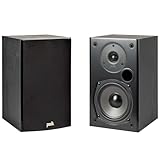
- 5. Polk Audio T15 — Best for families
- 6. Edifier R1280T — Best for small spaces
- 7. Saiyin Powered Bluetooth — Best budget pick
- What each price tier actually buys
- Passive or powered: which suits an audiophile budget?
- Driver size, tweeter type, and why they matter
- Placement, room size, and speaker pairing
- What to check before you buy
- The verdict
- FAQ
The best budget bookshelf speakers for audiophiles are the Klipsch R-51M, a passive pair with dual 5.25-inch spun-copper woofers, 1-inch aluminum LTS tweeters, and a 5-year limited warranty in a 15.3 x 8.46 x 7.01-inch cabinet. Step up to the Polk Audio Signature Elite ES20 if you want a heavier, walnut-finished pair rated for Dolby Atmos duty. Everything below is a shortlist of seven, chosen for what a careful listener on a tight budget actually gets in the box.
Best budget bookshelf speakers for audiophiles at a glance
| Pick | Woofer & tweeter | Warranty | Price |
|---|---|---|---|
Best overall Klipsch R-51M |
Dual 5.25" IMG woofers 1" aluminum LTS tweeter |
5-year limited | Check Price |
Best premium Polk Audio Signature Elite ES20 |
6.5" driver claim 1" Terylene tweeter |
5 years | Check Price |
Most versatile Edifier MR4.5 |
4.5" mid-bass 1" silk dome tweeter |
2-year manufacturer | Check Price |
Best for heavy use Sony SS-CS5M2 |
5.12" woofer tweeter + super tweeter |
1 year | Check Price |
Best for families Polk Audio T15 |
5.25" Dynamic Balance 0.75" tweeter |
5-year parts & labor | Check Price |
Best for small spaces Edifier R1280T |
4" full range 13mm silk dome |
2-year manufacturer | Check Price |
Best budget pick Saiyin Powered |
3.5" woofer 0.5" silk dome horn |
3-year manufacturer | Check Price |




How I screened this shortlist
I pulled the specifications for every pick side by side, then cut anything that couldn't back up its claims with numbers. The shortlist below is what survived.
The screen ran on published data only: driver diameter, tweeter type, cabinet weight and dimensions, warranty length, and included inputs. No listening, no room. That matters, because a "budget audiophile" claim is a marketing modifier that Amazon's search only partially honors, and this data set reflects that. Two of these speakers are studio-adjacent, three are home-theater speakers, and two are compact powered pairs that would sit on a desk. Grouping them under one heading is a shopper's convenience, not an acoustic one.
A few notes on what I did and didn't count:
- Driver size and tweeter type were the first sort. A 5.25-inch woofer moves more air than a 3.5-inch one, and that is a physical fact that survives any tuning.
- Warranty length broke ties. Three picks carry a 5-year term. That's rare in this bracket.
- Weight was a secondary clue. Heavier cabinets, all else equal, resist resonance better.
- Feature-bullet claims stayed as claims. Where a manufacturer says "Hi-Res" or "studio-grade", I've attributed the phrase and not repeated it as fact.
Any speaker without a published driver size was cut. Anything with a category path that pulled it far away from home stereo listening was noted, not hidden.
1. Klipsch R-51M — Best overall
The R-51M wins because it's the only pair here combining dual 5.25-inch woofers, a horn-loaded tweeter, and a five-year warranty in a passive cabinet an audiophile would recognize.
Best for: a stereo listener who runs an amp or receiver and wants horn-loaded detail Skip it if: you have no amplifier and no plans to buy one
Klipsch lists a 1-inch aluminum LTS tweeter mounted in a 90x90 square Tractrix horn, paired with dual 5.25-inch spun-copper IMG woofers and a rear-firing bass port. That horn-loaded top end is what separates the R-51M sonically from the soft-dome designs elsewhere on this list, and it's the reason the R-51M is a pick audiophiles actually talk about. The pair weighs 11 lb, measures 15.3 x 8.46 x 7.01 in, and shipped in 2020 with a 5-year limited warranty. That warranty is the joint-longest of the seven picks, matched only by the two Polks.
The trade-off is that this is the most expensive pick in the set, and it needs an amplifier. Feed it something clean with 40 to 100 watts per channel and it repays the effort. Feed it a phone jack and it does nothing at all. Compared to the Polk ES20, the R-51M is lighter, smaller, and comes in black rather than walnut; compared to everything else here, it's the only horn-loaded pair.
Pros:
- Dual 5.25-inch spun-copper IMG woofers
- Horn-loaded aluminum LTS tweeter
- 5-year limited warranty
- Compact 15.3 x 8.46 x 7.01-inch cabinet
- Rear-firing port for bass-reflex tuning
Cons:
- Highest-priced pair in this set
- Passive: needs a separate amplifier or receiver
- Only one color option listed
- Rear port needs clearance from the wall
2. Polk Audio Signature Elite ES20 — Best premium
The ES20 is the pair to buy if you're building a surround system and want speakers that can double as fronts or rears without looking like an afterthought.

Best for: someone building a Dolby Atmos or 5.1 system on a budget Skip it if: you only need a two-speaker desktop or shelf pair
Polk lists a 1-inch Terylene tweeter, a Dynamically Balanced Acoustic Array with what the brand calls Precision Crossovers, and 4- and 8-ohm compatibility for pairing with most receivers. The pair weighs 17 lb, the heaviest cabinet pair here, and measures 13.8 x 14.8 x 8.5 in in a contemporary walnut finish. Warranty runs 5 years. Polk says the Patented Power Port design delivers 3dB louder bass than conventional ported speakers, a manufacturer claim rather than a measured universal truth. The listing highlights Dolby Atmos compatibility and screw inserts for wall or stand mounting.
Against the R-51M, the ES20 is heavier, larger, and better suited to home cinema than close-range stereo. Against the T15 from the same brand, it's a serious upgrade in cabinet mass and driver size. It occupies the most expensive slot in this shortlist, which is the trade you make for versatility.
Pros:
- Heaviest cabinet pair here at 17 lb
- Walnut finish rather than black plastic wrap
- Dolby Atmos compatibility claim
- 5-year warranty
- Wall-mountable via screw inserts
Cons:
- The most expensive pick in this set
- Larger footprint than most desktop shelves accept
- Passive: needs a receiver
- Speaker stands sold separately
3. Edifier MR4.5 — Most versatile
The MR4.5 is the only pick here that combines balanced studio inputs, Bluetooth, and app-based room EQ in one active cabinet.

Best for: a listener who wants studio inputs, room EQ, and Bluetooth in one box Skip it if: you already own a good amplifier and prefer passive speakers
Edifier lists 80W RMS total (30W×2 + 10W×2), a 4.5-inch mid-bass driver, and a 1-inch silk dome tweeter with what the brand calls a dimpled waveguide. Inputs cover balanced XLR, balanced TRS, RCA, AUX, and a front-panel headphone jack, plus Bluetooth 6.0. Rear knobs give ±6dB high and low trim, and the Edifier ConneX app is listed as providing 9-band EQ and room correction. The pair weighs 14.6 lb across two cabinets measuring 9.61 x 8.19 x 5.51 in, with a 2-year warranty.
That input list is the widest on this shortlist. It's also the reason this pick sits in a different category path from the rest, listed under studio monitors. Against the R-51M, you gain a built-in amp and Bluetooth; you lose the horn-loaded top end and two years of warranty. Against the smaller R1280T, you gain balanced inputs and app EQ.
Pros:
- Balanced XLR and TRS inputs
- Bluetooth 6.0 with wired options
- App-based 9-band EQ claim
- Front headphone jack
- No separate amplifier needed
Cons:
- Shorter warranty than the passive picks
- 4.5-inch mid-bass rather than a full 5-inch class
- Listed in a studio-monitor category, not stereo
- Powered design ties speakers to a wall outlet
4. Sony SS-CS5M2 — Best for heavy use
The SS-CS5M2 is the only three-way, three-driver design in this shortlist, which is a genuinely uncommon spec at this price.

Best for: a three-way driver layout at a mid-tier price Skip it if: you want a longer warranty than one year
Sony lists a 5.12-inch woofer, a high-precision tweeter, and a wide-dispersion super tweeter as the three drivers, in a cabinet measuring 13.2 x 8.7 x 7 in. Model number is SSCS5M2.UC and the release date on the listing is 2025. Warranty runs 1 year, the shortest here by a clear margin. The pair sits mid-tier on price, cheaper than the Klipsch and both Polks.
A three-way design splits the frequency band into three passbands rather than two, which in principle lets each driver work in a narrower comfort zone. The SS-CS5M2 is passive, so it needs a receiver. Against the R-51M, you gain a super tweeter but lose four years of warranty and the horn-loaded midrange. Against the T15, you gain a driver but sit in the same passive, home-theater role.
Pros:
- Three-way, three-driver design
- Super tweeter added above main tweeter
- Compact 13.2 x 8.7 x 7-inch cabinet
- Mid-tier price rather than premium
Cons:
- 1-year warranty, the shortest here
- Passive: needs an amplifier
- Weight figure on the listing is unusually low
- No published color options in this data
5. Polk Audio T15 — Best for families
The T15 is the sensible first pair for a household that wants a stereo now and might expand into a 5.1 system later.

Best for: a first home theater with room to expand later Skip it if: you want a larger woofer than 5.25 inches
Polk lists a 0.75-inch tweeter and a 5.25-inch Dynamic Balance driver, in a black cabinet measuring 10.7 x 7.3 x 6.5 in and weighing 8.25 lb per pair. Warranty is 5 years parts and labor. The listing calls out wall mounting and describes the T15 as the starting point for a Polk 5.1 system that adds T50 towers, a T30 center, and a subwoofer as budget allows.
The T15 is the oldest design here by release date, listed as 2009. That's not automatically a strike: a bookshelf speaker that has stayed on Amazon for a decade and a half has usually been iteratively improved. Against the R-51M, you drop a woofer, a horn, and cabinet weight; against the ES20, you drop about 9 lb of cabinet and a lot of Polk's newer engineering claims. The T15 is entry-tier priced, and the value is in the warranty length rather than the driver count.
Pros:
- 5.25-inch Dynamic Balance driver
- 5-year parts and labor warranty
- Wall-mountable design
- Compact cabinet for tight shelves
- Documented upgrade path within Polk's line
Cons:
- Small 0.75-inch tweeter
- Oldest design in this shortlist
- Passive: needs an amp or receiver
- Only one color option listed
6. Edifier R1280T — Best for small spaces
The R1280T is the compact, wood-finish powered pair to pick when the room is small and the source is a phone or laptop.
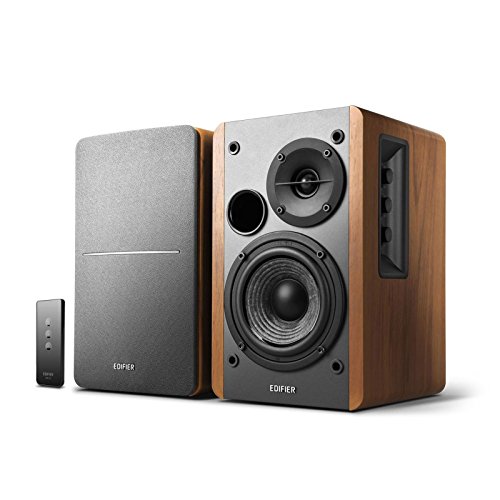
Best for: a desktop or small bedroom running from a phone or laptop Skip it if: you sit more than eight feet away
Edifier lists 42W RMS, a 13mm silk dome tweeter, and a 4-inch full-range driver, with two AUX inputs so you can leave both a computer and a turntable preamp connected. Side-panel knobs handle volume, bass, and treble. The cabinet is 5.8 x 6.9 x 9.5 in in a wood-effect vinyl finish, and the pair listing is 10.8 lb. Warranty runs 2 years, and the release year is 2018.
This is the smallest active pair here in cabinet volume, and it makes no pretense to filling a large room. Against the MR4.5 from the same brand, you drop the balanced inputs, the app EQ, and the Bluetooth, but you gain a lower price and the wood-look finish that suits a study or a bedroom. Against the Saiyin, you gain a larger 4-inch driver and a longer track record.
Pros:
- 4-inch full-range driver
- Two AUX inputs for parallel sources
- Side-panel bass and treble knobs
- Wood-effect finish
- 2-year manufacturer warranty
Cons:
- No Bluetooth
- Small cabinet limits low bass
- Fixed 42W RMS output
- One color scheme available
7. Saiyin Powered Bluetooth — Best budget pick
The Saiyin is the cheapest of the seven and the entry point for a listener who wants a modern input set with no amplifier at all.

Best for: the smallest possible outlay with optical and coaxial inputs Skip it if: you want a woofer larger than 3.5 inches
Saiyin lists a 3.5-inch woofer, a 0.5-inch silk dome horn tweeter, Bluetooth 5.3, and optical plus coaxial inputs, with a remote for volume and input switching. The active cabinet measures 5.3 x 6.3 x 8.6 in, according to the feature bullet, and the full listing dimensions are 8.5 x 6.5 x 10.6 in. Warranty is 3 years, which is longer than either Edifier's stated term. Model number is DS6701S.
This is the cheapest pick in the set and the driver size shows it: a 3.5-inch woofer is smaller than everything else here, and the low end will reflect that. Optical and coaxial inputs are unusual at this price and useful if you want to connect a TV directly. Against the R1280T, you gain Bluetooth and digital inputs, but you lose an inch of woofer diameter and a longer-established design.
Pros:
- Cheapest of the seven picks
- Bluetooth 5.3
- Optical and coaxial digital inputs
- 3-year manufacturer warranty
- Remote control included
Cons:
- 3.5-inch woofer is the smallest here
- Only one seller lists it
- 0.5-inch tweeter is smaller than most rivals
- Fewer published specs than the established brands
What each price tier actually buys
Three of these picks sit at entry level, one at mid, and three at premium. The tiers translate roughly to what an audiophile-minded shopper actually gets in the cabinet.
At the entry tier, you buy an active pair with a small woofer and modern digital inputs, or a passive pair with a 5.25-inch driver and a short-term view. The Saiyin gives you Bluetooth 5.3, optical and coaxial digital inputs, and a 3.5-inch woofer. The Edifier R1280T gives you a 4-inch full-range driver and two AUX inputs. The Polk T15 gives you a passive 5.25-inch driver and a 5-year warranty. None of these will replace a proper hi-fi system, but they'll all beat a soundbar for stereo separation.
The mid tier is thinly populated. The Sony SS-CS5M2 lands here on the price scale and offers something none of the entry picks do: a three-way driver layout. That extra driver comes at the cost of a 1-year warranty, which is unusual for the class.
The premium tier is where the audiophile case gets easier to make. The Edifier MR4.5 packs balanced XLR and TRS inputs, Bluetooth, and app-based EQ. The Klipsch R-51M brings dual 5.25-inch woofers and a horn tweeter. The Polk ES20 brings 17 lb of walnut-finished cabinet and a Dolby Atmos rating. The gap in physical build between the Saiyin and the ES20 is roughly 9 lb of extra cabinet mass per pair.
Passive or powered: which suits an audiophile budget?
The single biggest fork in the road is whether the speakers have amplifiers built in or not.
Powered speakers include their own amplifier in the active cabinet and connect straight to your source. Passive speakers do not. On this list, the Saiyin, the Edifier R1280T, and the Edifier MR4.5 are powered. The Klipsch R-51M, the Polk Signature Elite ES20, the Sony SS-CS5M2, and the Polk T15 are passive.
For a first-time buyer on a strict budget, powered is usually the cheaper total system:
- No amp to buy. You plug the speakers into your laptop, your phone, or your TV and you're done.
- No amp-to-speaker matching to worry about. The manufacturer chose an amp that suits its own drivers.
- Fewer cables. One power cord and one signal cable per source.
The passive route costs more upfront, but it opens the door to a proper hi-fi progression. You can upgrade the amp separately, add a subwoofer, and eventually build a 5.1 or Atmos system, as the Polk T15 listing explicitly points out with its T50/T30/subwoofer roadmap. Two of the passive picks here, the R-51M and the ES20, are the kind of speakers people keep for years and pair with better electronics over time.
For a budget audiophile, the cutoff is this: if you already own a receiver, buy passive. If you don't, buy powered.
Driver size, tweeter type, and why they matter
Most bookshelf comparisons stop at "5-inch woofer, silk dome tweeter" and call it a spec sheet. That misses the two things that actually decide how these speakers sound in a room.
Driver size sets the low-frequency limit. A 5.25-inch woofer moves substantially more air than a 3.5-inch one. Bigger woofers, all else equal, extend lower and distort less at moderate volume. Ranked by woofer diameter, this shortlist runs Sony 5.12" → Klipsch 5.25" (dual) → Polk T15 5.25" → Edifier R1280T 4" → Edifier MR4.5 4.5" → Saiyin 3.5", with the Polk ES20 listing a 6.5-inch driver claim. The R-51M is the only pick with two woofers per cabinet, which is why it earns the top slot.
Tweeter type sets the character of the top end. Silk dome tweeters, used in the Edifier pairs and the Saiyin, tend to sound smooth. Metal-dome and horn-loaded tweeters, like the Klipsch aluminum LTS in a Tractrix horn, tend to sound more forward and detailed. The Polk ES20 uses a 1-inch Terylene tweeter, a proprietary material Polk claims delivers cleaner high frequencies. None of these are objectively better; they suit different rooms and different ears.
The Sony's third driver, a super tweeter above the main tweeter, is a genuinely different approach at this price. Whether you hear the extra top-end air depends on your source and your ears.
Placement, room size, and speaker pairing
A speaker's spec sheet doesn't survive contact with a bad shelf. Where you put these pairs matters as much as which pair you buy.
- Rear-ported speakers need breathing room. The Klipsch R-51M has a rear-firing bass port. Put it flush against the wall and the bass will bloom. Give it four to six inches of clearance.
- Small rooms suit small drivers. The Edifier R1280T with its 4-inch full-range driver will sound better on a desk than a pair of Polk ES20 crammed into the same space.
- Wall-mounting is on the table for two picks. Both the Polk T15 and the Polk ES20 have wall-mount provisions listed.
- Toe-in helps most tweeters. Angle each speaker roughly toward the listening position. This is free and it changes the imaging noticeably.
- Speaker stands sold separately. The Polk ES20 listing spells this out.
For passive picks, the amplifier is part of the pairing decision. The Polk ES20 lists 4- and 8-ohm compatibility, which broadens the range of receivers that will drive it. The Klipsch R-51M pairs traditionally with modest wattage thanks to horn efficiency, though the exact figure isn't in the specifications supplied here.
What to check before you buy
A short checklist that catches most of the mistakes people make in this bracket:
- Do you have an amp? If no, the passive picks are off the table until you buy one.
- Do you need Bluetooth? Only the Saiyin and the MR4.5 have it. The R1280T does not.
- Is the source digital or analog? The Saiyin adds optical and coaxial inputs; the MR4.5 adds balanced XLR and TRS.
- How far is the listening seat? Under six feet, the small powered pairs work. Over ten, lean toward the R-51M or ES20.
- What warranty do you want? Five years on the Klipsch and both Polks, three on the Saiyin, two on both Edifiers, one on the Sony.
- Do you plan to expand to surround? The T15 and ES20 have documented upgrade paths within Polk's line.
Cross-check the listing dimensions against your actual shelf before ordering. Every pair here is bookshelf-sized on paper, but the ES20 at 13.8 x 14.8 x 8.5 in per cabinet won't fit where a Saiyin cabinet at 8.5 x 6.5 x 10.6 in will.
The verdict
The best budget bookshelf speakers for audiophiles are the Klipsch R-51M. Dual 5.25-inch spun-copper woofers, a 1-inch aluminum LTS tweeter in a Tractrix horn, a 5-year warranty, and a cabinet size that fits real shelves add up to a passive pair a careful listener won't outgrow quickly. It costs more than the entry picks here, and it needs an amp you already own or plan to buy. Both conditions are the price of entry to the audiophile route.
Two conditions flip the pick. First, if you're building a 5.1 or Atmos system rather than a stereo pair, the Polk Signature Elite ES20 is the better foundation. It's heavier, larger, walnut-finished, and Polk lists it explicitly as Atmos-capable. Second, if you don't own an amplifier and don't want to buy one, the Edifier MR4.5 wins on the strength of balanced XLR and TRS inputs, Bluetooth 6.0, and app-based room EQ, none of which the R-51M offers. Its 4.5-inch mid-bass is smaller, but you gain everything else the passive route asks you to buy separately.
The Klipsch is the default. The Polk ES20 is the surround upgrade. The Edifier MR4.5 is the no-amp all-in-one. Anything below those three on this list is a compromise in one of two directions: smaller drivers, or shorter warranties.
FAQ
Are these really audiophile speakers on a budget?
Are these really audiophile-grade at these prices? Partly. Amazon's search treats "audiophile" as a soft modifier, so this shortlist reflects what the marketplace returns rather than a strict audiophile-only screen. The Klipsch R-51M and Polk ES20 are the two picks most audiophile enthusiasts would recognize as serious entry-level hi-fi. The powered picks are convenience-first designs with some audiophile-adjacent specifications, especially the Edifier MR4.5 with its balanced inputs.
Is the Klipsch R-51M worth it over the Polk T15?
Is the Klipsch R-51M worth the step up from the Polk T15? For a stereo-first listener, yes. The R-51M brings a second 5.25-inch woofer per cabinet, a horn-loaded aluminum tweeter, and a rear bass-reflex port that the T15 doesn't have. Both carry 5-year warranties. The T15 wins on price and on its documented Polk surround-upgrade path, so a home-theater builder gets more mileage from the T15.
What does the 5.12-inch woofer on the Sony actually mean?
What does the 5.12-inch woofer figure tell you? It tells you the Sony SS-CS5M2's low-frequency driver is about the same diameter as the Klipsch and Polk T15 woofers, and larger than either Edifier's mid-bass driver. Bigger woofers move more air, which usually means deeper bass at moderate volume. The Sony pairs that woofer with a main tweeter and a super tweeter for a three-way layout, unusual at this price.
Which of these picks works without an amplifier?
Which speakers work without an amplifier? Three of the seven. The Saiyin, the Edifier R1280T, and the Edifier MR4.5 are all powered: the active cabinet houses an amplifier and connects directly to your source. The four passive picks, the Klipsch R-51M, the Polk Signature Elite ES20, the Sony SS-CS5M2, and the Polk T15, all require a separate amp or AV receiver to drive them.
What's the biggest mistake budget buyers make in this category?
What's the biggest mistake budget shoppers make? Buying passive speakers without budgeting for the amplifier that drives them, then plugging them into whatever cheap receiver's on hand. The Klipsch R-51M and Polk ES20 will only sound as good as the electronics feeding them. If your amp budget is zero, buy the Edifier MR4.5 or the R1280T instead and get the amplifier built in.
A last thought before you click through. The Klipsch R-51M earns the top slot on measurable grounds: two 5.25-inch woofers per cabinet, a horn-loaded aluminum tweeter, a 5-year warranty, and a cabinet size that fits ordinary shelves. What makes it the default rather than merely the winner is that it rewards the amplifier upgrade you'll make in three years. A better receiver drives it better; a cleaner source reveals more. Pick the ES20 if surround matters, the MR4.5 if you're skipping the amplifier, and the R-51M for everything else. Then match your shelves to the dimensions before you order.