Best Stereo Amplifier: Daakro AK45 Leads

Seven Bluetooth stereo amps compared on power ratings, size, inputs and warranty, with a clear winner for desktop setups and a heavier pick for real bookshelf speakers.

By Frederick CameronUpdated 16 min read
On this page
- Best stereo amplifier at a glance
- How I cut a longer list down to these seven
- Peak watts versus RMS: what the numbers really mean
- 1. Daakro AK45 — Best overall
- 2. Sony STRDH190 — Best premium
- 3. WOOPKER AK45 Pro — Best for heavy use
- 4. Fosi Audio BT20A — Best compact
- 5. Pyle PDA77BU — Best for families
- 6. Donner MAMP2 — Most versatile
- 7. Donner MAMP6 — Best for multi-room
- Which inputs actually matter for your setup?
- How much room will it take on the shelf?
- Who should skip a compact amp entirely?
- The verdict
- FAQ
The best stereo amplifier for most people right now is the Daakro AK45, a 1.92 lb desktop unit with Bluetooth 5.1 and bass and treble knobs that covers the majority of small-room setups without dominating the shelf. If you're driving real bookshelf or floorstanding speakers and want a phono input for a turntable, the Sony STRDH190 is the better buy at 100W x 2 into 8 ohms and 17.1 lb of chassis.
Best stereo amplifier at a glance
| Pick | Power claim | Weight | Price |
|---|---|---|---|
Best overall Daakro AK45 |
300W + 300W claim | 1.92 lb | Check Price |
Best premium Sony STRDH190 |
100W x 2 at 8 ohms | 17.1 lb | Check Price |
Best for heavy use WOOPKER AK45 Pro |
400W peak, 50W x 2 RMS | 1.96 lb | Check Price |
Best compact Fosi Audio BT20A |
100W x 2 max claim | 1.25 lb | Check Price |
Best for families Pyle PDA77BU |
800W peak claim | 10.9 lb | Check Price |
Most versatile Donner MAMP2 |
600W peak, 60W x 2 RMS | 10.4 lb | Check Price |
Best for multi-room Donner MAMP6 |
1000W peak, 25W x 6 RMS | 12 lb | Check Price |


How I cut a longer list down to these seven
I started with the Amazon Receivers & Amplifiers category and pulled every unit that claimed to be a stereo amplifier or a two-channel receiver with Bluetooth. Then I applied three cuts.
- Anything without a stated weight or physical dimensions came out. If a listing won't say how big the box is, I can't tell you where it will fit.
- Anything marketed purely for car audio or PA racks came out. This is a home audio roundup.
- Anything whose only spec was a peak wattage number, with no channel count and no separate RMS figure, came out too. Peak numbers alone tell you almost nothing.
That left seven units across three category paths: pure amplifiers, two-channel receivers and one six-channel receiver that still bills itself as a stereo receiver. Four of them are the lightweight desktop class under 2 lb, and three are full-width components between 10.4 and 17.1 lb. That split is what actually decides this article: the two groups are not really competing for the same shelf.
One note on the search that got you here. If you typed the exact phrase for a specific room size or amp class, the results are only a partial match to that qualifier, so I've tied every pick to a use case in the sections below and left the rest to your judgement.
Peak watts versus RMS: what the numbers really mean
Here is the trick with any best stereo amplifier list: peak wattage is a marketing number and RMS is a continuous number, and the two are not on the same scale.
The Daakro AK45 lists 300W + 300W peak. The WOOPKER AK45 Pro lists 400W + 400W peak and separately quotes 50W x 2 RMS. The Donner MAMP2 lists 600W peak and 60W x 2 RMS. The Sony STRDH190 skips peak entirely and quotes 100 watts x 2 into 8 ohms at 1 kHz.
Those are all reasonable specifications for the class, but only the Sony and the two Donners tell you what the amp will produce continuously into a real speaker load. That matters because your speakers see the RMS figure all evening, not the peak figure for a fraction of a second.
- Small desktop or bookshelf speakers in a bedroom: 20–50W per channel is plenty.
- Full-size bookshelves in a living room: 50–100W per channel starts to matter.
- Floorstanders in an open-plan room: this is where the Sony's rated 100W x 2 into 8 ohms pulls ahead.
Read the RMS line first, and treat the peak line as headroom on paper.
1. Daakro AK45 — Best overall
The AK45 wins because it does the core stereo amplifier job in a 1.92 lb box that will fit anywhere.
Best for: a desktop or bookshelf setup driving passive speakers over Bluetooth or RCA Skip it if: you want to plug in a turntable with a moving-magnet cartridge
This is the cheapest unit in the set and the one buyers here choose most often, and the shape of the pick is deliberate. Most people searching for a stereo amp are trying to bring a pair of passive bookshelf speakers back to life on a desk, and the AK45 does that without asking for a rack, a cabinet or a rethink of the shelf. Daakro lists it at 1.92 lb with dedicated volume, bass and treble control knobs and Bluetooth 5.1. The 300W + 300W figure is a peak claim rather than an RMS rating, so treat it as headroom rather than continuous output.
Where it loses ground is in the input list. The AK45 doesn't publish a phono stage or the optical and coaxial inputs the Donner MAMP2 carries, and against the Sony STRDH190 it gives up a proper A/B speaker switch and rated 100W x 2 into 8 ohms.
Pros:
- Lightest full-featured pick in the set at 1.92 lb
- Bluetooth 5.1 for phone and laptop streaming
- Dedicated bass, treble and volume knobs
- One-year warranty stated on the listing
- Lowest price position of the seven
Cons:
- No published phono input
- Peak power only, no RMS figure given
- Single seller lists it, so stock could be thin
2. Sony STRDH190 — Best premium
The STRDH190 is the only pick here with a published phono stage and rated 100W x 2 into 8 ohms.

Best for: listeners with real bookshelf or floorstanding speakers and a phono source Skip it if: your shelf can't take a 17-inch-wide chassis
The Sony is the most expensive pick here and it looks like a different product class the moment you unbox it. At 17.1 lb and 5.2 x 11 x 17 in it takes a proper AV shelf, and in return Sony quotes 100 watts x 2 into 8 ohms at 1 kHz with a speaker impedance rating of 6–16 ohms. That is a continuous specification, not a peak marketing number, and it is why this is the pick when the speakers matter.
The input list is where the STRDH190 earns its place. Sony lists a phono input for a turntable, four stereo RCA audio inputs, a 3.5 mm input, a stereo RCA output and built-in Bluetooth. The A/B speaker switching lets you drive up to four speakers, either all at once or split into two zones. Released in 2018, the design shows its age against the newer touch-screen receivers, but for a straightforward two-channel setup that is not really a criticism.
Pros:
- Rated 100W x 2 into 8 ohms, not a peak figure
- Phono input for turntables
- Four RCA line inputs plus 3.5 mm
- A/B speaker switching for two zones
- One-year warranty from a major brand
Cons:
- Heaviest chassis in the set at 17.1 lb
- Widest footprint at 17 in across
- Bluetooth only, no optical or coaxial
3. WOOPKER AK45 Pro — Best for heavy use
The AK45 Pro adds mic, USB and SD inputs to the same compact form factor as the Daakro.

Best for: someone who wants a USB and SD input alongside Bluetooth in a small box Skip it if: you only ever stream and prefer the simplest possible front panel
WOOPKER's AK45 Pro sits at 1.96 lb and 2.56 x 5.43 x 7.09 in, so it is essentially the same size class as the Daakro AK45 but with more sockets on the back. WOOPKER lists 400W + 400W peak and, unusually for this tier, quotes an RMS figure of 50W x 2. That RMS number is the honest one to plan speakers around, and it puts the AK45 Pro at the sensible end of the small-amp market.
The input list is the reason to pick it over the Daakro. WOOPKER lists USB stick and SD card inputs alongside Bluetooth, plus a microphone input, so it will hand you a plug-and-play jukebox for a small room or a workshop. Bass, treble and master volume all have their own knobs. Against the full-width picks it gives up optical, coaxial and phono connectivity, and there is no A/B speaker switch, so plan on a single speaker pair.
Pros:
- Rated 50W x 2 RMS, not just a peak claim
- USB and SD card playback built in
- One microphone input for karaoke or announcements
- One-year warranty stated on the listing
- Compact 2.56 x 5.43 x 7.09 in footprint
Cons:
- No phono, optical or coaxial input
- Single speaker pair, no A/B switching
- Only one seller lists it
4. Fosi Audio BT20A — Best compact
The BT20A is the smallest and lightest pick in the set and made for hidden installs.
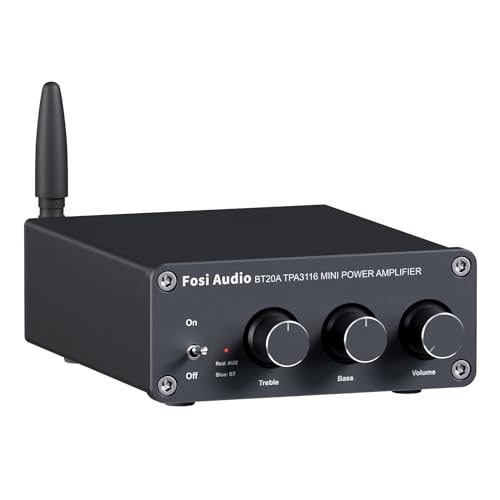
Best for: a garage, patio or ceiling-speaker install where the amp has to disappear Skip it if: you need microphone inputs or a tuner
Fosi Audio sells the BT20A as a mini Class D amp, and the physical numbers back that up. It weighs 1.25 lb, measures 1.42 x 5.2 x 3.54 in and carries a 24-month manufacturer warranty, which is the longest published cover in this whole set. The listing quotes 100W x 2 maximum output power, so again read that as peak headroom rather than continuous.
The idea here is to hide it. Fosi pitches it for offices, bedrooms, garages, patios and ceiling-speaker setups where a full-width receiver would look absurd, and the input list keeps up: Bluetooth and RCA line-in, a one-touch power switch, one all-black case. Nothing else. Compared with the Donner MAMP2 or the Pyle PDA77BU, you lose FM, USB, optical and mic inputs, but that is the deal. If you want a small, mostly invisible stereo amp for passive speakers, the BT20A is the one designed to do exactly that job and nothing else.
Pros:
- Lightest amp in the set at 1.25 lb
- Smallest footprint at 1.42 x 5.2 x 3.54 in
- 24-month manufacturer warranty
- Bluetooth plus RCA, no other clutter
- One-touch power switch
Cons:
- No microphone, USB or SD input
- No FM tuner or optical input
- Peak power claim only, no RMS figure
5. Pyle PDA77BU — Best for families
The PDA77BU is the pick when karaoke, FM radio and dual mics matter more than pure two-channel purity.

Best for: karaoke nights and family rooms that need two mics and FM radio Skip it if: you're building a two-channel hi-fi and nothing else
The Pyle is a four-channel unit that Amazon still lists under amplifiers, and it targets a different buyer to everything above. Weight is 10.9 lb, dimensions are 3.5 x 13.8 x 9.8 in, and the front panel is arranged around a digital LED display. Pyle quotes 800W peak power, without a separate RMS figure, so treat it as marketing headroom.
The reason to buy it is the mic section. Pyle lists two 1/4-inch microphone jacks with independent controls, reverb and delay effects and Bluetooth 5.0, plus USB-A input with an MP3 player, SD card, FM radio and RCA in and out. That is a karaoke and party rig first and a music amp second. Against the Donner MAMP2 it gives up optical, coaxial and phono, and against the Sony it gives up rated RMS output and a phono stage. The trade-off buys you a family-room feature set none of the two-channel picks can match.
Pros:
- Two quarter-inch mic inputs with independent controls
- Reverb and delay effects for karaoke
- Bluetooth 5.0 plus FM, USB and SD
- RCA in and out for a source or subwoofer
- Full-width chassis with LED display
Cons:
- No published warranty on the listing
- Peak-only power claim, no RMS figure
- No phono, optical or coaxial input
6. Donner MAMP2 — Most versatile
The MAMP2 is the only pick here that publishes Bluetooth, phono, optical, coaxial, USB, FM, aux, RCA and dual mic inputs together.

Best for: a home theatre corner that needs optical, coaxial, phono and Bluetooth in one unit Skip it if: you don't need more than an aux and a Bluetooth link
Donner's MAMP2 is a 10.4 lb, 3.86 x 13.8 x 9.76 in two-channel receiver, and the input list is what makes it interesting. Donner lists Bluetooth 5.3, USB up to 64 GB, phono, optical, coaxial, RCA, 2 mic inputs, aux and FM radio. That covers a turntable, a TV over optical, a games console over coaxial and a phone over Bluetooth all from one box, which none of the other picks manage.
Power sits at 600W peak with 60W x 2 RMS, so this is a genuinely usable continuous rating in the same order as the Sony's 100W x 2 into 8 ohms. Donner also ships a remote that independently controls treble, midrange, bass, echo and a talkover function, and the FM tuner lets you enter frequencies numerically. The trade-off against the Sony is a shorter published input list on the analogue side, no A/B speaker switching and a mid price position rather than premium. Against the Pyle it gains optical, coaxial and phono at the cost of some family-room polish.
Pros:
- Bluetooth 5.3, optical, coaxial and phono in one unit
- Rated 60W x 2 RMS, not just peak
- USB playback up to 64 GB
- Remote with independent EQ and echo control
- One-year warranty stated on the listing
Cons:
- No A/B speaker switching
- Only one seller lists it
- Karaoke feature set is thinner than the Pyle's
7. Donner MAMP6 — Best for multi-room
The MAMP6 is the only pick here that publishes six channels of amplification.

Best for: driving three pairs of speakers from one box across rooms or zones Skip it if: you only have one pair of speakers and no plans to add more
The MAMP6 is the outlier in this set: a 6-channel unit at 12 lb and 3.86 x 15 x 9.76 in that still lives in the receivers category. Donner quotes 1000W peak and 25W x 6 RMS, which is the honest way to read it. That RMS-per-channel number is lower than the MAMP2's 60W x 2, so this is not a straight upgrade over its stablemate. It is a different tool.
Where it earns its keep is spread. If you want to run bookshelf speakers in the living room, a pair in the kitchen and a pair on the patio from one amplifier, this is the only pick in the set that will do it without a matrix or a second box. Inputs mirror the MAMP2: Bluetooth 5.3, USB, two pairs of RCA, 2 mic inputs, aux, FM, optical and coaxial. Against the Sony and the MAMP2 you give up per-channel power, and the premium price position matches. The MAMP6 also carries the same one-year warranty as the two-channel picks, so the award label reflects the length of that cover rather than any exceptional term.
Pros:
- Six channels for multi-room or multi-pair setups
- Bluetooth 5.3 with wide input list
- Rated 25W x 6 RMS quoted
- Numeric FM tuning from the remote
- 1000W peak headroom claim
Cons:
- Lower per-channel RMS than the MAMP2
- Premium price position for entry per-channel power
- Same one-year cover as everything else here
Which inputs actually matter for your setup?
Power is where these listings shout loudest, but inputs are what actually determine whether an amp works with your gear.
- A turntable with a moving-magnet cartridge. You need a phono input. Only the Sony STRDH190 and the Donner MAMP2 and MAMP6 publish one.
- A TV or soundbar-less setup. You want optical or coaxial digital in. The two Donner receivers publish both. The Sony and the compact picks don't.
- A phone or laptop for streaming. Every pick here supports Bluetooth. The Donner MAMP2 and MAMP6 are the newest at Bluetooth 5.3, the Daakro is Bluetooth 5.1, the Fosi and Pyle are Bluetooth 5.0, and Sony's built-in Bluetooth predates those revisions.
- A microphone for karaoke or announcements. The Pyle publishes two 1/4-inch inputs, the Donner MAMP2 and MAMP6 publish two, and the WOOPKER publishes one. The Daakro, Fosi and Sony don't publish any.
- A USB stick or SD card. The WOOPKER, Pyle and both Donners handle both. The Daakro, Fosi and Sony don't.
Write your source list on paper before you buy. Then match it to the input list on the product page.
How much room will it take on the shelf?
This is the specification most buyers skip and regret. The set splits into two clear physical classes.
Compact desktop units:
- Fosi Audio BT20A: 1.25 lb, 1.42 x 5.2 x 3.54 in
- Daakro AK45: 1.92 lb, dimensions not published
- WOOPKER AK45 Pro: 1.96 lb, 2.56 x 5.43 x 7.09 in
Full-width components:
- Donner MAMP2: 10.4 lb, 3.86 x 13.8 x 9.76 in
- Pyle PDA77BU: 10.9 lb, 3.5 x 13.8 x 9.8 in
- Donner MAMP6: 12 lb, 3.86 x 15 x 9.76 in
- Sony STRDH190: 17.1 lb, 5.2 x 11 x 17 in
If your shelf is 12 in wide, the top three are your only options. If it is 14 in wide with an inch of ventilation, both Donners and the Pyle work, but the Sony does not. Ventilation matters. Class D amps like the Fosi run cool, but the Sony is a traditional design that wants breathing room above the top vents.
Who should skip a compact amp entirely?
Some readers are on the wrong page. If you nod at more than one of these, jump to a full AV receiver instead.
- You want to run a subwoofer with its own crossover. None of the picks here publishes a dedicated LFE output.
- You want HDMI switching between a games console, a streamer and a set-top box. This is a stereo roundup, and stereo means two channels of audio.
- You want Dolby Atmos or any surround format. Look at 5.1 or 7.2 AV receivers.
- You want network streaming with AirPlay 2, Chromecast or Spotify Connect built in. Every pick here relies on Bluetooth.
- You want room correction like Audyssey or Dirac. Not a feature on any of these listings.
Stereo amps solve one problem well: making a pair of passive speakers loud enough to enjoy. If you need more than that, you need a different category.
The verdict
The best stereo amplifier for most rooms is the Daakro AK45. It is the smallest full-featured pick in the set at 1.92 lb, it has bass and treble control on the front panel, Bluetooth 5.1 on the back and a one-year warranty on the box. That covers a desktop or a bookshelf setup driving passive speakers, which is the actual job most people are hiring one for.
Two conditions flip the recommendation. First, if you have a turntable with a moving-magnet cartridge or real floorstanding speakers, the Sony STRDH190 is the better choice: rated 100W x 2 into 8 ohms, phono input, four RCA inputs, A/B speaker switching for two zones. Second, if you want optical, coaxial, phono, USB, FM and two mic inputs in one unit, the Donner MAMP2 is the pick, with 60W x 2 RMS and Bluetooth 5.3. Multi-room setups with three speaker pairs step up to the MAMP6.
FAQ
Is a stereo amplifier worth it in 2024?
A stereo amplifier is worth it if you already own passive speakers or plan to buy them. Powered speakers or a soundbar already contain amplification, so a separate amp adds nothing. Passive bookshelves, floorstanders or ceiling speakers need one to make a sound. For that use case, any pick in this roundup will do the job.
What is the best stereo amplifier for a turntable?
The best stereo amplifier for a turntable in this set is the Sony STRDH190, because it is the only pick that publishes a dedicated phono input for a moving-magnet cartridge and also a rated 100W x 2 into 8 ohms. The Donner MAMP2 and MAMP6 also list phono inputs and are the alternate picks if you want optical and coaxial digital in the same box.
How many watts do I need in a stereo amp?
How many watts you need depends on speaker sensitivity and room size. For a desk or bedroom with small bookshelves, 20 to 50W RMS per channel is plenty and the compact picks here cover it. For a living room with 6-ohm bookshelves or floorstanders, aim for 50 to 100W RMS per channel. The Sony STRDH190 at 100W x 2 into 8 ohms is the ceiling in this set.
Daakro AK45 or Fosi BT20A: which compact wins?
Daakro AK45 or Fosi BT20A comes down to inputs and warranty. The AK45 has three tone knobs and Bluetooth 5.1 in a 1.92 lb chassis with a one-year warranty. The BT20A is smaller at 1.25 lb and 1.42 x 5.2 x 3.54 in with a 24-month manufacturer warranty, but it drops the tone controls. Pick the AK45 for a visible desktop, the BT20A for a hidden install.
What is the biggest mistake buying a stereo amplifier?
The biggest mistake buying a stereo amplifier is trusting the peak wattage claim on the front of the box. Numbers like 300W, 600W or 1000W peak are momentary figures. What matters is RMS wattage per channel, ideally at a stated impedance. Read the RMS line, match it to your speakers, and treat everything else as marketing. That single habit will get you the right amp on the first try.
Start with your source list, not the wattage number. Write down every device you'll plug in, note whether each one needs phono, optical, coaxial, Bluetooth, USB or a microphone jack, then measure the shelf. The Daakro AK45 handles most desks with Bluetooth and a pair of passive speakers, and it will not swamp the space it lives in. The moment your gear list gets more ambitious, step up to the Sony for pure two-channel work with a turntable, or a Donner receiver for a mixed digital and analogue setup. Buy for the sources you already own, not the ones you might.