Best Wireless Earbuds for a Swimmer's Training Week

Five open-ear and bone conduction picks compared by water rating, weight and playtime, with a clear note on which ones belong nowhere near a pool.

By Frederick CameronUpdated 15 min read
On this page
- Best smart wireless earbuds for swimmers at a glance
- How I screened these five listings
- What does the water rating actually promise?
- Why Bluetooth is the wrong spec to compare for swimming
- 1. CXK Bone Conduction Headphones X17 — Best overall
- 2. SAMVEK Swimming Headphones Underwater X7 — Best upgrade
- 3. OHAYO Open Ear Headphones T10 — Best warranty
- 4. Eigsupia Open Ear Headphones X18 — Best budget pick
- 5. TANFESO Clip On Earbuds M100 — Best minimal setup
- Onboard storage or your phone: which do you need?
- What the listings do not tell you about pool use
- The verdict
- FAQ
The best smart wireless earbuds for swimmers here are the CXK Bone Conduction Headphones X17, because they carry the strongest published sealing in this group at IPX8 and still weigh just 1.06 oz. If you'd rather leave your phone in a locker entirely, the SAMVEK X7 is the better buy with 32GB of onboard storage and an IP68 claim. Water rating is the specification that splits this field, and it splits it hard: two of these five publish figures that belong in a pool, and three publish figures that belong on a treadmill.
Best smart wireless earbuds for swimmers at a glance
| Pick | Water rating | Playtime | Price |
|---|---|---|---|
Best overall CXK Bone Conduction Headphones X17 |
IPX8 claim | 12 hrs claim | Check Price |
Best upgrade SAMVEK Swimming Headphones Underwater X7 |
IP68 claim | Not stated | Check Price |
Best warranty OHAYO Open Ear Headphones T10 |
IPX6 claim | 40 hrs with case | Check Price |
Best budget pick Eigsupia Open Ear Headphones X18 |
IP54 claim | 36 hrs with case | Check Price |
Best minimal setup TANFESO Clip On Earbuds M100 |
IPX7 claim | 40 hrs with case | Check Price |




How I screened these five listings
I started with one filter and applied it before anything else: what does the listing publish about water resistance, in a standard rating, using a number? Everything else in the category is negotiable. A sealing rating is not.
That filter reorders the whole set. Sorted by published rating alone, the order runs IP68, IPX8, IPX7, IPX6, IP54. Two of those five are described by their sellers as swimming products. Three are described as sports products, which is a different job.
The second screen was weight, because open-ear frames that sit on your cheekbones get heavy fast during a long set. Four of the five publish a figure, ranging from 0.18 oz per earbud on the TANFESO M100 up to 2.47 oz for the OHAYO T10 package.
The third screen was what happens when Bluetooth stops working, which under water it does. Only two picks here publish an MP3 or onboard-storage mode. That single line item separates a pair you can actually use in a lane from a pair you can only use beside the pool.
Here's the honest limit of this screening. Amazon's search returned a shelf that is mostly running and cycling gear, so this guide names which picks the data supports for water use and which it clearly does not.
What does the water rating actually promise?
The ratings look like a smooth scale. They aren't.
- IP54 means limited dust protection and splashing water. Sweat, drizzle. Not submersion.
- IPX6 means powerful water jets. Heavy rain, a rinse under a tap. Still not submersion.
- IPX7 means submersion, and the standard test is shallow and brief.
- IPX8 means submersion deeper or longer than IPX7, with the depth set by the manufacturer. CXK's listing mentions immersion in water alongside a triple-seal design.
- IP68 means the IPX8 water test plus full dust protection.
So the jump that matters for a swimmer sits between IPX6 and IPX7. Below that line you have splash resistance. At or above it you have a submersion claim, and for the best smart wireless earbuds for swimmers that line is the whole decision.
That also means the OHAYO T10 at IPX6 and the Eigsupia X18 at IP54 are not pool products, no matter how good their other numbers look. Both publish long playtime. Neither publishes a submersion rating. I'd use them for the dryland half of a training week and nothing more.
One more thing worth naming: every rating in this table is the manufacturer's claim from the listing, not an independent measurement. Treat a claimed rating as a starting point, and treat a seller's return window as part of the purchase.
Why Bluetooth is the wrong spec to compare for swimming
Every listing here leads with a Bluetooth version. Four of the five put it in the product title. It's the most prominent number on the page and it's close to irrelevant once your head goes under.
Radio at 2.4GHz does not travel through water well. The SAMVEK listing itself puts the effective Bluetooth range at 10 meters, or 33 feet, and that figure is for air. Submerge the buds and a phone on the deck stops being a source. This is why bone conduction pairs meant for swimming ship with storage on board.
So the ranking that a Bluetooth number implies is upside down for this use:
- Onboard storage decides whether you have audio in the water at all.
- Sealing rating decides whether the pair survives the session.
- Fit and weight decide whether it stays put off a push.
- Bluetooth version decides how the pair behaves on the drive home.
CXK lists Bluetooth 6.0 alongside an MP3 mode. SAMVEK lists Bluetooth 5.4 alongside 32GB of storage. Both of those combinations work. A Bluetooth 5.4 pair with no storage and an IP54 rating is a running product wearing sports vocabulary.
1. CXK Bone Conduction Headphones X17 — Best overall
The highest submersion claim in this set paired with the lightest full-frame body, which is the combination a lap swimmer needs.
Best for: someone who wants the highest published water rating with real playtime Skip it if: you want a charging case that tops the buds up between sessions
Within this group of five, the X17 is the only pick that publishes both a submersion-class rating and a playtime figure. CXK claims IPX8 with a triple-seal design and says the pair handles immersion. It also claims 12 hours of continuous playback on one charge, which covers a fortnight of hour-long sessions before you think about the magnetic charger.
The weight is the quiet advantage. At 1.06 oz for the whole one-piece frame, it's less than half the 2.47 oz the OHAYO T10 publishes. For a bone conduction band that wraps behind your head, that difference shows up in the last 500 meters, not the first.
CXK also lists an MP3 mode and Bluetooth 6.0, plus a 15x10mm transducer it calls PulseCraft. Take the sound quality language as marketing and the format as the point: with an onboard mode, you're not depending on a signal that water blocks anyway.
The trade-off against the rest is the charging setup. The T10, X18 and M100 all publish a case that carries 30 hours or more of reserve. The X17 gives you a magnetic cable instead, so 12 hours is 12 hours until you find a socket. It's also the second-most expensive pick here.
Pros:
- IPX8 claim, the second-strongest sealing figure in this set
- Lightest full-frame body here at 1.06 oz
- 12 hours of playback claimed on one charge
- MP3 mode listed, so audio works without a phone signal
- Sells faster than every other pick in this group
Cons:
- No charging case, only a magnetic cable
- Playtime reserve well short of the 40-hour case picks
- Second-highest price position in this set
- Only one seller lists it
- Warranty period published as a bare figure with no unit
2. SAMVEK Swimming Headphones Underwater X7 — Best upgrade
The only pick with 32GB of storage on board, which makes it the one pair here that works with your phone in a locker.

Best for: anyone who wants music without carrying a phone at all Skip it if: you need a published weight before you commit
The X7 publishes the strongest sealing figure in this comparison at IP68, which is the IPX8 water test plus full dust protection. For open water and sand, that dust half is not a throwaway.
The real separator is storage. SAMVEK lists 32GB built in, which the listing puts at up to 8,000 songs, and no other pick here publishes onboard capacity in gigabytes. Load a playlist, leave the phone in a bag, swim. That solves the problem Bluetooth cannot: the listing itself gives the wireless range as 10 meters in air, and water shortens that to nothing.
The listing also mentions the earphones weigh 30 grams, though the specifications section publishes no weight for the product, so I'd treat the figure as a claim rather than a confirmed number. Bluetooth 5.4 handles the dryland half.
Where it loses to the X17 is transparency and momentum. There's no published playtime, no published dimensions, and no confirmed weight in the specification list. It's also the slowest seller in this set by a wide margin, and it sits in the more expensive half. You're paying for the storage and the IP68 claim while accepting a thinner specification sheet than the winner offers.
Pros:
- IP68, the strongest sealing claim in this group
- 32GB onboard storage, the only capacity figure published here
- 1 Year warranty stated in the listing
- Bluetooth 5.4 with a stated 33-foot range for dryland use
Cons:
- No playtime figure published anywhere in the listing
- No weight or dimensions in the specifications
- Slowest seller of the five
- Sits in the more expensive half of this set
3. OHAYO Open Ear Headphones T10 — Best warranty
A 40-hour dryland pair with a clearly stated 1 Year warranty, and an IPX6 rating that keeps it out of the water.
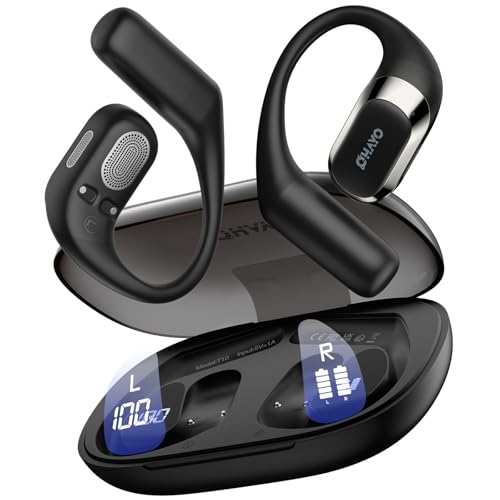
Best for: dryland training, treadmill work and cycling between swim sessions Skip it if: the buds will ever go under water
Be clear on what this is. IPX6 covers powerful jets of water, so rain, sweat and a rinse are fine, and submersion is not. The T10 is the pick for the half of a swimmer's week that happens out of the pool.
For that job it's strong. OHAYO publishes 10 hours from the buds plus 30 hours from the case, totalling 40, which ties the TANFESO M100 for the longest figure here. It also publishes the most complete specification set of the five: 2.47 oz packaged weight, 1 x 3.15 x 2.17 in dimensions, and a warranty stated plainly as 1 Year rather than a bare number or a vague phrase. In a category where two picks publish neither dimensions nor a clear warranty unit, that clarity has value.
OHAYO claims a quad-speaker layout with two 15mm dynamic drivers per earbud, plus Bluetooth 5.4 and touch controls. Those are the manufacturer's claims, and the driver size is at least a figure you can compare.
The cost is the one thing a swimmer came for. It's the heaviest pick here at 2.47 oz, and its IPX6 rating puts it two steps below the X17 for water. Sitting mid-range in price, it's asking swim money for dryland capability.
Pros:
- 40 hours total playtime claimed, tied for longest here
- Clearest warranty statement in the set at 1 Year
- Only pick publishing full dimensions at 1 x 3.15 x 2.17 in
- Bluetooth 5.4 with earhook fit and touch controls
Cons:
- IPX6 rating rules out any submersion
- Heaviest pick in this comparison at 2.47 oz
- No MP3 or onboard storage mode listed
- Mid-range price for a pair that can't enter the pool
4. Eigsupia Open Ear Headphones X18 — Best budget pick
The cheapest of the five and the lightest of the case-based picks, but IP54 keeps it firmly on dry land.

Best for: a first pair of open-ear buds for gym and running use Skip it if: you want the strongest sealing in this group
The X18 is the cheapest pick here and it does the entry-level job honestly. Eigsupia publishes 36 hours of playtime with the LED-display case, a 2.25 oz weight, and a one-year manufacturer warranty. Against the OHAYO T10, that's four fewer hours and a lighter package for less money.
The listing claims 8 grams per earbud in lightweight PC material and Bluetooth 5.3 for low latency. It also mentions a 14 figure that the listing cuts off mid-sentence, which is a good reminder that these bullets are seller copy, not a datasheet.
Now the part that decides it. IP54 is the weakest rating in this comparison by a clear margin: splashes and limited dust, nothing more. It is the only pick here with no jet-resistance or submersion claim at all. For a swimmer, that makes the X18 a gym-bag pair, not a pool-bag pair.
The trade-off against the rest of the set is exactly what you'd expect from the lowest price position. You get the case, the playtime and the weight, and you give up water capability entirely, along with any onboard playback mode. If your budget only stretches this far and you swim, buy a cheap dryland pair and save separately for a sealed one.
Pros:
- Cheapest pick in this comparison
- 36 hours of playtime claimed with the LED case
- 2.25 oz, lighter than the OHAYO T10
- One-year manufacturer warranty listed
- LED case display shows remaining charge
Cons:
- IP54, the weakest water rating in the set
- No submersion or jet-resistance claim of any kind
- No MP3 or onboard storage mode
- Older Bluetooth 5.3 than three other picks here
5. TANFESO Clip On Earbuds M100 — Best minimal setup
The lightest earbud published anywhere in this set at 0.18 oz, with an IPX7 rating and a two-month warranty that you should read twice.
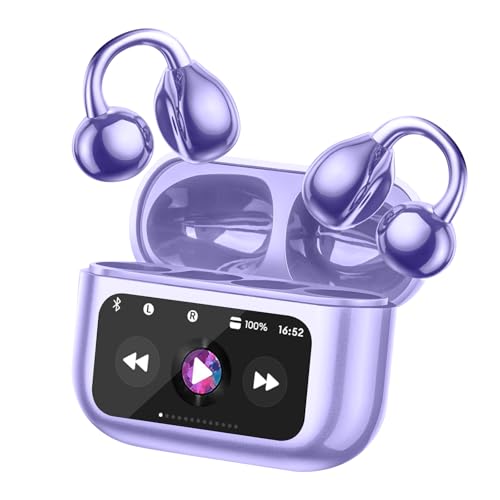
Best for: clip-on comfort at the lowest weight published here Skip it if: a two-month warranty bothers you
The M100 is the only clip-on design in this comparison. Rather than a band behind your head or a hook over your ear, each bud clamps onto the outer ear in soft silicone. TANFESO publishes 0.18 oz per earbud, which is the smallest weight figure in this entire set.
It also claims 40 hours of playtime with the digital-display case, tying the OHAYO T10, plus Bluetooth 5.4 and an IPX7 rating. IPX7 is a submersion-class figure, so on paper this clears the line the T10 and X18 do not. It's the second-cheapest pick here, which makes that rating look generous.
Two things hold it back. The warranty is published as two months, the shortest in the set by a factor of six against the one-year figures from CXK, OHAYO, Eigsupia and SAMVEK. And there's no onboard storage mode, so in the water you'd be relying on a Bluetooth link that water interferes with.
The other worry is mechanical. A clip-on gripping the ear rim is a different retention problem from a band that wraps your skull, and no listing figure tells you how it behaves off a wall push. Against the X17, you're trading a shorter warranty and a weaker sealing rating for less weight and a lower price.
Pros:
- Lightest earbud figure in this set at 0.18 oz
- IPX7 submersion-class rating claimed
- 40 hours of playtime claimed with the display case
- Second-cheapest pick here
- Soft silicone clip-on rather than a rigid band
Cons:
- Two-month warranty, by far the shortest here
- No onboard storage, so no audio without a signal
- Clip-on retention unproven for push-offs and turns
- No published weight for the case or full package
- Second-slowest seller in this group
Onboard storage or your phone: which do you need?
Answer one question and the pick narrows to two.
Does your phone come to the pool deck, and does it stay dry? If the answer is no, or if you swim laps rather than standing in the shallow end, you need onboard playback. Only the CXK X17 with its MP3 mode and the SAMVEK X7 with 32GB publish that capability here.
If the answer is yes and the buds are for the weights room, the bike or the run, then storage is dead weight and case capacity matters more. That points at the 40-hour figures from the T10 and the M100, or the 36 hours from the X18.
Storage has a second benefit worth naming. A pair holding its own files has no dropouts, no pairing fuss and no dead phone battery at 6am. The trade is loading it: you copy files across by cable and manage a playlist manually, without any of the app convenience you get from streaming.
What the listings do not tell you about pool use
Chlorine is not water, and no IP rating tests for it. Rinse any pair in fresh water after a session and dry it before charging. Salt is worse.
These are the gaps I'd want closed before buying, and none of the five listings closes them:
- Depth and duration behind the rating. IPX8 is manufacturer-defined. CXK mentions immersion; the figure is cut off in the listing text.
- Whether the seal survives repeated cycles. A rating is a one-off test, not a season of training.
- How the frame behaves under a cap. Bone conduction bands and swim caps compete for the same space.
- Behaviour off a turn. No listing publishes any retention figure.
- Which files the MP3 modes accept. Neither CXK nor SAMVEK names supported formats.
One practical note on availability: only one seller lists each of these five products, so returns run through a single channel. Check that channel's terms before you buy, particularly with the M100's two-month warranty.
The verdict
Split by price and the picture is clean.
At the entry end, the Eigsupia X18 is the cheapest here and delivers 36 hours of playtime at 2.25 oz. It's a dryland pair. IP54 covers splashes and nothing else, so buy it for the treadmill, not the pool. The TANFESO M100 sits just above it and does clear the submersion line at IPX7, at 0.18 oz per earbud, but its two-month warranty is the shortest in the set and it has no onboard playback.
In the middle, the OHAYO T10 has the most complete specification sheet of the five and the clearest warranty at 1 Year, with 40 hours total playtime. Its IPX6 rating still keeps it out of the water.
At the top, the two picks that belong in a lane. The CXK X17 is the best smart wireless earbuds for swimmers choice for most people: IPX8, 12 hours of claimed playback, an MP3 mode and just 1.06 oz on your head. It's also the one buyers choose most often in this group. The SAMVEK X7's exact advantage is 32GB of onboard storage plus an IP68 claim, and it wins if you want the phone left behind entirely, provided a listing with no published playtime or weight doesn't put you off. Buy the X17 by default. Buy the X7 for storage.
FAQ
Are the best smart wireless earbuds for swimmers worth the extra money?
Worth the extra money depends on how much you swim. If you're in the pool twice a week, yes: a submersion-rated pair like the CXK X17 at IPX8 replaces a phone-and-armband setup that never worked well anyway. If you swim once a month and run four times, a cheaper IPX6 or IP54 pair covers more of your week for less.
What water rating do earbuds need for swimming?
The water rating you need for swimming starts at IPX7, which is the first level that involves submersion rather than splashing. IPX8 goes deeper or longer, with the depth set by the manufacturer. IP68 adds full dust protection on top. Ratings below IPX7, including IPX6 and IP54, cover sweat and rain only, so they are dryland products.
CXK X17 or SAMVEK X7: which should I buy?
Between the CXK X17 and the SAMVEK X7, pick the X17 unless onboard storage is your priority. The X17 publishes IPX8, 12 hours of claimed playback and a 1.06 oz weight. The X7 publishes IP68 and 32GB of storage, enough for 8,000 songs by its listing, but no playtime figure and no confirmed weight in its specifications.
Does Bluetooth work under water?
Bluetooth does not work under water in any useful way, because 2.4GHz radio is absorbed almost immediately. SAMVEK's own listing gives a 33-foot range in air. Submerge your head and a phone on the deck stops reaching you. That's why the X17's MP3 mode and the X7's 32GB matter far more for pool use than which Bluetooth version a listing advertises.
What's the most common mistake buying swimming earbuds?
The most common mistake buying swimming earbuds is trusting the word "sport" in a product title instead of reading the rating. Three of the five picks here are sold with sport language, and two of those three publish IPX6 or IP54, which are not submersion ratings. Find the IP figure in the specifications, then decide. The title is copy, not a rating.
Pick your side of the water line first, then shop. If your training week is mostly pool, the CXK X17 is the default: it's the only pick here that pairs an IPX8 seal with a 12-hour claim and an MP3 mode, at a weight low enough that you forget it's on. If your week is mostly dryland with the occasional swim, buy the OHAYO T10 for its 40 hours and clear one-year warranty, and accept that it stays on the deck. Whichever you choose, rinse it in fresh water afterwards and dry it before charging. Chlorine outlasts warranties.