Best Receiver for Home Stereo by Watts and Inputs
A ranked look at five receivers for a home stereo setup, from a 1.96 lb desktop amp to a 5.2-channel Yamaha, with the trade-offs named for each.
The best receiver for home stereo is the Sony STRDH190, a 2-channel unit rated 100 watts x 2 into 8 ohms with a phono input, four RCA stereo inputs and A/B switching for up to four speakers. If you want the same box to run a TV with Dolby Atmos and 4K120 HDMI, the Yamaha RX300A 5.2-channel is the alternate pick. The three cheapest options here map to three very different rooms.
Best receiver for home stereo at a glance
| Pick | Channels & power | Key inputs | Price |
|---|---|---|---|
| Best overall Sony STRDH190 |
2ch, 100W x 2 (8Ω) | Phono, 4x RCA, Bluetooth | Check Price |
| Best premium Yamaha RX300A |
5.2ch, Dolby Atmos claim | HDMI 4K120/8K60, Bluetooth Multipoint | Check Price |
| Best minimal setup Yamaha R-S202BL |
2ch stereo | Bluetooth, 40-preset FM/AM | Check Price |
| Best budget pick WOOPKER AK45Pro |
2ch, 50W x 2 RMS claim | Bluetooth 5.0, USB, SD | Check Price |
| Best for pros Pyle PDA77BU |
4ch, 800W peak claim | Dual 1/4" mic, USB, SD, FM | Check Price |
What each price tier actually buys
The five picks land on three tiers, and the jump between them is not a smooth curve.
At the entry tier sit the WOOPKER AK45Pro and the Pyle PDA77BU. Both are compact class-D amps in receiver clothing. Their published power figures are peak watts, not the sustained figure a hi-fi shopper compares. The Pyle adds two 1/4" mic inputs, a karaoke feature the AK45Pro's single mic input hints at but doesn't match.
The Sony STRDH190 sits alone in the middle. It's the only pick here that publishes a per-channel 8-ohm figure in the classic hi-fi form: 100 watts x 2 into 8 ohms at 1 kHz. It's also the only one in this set with a phono input for a turntable.
At the premium end, both Yamahas cost more, but for very different reasons. The R-S202BL is a stereo-only receiver in a full-width chassis, tuned for two-speaker listening. The RX300A is a 5.2-channel AV receiver with HDMI switching. You are paying for room correction and video, not for cleaner two-channel sound.
Two channels or five: which fits a music-first room?
Most home stereo guides compare wattage. That's not what decides it.
The real question is how many speakers you actually plan to run. Two-channel receivers pair with two full-range speakers, or two pairs on an A/B switch. Five-channel AV receivers assume you have a center speaker, two surrounds and a subwoofer.
- Two speakers in one room: the Sony STRDH190 or the Yamaha R-S202BL.
- Two pairs across two rooms: the Sony, because A/B switching is called out in the listing.
- Full home theater with a TV: the Yamaha RX300A.
- A desk, a shelf or a garage: the WOOPKER AK45Pro at 1.96 lb.
- Weddings, karaoke or a small venue: the Pyle PDA77BU with dual mic inputs.
Buying a 5.2 AV receiver for a music-only room is a common mistake. You pay for HDMI, video processing and three amplifier channels you never use. If the TV isn't part of the plan, the two-channel picks are the better receiver for home stereo listening.
1. Sony STRDH190 — Best overall
The only pick here with both a phono input and a per-channel 8-ohm power spec, at a mid price position.

Best for: a turntable and bookshelf speakers in one room, or a two-room A/B setup. Skip it if: you need HDMI, a subwoofer output or any surround processing.
The STRDH190 is the receiver in this set that reads as a real stereo receiver on paper. Sony lists 100 watts x 2 into 8 ohms at 1 kHz, four stereo RCA inputs, a phono input, a 3.5 mm input and stereo RCA output, plus Bluetooth. Speaker impedance is 6 to 16 ohms, which covers most bookshelf and floorstanding pairs. It weighs 17.1 lb and measures 5.2 x 11 x 17 in, the classic full-width component shape that stacks with a turntable and a CD player.
The listing also names A/B speaker switching for up to four speakers, which is the trick for running one pair in a living room and a second pair in a kitchen or patio from the same box. Warranty is one year, which is the shortest here alongside the R-S202BL and the amps.
Against the rest of the set, it makes one trade-off: no HDMI, no video, no room correction. If you want the receiver to handle a TV too, look at the Yamaha RX300A below.
Pros:
- 100W x 2 into 8 ohms, the clearest power spec here
- Phono input for a turntable, the only one in this set
- Four RCA stereo inputs plus a 3.5 mm input
- A/B switching to run up to four speakers
- Classic full-width chassis at 5.2 x 11 x 17 in
Cons:
- No HDMI and no subwoofer output listed
- One-year warranty, half the length of the RX300A's
- Released 2018, the oldest of the two-channel picks
2. Yamaha RX300A 5.2-Channel — Best premium
The only pick in this set that handles a TV, a surround system and a subwoofer in one box.

Best for: a music room that also handles movies and gaming through a TV. Skip it if: you only listen in stereo and want simple front-panel controls.
The RX300A is the most expensive pick here, and it earns that with features no other unit in the set publishes. Yamaha lists 5.2 channels, Dolby Atmos and DTS Virtual:X processing, 4K120 and 8K60 HDMI switching, Dolby Vision and HDR10+ passthrough, HDMI eARC/ARC, and Bluetooth Multipoint. The listing also names a room correction routine that uses an included setup microphone to measure the speakers and the room.
It weighs 16.8 lb, roughly the same as the Sony, and measures 6.13 x 12.5 x 17.1 in. Warranty is 2 years, the longest here. Yamaha lists the model as released 2026, so it's the newest AV design in the set.
The trade-off against the Sony is direct. You get video switching, surround processing and a longer warranty. You lose the phono input and the pure two-channel simplicity of a stereo receiver. It also sells slower than the Sony in this category, so listings can be harder to compare against similar AV models. For a room built around a TV, though, this is the only pick that answers the brief.
Pros:
- 5.2 channels with Dolby Atmos and DTS Virtual:X claims
- 4K120 and 8K60 HDMI switching claim
- Room correction routine with included setup microphone
- 2-year warranty, the longest in this set
- Bluetooth Multipoint for two paired sources
Cons:
- No phono input for a turntable
- The most expensive pick here for a music-only room
- More setup steps than a two-channel receiver
3. Yamaha R-S202BL — Best minimal setup
A stripped-down stereo receiver with 40 FM/AM presets and Bluetooth, and nothing you don't need.
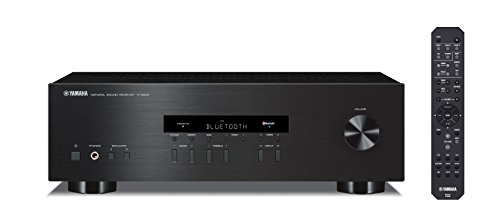
Best for: a clean two-speaker rig where you stream by Bluetooth and listen to FM. Skip it if: you plan to plug in a turntable directly, or you want a subwoofer output.
The R-S202BL is Yamaha's stereo receiver built around the same idea as the Sony, minus the phono input. The listing names a speaker selector for two speaker systems, a headphone terminal, an auto power standby function, and a 40-station FM/AM preset tuner. Frequency response is listed as 10 Hz to 100 kHz (0 ±0.5 dB / 0 ±3 dB). Bluetooth handles streaming from a phone or laptop.
It's the lightest of the three full-width receivers at 14.8 lb, in a 5.5 x 12.6 x 17.1 in chassis with a brushed aluminum front. That fits a bookshelf or a hi-fi rack neatly.
Against the Sony, the R-S202BL sits at the top of the premium price band with fewer published inputs and no phono stage. Against the AV Yamaha, it makes the case for staying in stereo: fewer menus, no HDMI setup, no surround calibration. Its trade-off is that if you later add a turntable, you'll need a separate phono preamp. Choose it when you're sure you're a Bluetooth-and-FM listener.
Pros:
- Two-speaker selector for A/B pairs
- 40-station FM/AM preset tuner
- Bluetooth for phone and laptop streaming
- Brushed aluminum front in a 14.8 lb chassis
- Frequency response 10 Hz to 100 kHz claim
Cons:
- No phono input listed
- Sits in the premium price band without an obvious feature edge over the Sony
- Sells more slowly than the Sony in this category
4. WOOPKER AK45Pro — Best budget pick
A 1.96 lb desktop amp with Bluetooth 5.0, tone controls and a mic input, at the lowest price position here.

Best for: a desktop or bookshelf setup where a full-width receiver won't fit. Skip it if: you own full-size floorstanders or plan to run two speaker pairs.
The AK45Pro is the cheapest pick and by far the smallest, at 2.56 x 5.43 x 7.09 in and 1.96 lb. The listing names 400W + 400W peak power with 50W x 2 RMS rated power, Bluetooth 5.0, USB and SD card inputs, a microphone input, and separate bass, treble and master volume knobs. That last part matters more than the wattage: knobs beat a five-menu deep tone control every time.
Only one seller lists it, which limits your options if there's a return.
Its trade-off against the Sony is scale. This is a compact desktop amplifier, not a component receiver. It has no phono input, no HDMI, no A/B switching and no tuner. But for a home office, a bedroom shelf or a garage workbench, none of that matters. Pair it with a small pair of bookshelf speakers and you have a legitimate stereo rig for very little floor space and very little money on the shelf.
Pros:
- 1.96 lb and 2.56 x 5.43 x 7.09 in, the smallest here
- Bluetooth 5.0 and USB/SD input
- Physical bass, treble and master volume knobs
- 50W x 2 RMS rated power claim
- The cheapest of the five
Cons:
- Peak power in the marketing is not sustained watts
- No phono input, no HDMI, no tuner
- Only one seller lists it
5. Pyle PDA77BU — Best for pros
A 4-channel unit with dual 1/4" mic inputs, reverb and delay, aimed at karaoke and event use.

Best for: karaoke nights, small events, DJ practice or classroom PA duty. Skip it if: you want a pure hi-fi listening box for a couch and two speakers.
The Pyle PDA77BU is the odd unit out, and it's included because the "receiver for home stereo" query catches a lot of people who really want a mic-friendly amp. The listing calls out 800W peak power, four channels, Bluetooth 5.0, dual 1/4" microphone jacks with reverb and delay, USB-A with an MP3 player, an SD card slot, FM radio, and RCA in/out. It weighs 10.9 lb in a 3.5 x 13.8 x 9.8 in chassis, half-width rather than full-width.
Its published specs skip a warranty, which is a real gap: it's the only pick here without one on the listing.
Against every other pick, the Pyle makes one clear trade: it puts hosting features first and hi-fi features second. There's no phono input, no room correction, no A/B stereo switching. But if the room you're outfitting hosts parties or singalongs, none of the others give you two independent mic channels with effects. Judge it as a party amp with Bluetooth attached, not as a stereo receiver, and it earns its spot.
Pros:
- Two 1/4" mic inputs with reverb and delay
- USB-A with built-in MP3 player claim
- SD card slot and FM radio
- Half-width chassis at 3.5 x 13.8 x 9.8 in
- Second-cheapest of the five
Cons:
- No warranty listed
- 800W is a peak figure, not sustained
- Not designed for critical two-channel listening
How I screened the shortlist
I compared the published specifications side by side across all five listings. Three criteria drove the cut, weighted in this order.
- A published per-channel power figure at a stated impedance. The Sony is the only pick that spells this out cleanly at 100W x 2 into 8 ohms. Peak wattage figures like the Pyle's 800W and the WOOPKER's 400W + 400W are marketing claims, not comparable numbers.
- Input variety matched to home stereo use. A phono input, multiple RCA pairs and Bluetooth cover almost every music source a home listener plugs in.
- A chassis and warranty that suggest a permanent install. Full-width receivers with 1- to 2-year warranties survive a decade on a rack. Compact desktop amps serve a different job.
Those criteria explain why the Sony leads, why the Yamaha RX300A is the alternate pick for anyone who also wants HDMI, and why the AK45Pro and PDA77BU show up as scenario picks rather than overall contenders.
Do you actually need a phono input?
Only if you own a turntable, and only if that turntable doesn't already have a built-in preamp.
- Yes, you need a phono input: you own a turntable with a "phono" output only. The Sony STRDH190 is the pick.
- No, you don't: your turntable has a "line" output or a built-in preamp switch set to line. Any pick here works, and you plug into a regular RCA input.
- Not yet: you might add a turntable next year. Consider the Sony now, or a Yamaha R-S202BL plus a small outboard phono preamp later.
The trap is buying a stereo-only receiver with no phono input, adding a turntable later, then discovering you need a separate preamp box anyway. If a turntable is in the plan at all, the receiver with the phono input already fitted is the cleaner buy.
Sony STRDH190 vs Yamaha R-S202BL: which wins?
Both are two-channel receivers in a full-width chassis with Bluetooth. On the surface they overlap.
The Sony wins on inputs. It lists a phono stage, four RCA stereo inputs, a 3.5 mm input, an RCA output, and A/B speaker switching for up to four speakers. Sony publishes 100W x 2 into 8 ohms at 1 kHz.
The Yamaha wins on tuner and finish. It lists a 40-preset FM/AM tuner, an auto standby function, a two-speaker selector and a brushed aluminum front. It weighs 14.8 lb, the lighter of the two.
The Sony sits at a lower price rank in this set than the Yamaha, and it carries the phono input. For most home stereo buyers, especially anyone who owns or might buy a turntable, the Sony is the pick. Choose the Yamaha only if the FM presets and the brushed aluminum finish matter more to you than a phono input and A/B for four speakers.
What the listings don't spell out
Product pages skip the details you find out on day one of setup. A few worth knowing:
- Speaker wire is not included. Every receiver here ships with a remote and a power cord. You buy 14- or 16-gauge speaker wire separately, by the foot.
- The RX300A wants a subwoofer. A 5.2 system is five main speakers plus two subwoofer outputs. Without a sub, you're running the receiver in a mode it wasn't tuned around.
- Bluetooth range varies by room, not by spec. A number in the listing tells you very little about how it works through a plaster wall.
- Full-width chassis are 17 inches wide. Measure the shelf before you buy. Three picks here are 17 to 17.1 inches wide.
- Room correction takes 10 minutes. The Yamaha RX300A's setup mic routine is worth running once, then leaving alone.
The verdict
The best receiver for home stereo, taken across this set, is the Sony STRDH190. It's the only pick here with a phono input, the only one with a published 100W x 2 into 8 ohms figure, and it lists A/B switching for up to four speakers so a single unit can drive two pairs across two rooms. At a mid price position, it's also the cheapest full-width stereo receiver in the shortlist.
Two conditions flip the pick. If your room is built around a TV as much as a pair of speakers, buy the Yamaha RX300A 5.2-channel: it's the only unit here with HDMI switching, Dolby Atmos processing and a 2-year warranty. If you're outfitting a desktop or a bookshelf where a 17-inch-wide chassis won't fit, buy the WOOPKER AK45Pro instead: 1.96 lb, Bluetooth 5.0, and real tone knobs.
The Yamaha R-S202BL is a fine second stereo receiver, but the Sony carries a phono input at a lower price position, and that decides it. The Pyle PDA77BU is the answer to a different question entirely: hosting, karaoke and events.
FAQ
What is the best receiver for home stereo overall?
The best receiver for home stereo overall in this set is the Sony STRDH190. It publishes 100 watts x 2 into 8 ohms at 1 kHz, includes a phono input for turntables, offers four RCA stereo inputs plus a 3.5 mm input, and adds A/B switching for up to four speakers. It sits in the mid price band and comes with a 1-year warranty.
Is a 5.2-channel AV receiver worth it for a music-only room?
A 5.2-channel AV receiver is worth it only when you also want the same box to drive a TV. In a music-only room, you pay for HDMI switching, video processing and three amplifier channels you never use. A two-channel receiver for home stereo like the Sony STRDH190 or Yamaha R-S202BL uses its whole budget on the two channels you actually listen to.
How many watts do I need for bookshelf speakers?
How many watts you need depends on room size and speaker sensitivity, not on a marketing peak number. For most bookshelf pairs in a bedroom or living room, the Sony's 100 watts x 2 into 8 ohms is more than enough headroom. The WOOPKER AK45Pro's 50W x 2 RMS claim covers a desktop or a small shelf setup with the same speakers at lower volumes.
Sony STRDH190 vs Yamaha RX300A: which should I pick?
Sony STRDH190 vs Yamaha RX300A comes down to whether a TV is in the room. Pick the Sony for a stereo listening room with a turntable or Bluetooth streaming: it has a phono input and costs less. Pick the Yamaha RX300A when the receiver also has to handle a TV with Dolby Atmos, 4K120 HDMI and a subwoofer, and you want a 2-year warranty.
What's the biggest mistake buyers make with a stereo receiver?
The biggest mistake buyers make is comparing peak watts across brands. The Pyle's 800W and the WOOPKER's 400W + 400W are peak figures, while the Sony's 100W x 2 into 8 ohms is a sustained per-channel figure. Compare per-channel watts at a stated impedance, or compare inputs and features instead. Peak numbers across different manufacturers are not the same measurement.
The cleanest next step is to measure the shelf, count the speakers, and decide whether a TV is in the picture. If the answer is two speakers, one room, and no TV, the Sony STRDH190 is the default: phono in, 100 watts per channel, and A/B for four speakers means it grows with you. If a TV joins the setup a year from now, the Yamaha RX300A takes over the whole room without a second box. And if the room is smaller than any of that, the WOOPKER AK45Pro fits on a shelf you already own.
Last updated: September 7, 2026. Product availability re-checked.
This page contains affiliate links. As an Amazon Associate we earn from qualifying purchases, at no extra cost to you.