Best Powered Bookshelf Speakers: Edifier R1280T Wins
Six powered bookshelf speaker sets compared on inputs, driver size, warranty and desk footprint, with a named winner and the conditions that flip the pick.

By Frederick CameronUpdated 16 min read
On this page
- Best powered bookshelf speakers for podcasters at a glance
- How I screened this shortlist down to six
- Do these actually work for podcast production?
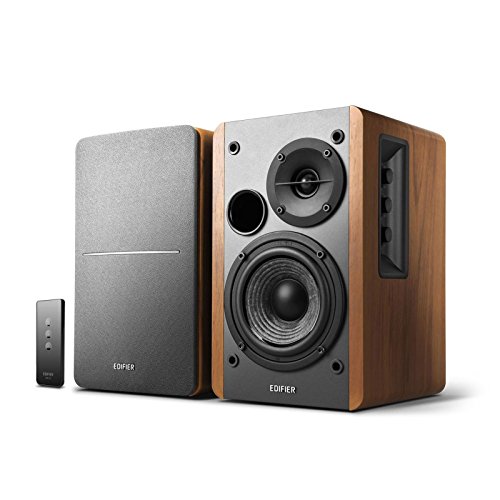
- 1. Edifier R1280T Powered Bookshelf Speakers — Best overall
- 2. ULTIMEA 3-Way Powered Bookshelf Speakers — Best for pros
- 3. Saiyin Powered Bluetooth Bookshelf Speakers — Best upgrade
- 4. MEVOSTO Active Bookshelf Speakers 36W RMS — Best minimal setup
- 5. Electrohome Huntley Powered Bookshelf Speakers — Best budget pick
- 6. Klipsch R-51M Bookshelf Speaker — Best premium
- What decides it: inputs, not watts
- How much desk space does each one eat?
- What more money buys across this set
- The verdict
- FAQ
The best powered bookshelf speakers for podcasters are the Edifier R1280T, because two AUX inputs let an interface and a laptop stay connected at once inside a 10.8 lb wooden cabinet with a 2-year warranty. If you need more output and HDMI ARC for TV duty, the ULTIMEA BS-3 claims 70W RMS and a 5.25-inch woofer instead. This roundup is not for anyone who needs a calibrated mixing reference. If you master music for release, buy a true near-field monitor with a published frequency response and a measurement microphone. What you get here is honest desk playback: something that tells you when a guest's audio is boomy, when your room is ringing, and when a plosive slipped through.
Best powered bookshelf speakers for podcasters at a glance
| Pick | Drivers | Inputs | Price |
|---|---|---|---|
Best overall Edifier R1280T |
4 in full range 13mm silk dome |
2 x AUX (3.5mm / RCA) |
Check Price |
Best for pros ULTIMEA BS-3 |
5.25 in woofer 3-way claim |
HDMI ARC wireless |
Check Price |
Best upgrade Saiyin DS6701S |
3.5 in woofer 0.5 in silk dome |
Optical, coaxial Bluetooth 5.3 |
Check Price |
Best minimal setup MEVOSTO DS19 |
5 in woofer 1 in silk dome |
USB, RCA, AUX Bluetooth 5.4 |
Check Price |
Best budget pick Electrohome Huntley |
3 in drivers | RCA, Aux-In Bluetooth 5 |
Check Price |
Best premium Klipsch R-51M |
Dual 5.25 in 1 in aluminium |
Passive pair needs an amp |
Check Price |


How I screened this shortlist down to six
I started from the published specifications and worked outward, because that is the only material here that compares cleanly across brands. Driver size, cabinet dimensions, weight, warranty length and input list are all stated. Everything else is the manufacturer talking.
Three screens produced this six:
- Stated input list. A speaker set with one input is a speaker set you unplug every session. Five of the six list at least two ways in.
- Published cabinet dimensions. A desk has a hard depth limit. Every pick here states its footprint in inches, so you can measure before you buy.
- A stated warranty term. All six publish one, from 1 year up to 5 years. That is unusual for this category and it made ranking easier.
What got cut: single-driver Bluetooth pucks, soundbars, and anything without published cabinet dimensions. One product survived the screens without being powered at all, which is the Klipsch R-51M. I kept it because it is the only pair in the set and the only one with a 5-year warranty, and because plenty of readers already own an amplifier.
The rest of the ranking came down to how many sources you can leave connected and how much desk each cabinet consumes.
Do these actually work for podcast production?
Partly, and the honest answer matters more than the flattering one. Nothing in this set publishes a frequency response figure, a self-noise figure, or a distortion measurement you could hold to. So no product here can be called a podcast monitor on the strength of the data.
What powered bookshelf speakers genuinely give a podcaster is a second opinion. Headphones flatter close-mic voices. A pair of speakers a metre away shows you how the episode sounds on a kitchen counter, which is where most listeners hear it. That is a real job, and a 4-inch or 5-inch driver does it better than a laptop grille.
Where they fall short is decisions about EQ curves and compression thresholds. A 3-inch driver like the Electrohome Huntley's will not reproduce the low end you are cutting, so you cut blind. Judge on speech intelligibility, not on bass.
One practical note: any speaker on the same desk as a microphone will feed back if you monitor live. Mute the speakers while recording, or place them behind the mic's null.
1. Edifier R1280T Powered Bookshelf Speakers — Best overall
Two simultaneous AUX inputs make this the only pick in the set that never asks you to swap a cable mid-session.
Best for: a desk fed by two sources at once Skip it if: you need Bluetooth or a digital input
The R1280T earns the top spot on workflow, not on raw output. Edifier states two AUX inputs, each accepting a 3.5mm headphone output or dual RCA, and says both can stay connected with no plugging or switching. That is the single most useful thing on this list for anyone running an interface and a laptop side by side. Nothing else here does it.
The cabinet measures 5.8 x 6.9 x 9.5 in and weighs 10.8 lb, which is mid-pack for footprint and comfortably stable on a shelf. Edifier lists a 13mm silk dome tweeter and a 4-inch full-range unit, plus bass and treble knobs on the side panel of the active speaker. Physical EQ knobs beat software EQ when you need to check whether a boomy guest is the recording or the room. There's a remote for volume too.
It is also the one buyers choose most often here by a wide margin, and it carries a 2-year warranty against the Klipsch pair's 5.
The trade-off is connectivity age. This is a 2018 design with analogue inputs only. No Bluetooth, no optical, no USB. The Saiyin and MEVOSTO picks all offer digital paths this does not.
Pros:
- Two AUX inputs usable at the same time
- Side-panel bass and treble knobs on the active unit
- 2-year warranty, longer than three picks here
- The one buyers choose most often in this set
- Wooden MDF cabinet at a manageable 10.8 lb
Cons:
- No Bluetooth of any kind
- No optical, coaxial or USB input
- 4-inch driver is smaller than the ULTIMEA and MEVOSTO woofers
- Only one seller lists it
- 2018 design, oldest connectivity in the group
2. ULTIMEA 3-Way Powered Bookshelf Speakers — Best for pros
The largest, heaviest and most powerful set here, and the only one claiming a dedicated midrange driver.

Best for: a larger room and TV audio duty Skip it if: your desk is shallow or you dislike heavy speakers
ULTIMEA lists a 5.25-inch woofer, a dedicated midrange driver and a tweeter, which makes the BS-3 the only three-way design in this group. For voice work that separation is the interesting part: the midrange is where speech lives, and a driver that only handles midrange is not also being asked to move bass air. The brand claims 70W RMS at 0.1% distortion and 50Hz lows via its long-excursion woofer, and says HDMI ARC handles TV audio.
At 19 lb and 13.2 x 9.17 x 7.4 in, this is by a distance the biggest pick here. That is nearly twice the Edifier's weight and over four times the Electrohome's. It is also the only entry filed under studio monitors rather than bookshelf speakers, which is worth noting even though the category label is not a measurement.
The catches are real. The warranty runs 1 year, the shortest here alongside the Electrohome. It is the second-most expensive pick and only one seller lists it. And a 13.2-inch tall cabinet on a shallow desk will crowd a microphone arm badly, where the Edifier's 9.5-inch height does not.
Pros:
- Only three-way driver layout in this set
- 5.25 in woofer, tied largest here
- HDMI ARC listed for TV audio
- Claimed 70W RMS, highest stated output in the group
Cons:
- 19 lb, heaviest pick by 8 lb
- 13.2 in tall crowds a shallow desk
- 1-year warranty, shortest here
- Second-highest price position in the set
- Only one seller lists it
3. Saiyin Powered Bluetooth Bookshelf Speakers — Best upgrade
Optical and coaxial inputs plus a 3-year warranty, at the second-cheapest position in the set.

Best for: someone who wants optical and coaxial in cheaply Skip it if: you need a large woofer for low-end weight
The Saiyin pair is the value story of this roundup. It is the second-cheapest of the six, and it is the only pick besides the Klipsch to publish a warranty longer than 2 years, at 3 years. Digital inputs are the other draw: Saiyin lists optical and coaxial alongside analogue, plus Bluetooth 5.3. An optical feed from a TV or a mixer avoids ground loops entirely, and that matters on a desk full of USB devices.
Saiyin describes an active and passive pair that needs no pre-amp, built around a 0.5-inch silk dome horn tweeter and a 3.5-inch woofer. The listing gives the active speaker as 5.3 x 6.3 x 8.6 in, with the boxed dimensions at 8.5 x 6.5 x 10.6 in. A remote handles volume and input switching.
Where it loses is driver area. That 3.5-inch woofer is the second-smallest here, ahead of only the Electrohome's 3-inch units, and well behind the 5-inch and 5.25-inch woofers above it. Expect a thinner low end than the MEVOSTO or ULTIMEA deliver.
No weight figure is published either, which makes shelf planning guesswork compared with the four picks that state one.
Pros:
- Optical and coaxial inputs, rare at this price position
- 3-year warranty, second-longest in the set
- Bluetooth 5.3 plus analogue in
- Second-cheapest of the six
- Remote switches inputs as well as volume
Cons:
- 3.5 in woofer, second-smallest here
- No published weight figure
- 0.5 in tweeter is the smallest listed in the group
- Only one seller lists it
4. MEVOSTO Active Bookshelf Speakers 36W RMS — Best minimal setup
USB digital audio means one cable from the computer carries both power reference and signal, with no interface in the chain.

Best for: a single-USB-cable desktop with no clutter Skip it if: you want a long published warranty
If your desk is already a nest of cables, the MEVOSTO DS19 is the pick that shortens it. MEVOSTO lists USB digital audio and says it delivers lossless quality with low latency, alongside RCA, AUX and support for a USB flash drive. Plugging speakers straight into a laptop's USB port skips the 3.5mm jack, which is the noisiest output on most machines.
Driver-wise it is well specified for its position: MEVOSTO claims dual 1-inch silk dome tweeters and 5-inch bass drivers at 36W RMS, plus bass and treble adjustment across 10 levels. That 1-inch tweeter is double the Saiyin's stated 0.5-inch dome. Bluetooth 5.4 is the newest wireless version in this set. Weight is 10.1 lb, in a 9.65 x 6.1 x 5.91 in cabinet, so it takes up slightly less desk depth than the Edifier.
The compromise is longevity cover and popularity. It carries a 2-year warranty, the same as the Edifier but half the Saiyin's, and it is the slowest seller among the four mid and entry picks. Only one seller lists it, so there is no fallback if that listing goes quiet.
Pros:
- USB digital audio input, only pick with it
- 5 in bass driver, tied largest in the set
- 1 in silk dome tweeter, tied largest here
- 10-level bass and treble adjustment
- Bluetooth 5.4, newest version in this group
Cons:
- 2-year warranty against the Saiyin's 3
- Slowest seller of the mid-priced picks
- No HDMI input, unlike the ULTIMEA
- Only one seller lists it
5. Electrohome Huntley Powered Bookshelf Speakers — Best budget pick
At 4.08 lb and 5.9 x 4.8 x 4.5 in, this is the only pick small enough to disappear on a crowded desk.

Best for: a tight shelf or a second monitoring spot Skip it if: you want the biggest drivers in this set
The Huntley is the cheapest of the six and the smallest by a long way. Its 4.5-inch depth is under half the ULTIMEA's, and 4.08 lb makes it a quarter of that speaker's weight. If you have a shelf above a monitor or a narrow gap beside a mic arm, this is the pick that fits where none of the others will.
Electrohome lists 3-inch drivers in handcrafted wood cabinets with a rear-ported design, and a built-in amplifier so no receiver is needed. Inputs cover RCA, Aux-In and Bluetooth 5, which the brand pitches at turntables, TVs, consoles and podcast playback. Two sellers stock it, which is better coverage than the four single-seller picks here.
The honest limits: 3-inch drivers are the smallest in this comparison, and small drivers in a small box mean the low end is thin. For checking speech clarity that is survivable. For judging whether an episode's bass rumble is a problem, it is not. The 1-year warranty is the shortest here alongside the ULTIMEA's.
Treat this as a secondary listening position rather than your only one.
Pros:
- Cheapest pick in this set
- Smallest footprint at 5.9 x 4.8 x 4.5 in
- Lightest at 4.08 lb
- Built-in amplifier, no receiver needed
- Two sellers stock it
Cons:
- 3 in drivers, smallest in the group
- 1-year warranty, shortest here
- No optical, coaxial or USB input
- Thin low end for a 4.5 in deep cabinet
6. Klipsch R-51M Bookshelf Speaker — Best premium
The only true pair here, the only 5-year warranty, and the only pick that needs an amplifier you supply yourself.

Best for: a long-term listening pair with the best coverage Skip it if: you need built-in amplification
The R-51M is the outlier and the one to understand before buying. Klipsch ships it as a pair, listed with a count of 2, where every other entry here is sold as a single unit. It is also passive, so there is no built-in amp. That means the sticker price is not the whole cost.
What you get for that is the strongest hardware list in the set. Klipsch specifies a 1-inch aluminium LTS tweeter loaded into a 90x90 square Tractrix horn, dual 5.25-inch spun-copper IMG woofers, and bass-reflex via a rear-firing port. The 90x90 horn is the interesting part for a desk: horn loading narrows how widely treble scatters, which reduces what bounces off the walls behind you. The 5-year limited warranty is more than double what four of these picks offer, and two sellers stock it.
The costs are clear. It is the most expensive pick here before you add amplification, at 15.3 x 8.46 x 7.01 in the second-largest cabinet, and the slowest seller of the six. Anyone buying their first set of speakers is better served by any of the five powered picks above.
Pros:
- Sold as a pair, only one in this set
- 5-year limited warranty, longest here
- Dual 5.25 in woofers per cabinet
- 90x90 Tractrix horn narrows treble dispersion
- Two sellers stock it
Cons:
- Passive, so an amplifier is an extra purchase
- Most expensive pick in the group
- Slowest seller of the six
- No Bluetooth, USB or optical input at all
What decides it: inputs, not watts
Most guides to the best powered bookshelf speakers for podcasters rank on wattage. Wattage is close to useless as a comparison here, because only two of the six publish an RMS figure at all: 42W for the Edifier and 70W claimed by ULTIMEA, with MEVOSTO listing 36W. Three publish nothing. You cannot rank a field on a specification two-thirds of it omits.
What actually decides your daily experience is how many sources can stay connected.
- Two analogue sources live at once: only the Edifier R1280T states it.
- A digital feed: the Saiyin offers optical and coaxial; the MEVOSTO offers USB; the ULTIMEA offers HDMI ARC.
- Bluetooth: four of the six list it, in versions 5, 5.3 and 5.4.
- Nothing wireless: the Edifier and the Klipsch.
Think about a normal week. You play back an edit from a DAW, check a reference episode on your phone, watch a video on a laptop, then take a call. Every source swap on a single-input speaker means reaching behind a cabinet. Over a year that is hundreds of cable swaps for no gain.
Driver size matters second, and it splits the field cleanly at four inches. Below that, in the Saiyin and Electrohome, low-end judgment gets hard. At or above it, the Edifier, MEVOSTO, ULTIMEA and Klipsch give you enough to hear a boomy room.
How much desk space does each one eat?
This is the specification that stops a purchase, and every pick here publishes it. Measure before you order.
Ranked by depth, which is the dimension a desk runs out of first:
- Electrohome Huntley: 5.9 x 4.8 x 4.5 in, 4.08 lb
- MEVOSTO DS19: 9.65 x 6.1 x 5.91 in, 10.1 lb
- Edifier R1280T: 5.8 x 6.9 x 9.5 in, 10.8 lb
- Klipsch R-51M: 15.3 x 8.46 x 7.01 in, 11 lb
- Saiyin DS6701S: 8.5 x 6.5 x 10.6 in boxed
- ULTIMEA BS-3: 13.2 x 9.17 x 7.4 in, 19 lb
Two things follow. First, if your desk is 24 inches deep and already carries a monitor arm and a mic boom, the ULTIMEA and the Klipsch will fight everything else for room. Second, weight is a stability question, not just a shipping one. The Electrohome at 4.08 lb is light enough to walk across a desk when a cable tugs it. The ULTIMEA at 19 lb will not move, but it also will not sit on a flimsy shelf.
Rear-ported cabinets need breathing room too. Both the Electrohome and the Klipsch list rear ports, so pushing either flat against a wall will change how the bass behaves. Leave a few inches.
What more money buys across this set
Spending more in this category buys three things, and only three. Driver area, warranty length, and cabinet mass. It does not reliably buy inputs, which is the surprise.
At the entry positions, the Electrohome and Saiyin, you get 3-inch and 3.5-inch drivers with 1-year and 3-year warranties respectively. The Saiyin is the value anomaly of the whole set: cheap, and yet the second-longest warranty here.
In the middle, the Edifier and MEVOSTO step up to 4-inch and 5-inch drivers, both with 2-year cover, and both add capability the cheaper picks lack. The Edifier's dual live AUX inputs and the MEVOSTO's USB path are genuinely different tools, not just louder versions of the same thing.
At the top, the ULTIMEA and Klipsch buy driver count and cabinet engineering: a three-way layout in one, dual 5.25-inch woofers plus a horn-loaded tweeter in the other. Note what happens to warranty though. The ULTIMEA drops to 1 year, the same as the cheapest pick in the set. Paying more does not guarantee longer cover.
The verdict
Entry tier: take the Saiyin DS6701S. It is the second-cheapest here, it publishes a 3-year warranty that beats four more expensive picks, and optical plus coaxial inputs are unusual at that position. Accept the 3.5-inch woofer and treat it as a speech-clarity check rather than a bass reference.
Middle tier, and the overall winner: the Edifier R1280T. Two AUX inputs live at the same time is the one feature nothing else in this group matches, and it removes a cable swap you would otherwise make every session. A 4-inch full-range driver, side-panel bass and treble knobs and a 2-year warranty in a 10.8 lb cabinet is the most complete package here for a desk. Its gap is wireless: if Bluetooth is non-negotiable, the MEVOSTO DS19 gives you version 5.4, a 5-inch woofer and USB audio at the same warranty length.
Premium tier: the Klipsch R-51M, on the condition that you already own an amplifier. It is the only pair in this set, the only 5-year warranty, and its 90x90 Tractrix horn is the only stated attempt at controlling treble dispersion. If you want power built in at that level instead, the ULTIMEA BS-3 claims 70W RMS and a three-way layout, but its 1-year warranty is the shortest here.
FAQ
Are the best powered bookshelf speakers for podcasters worth it over headphones?
Powered bookshelf speakers for podcasters are worth adding, not worth substituting. Headphones exaggerate detail in close-mic voices and hide room problems. A pair of speakers a metre away shows you how the episode sounds in a kitchen or a car, which is where most people listen. Keep the headphones for editing precision and use the speakers as your second opinion.
Which offers better value, the Edifier R1280T or the Saiyin DS6701S?
Better value between the Edifier R1280T and the Saiyin depends on your input needs. The Saiyin costs less, adds optical, coaxial and Bluetooth 5.3, and publishes a 3-year warranty. The Edifier has the larger 4-inch driver, two simultaneous AUX inputs and physical EQ knobs, with a 2-year warranty. Pick Saiyin for digital sources, Edifier for a two-source analogue desk.
Do I need an amplifier for these bookshelf speakers?
You need an amplifier for one pick only: the Klipsch R-51M is a passive pair, so budget for external amplification on top. The Edifier, Saiyin, MEVOSTO, Electrohome and ULTIMEA all state built-in amplification and need no receiver. Saiyin notes you can still feed its speakers from an amplifier's line out if you already own one.
Will powered bookshelf speakers fit on a desk with a microphone arm?
Powered bookshelf speakers fit alongside a mic arm if you check depth first. The Electrohome Huntley is 4.5 in deep and the MEVOSTO 5.91 in, both easy. The ULTIMEA BS-3 stands 13.2 in tall and the Klipsch R-51M 15.3 in, so either will compete with a boom for space on a standard 24-inch desk.
What is the biggest mistake when buying bookshelf speakers for voice work?
The biggest mistake is ranking on wattage. Only three picks here publish an RMS figure at all, so the number cannot compare the field. Judge on driver size, published cabinet dimensions and how many sources can stay connected. A speaker you unplug twice a day is a speaker you stop using, regardless of its stated output.
Start by measuring the depth available beside your microphone, then pick from the entries that fit. If two sources need to stay live and the space allows a 9.5-inch cabinet, the Edifier R1280T is the default because it solves a problem the rest of this set leaves you to manage with your hands. The reason it wins is not sound, it is friction. Every other pick here makes you choose which device is plugged in today. That is a small annoyance the first week and a real one by month six, and it is the kind of thing you only notice once it's gone.