Best Pedal Power Supply for a Real Pedalboard

Seven pedal power supplies, ranked by what actually keeps a board quiet: isolation, current per port, and switchable voltage. The Donner DP-1 wins on outputs per ounce.

By Frederick CameronUpdated 16 min read
On this page
- Best pedal power supply at a glance
- How I screened this shortlist
- 1. Donner DP-1 — Best overall
- 2. Voodoo Lab Pedal Power 3 PLUS — Best premium
- 3. D'Addario PW-CT-9V — Runner-up
- 4. JOYO DC 9V 800mA — Best budget pick
- 5. Mosky 10 Isolated + USB — Best for beginners
- 6. Voodoo Lab Pedal Power 2 Plus — Best for heavy use
- 7. LEKATO 10-Port + USB — Best for families
- Isolated outputs vs daisy chains: which do you actually need?
- Reading the current spec: mA per port, not total
- Will one brick power a digital reverb and a fuzz together?
- What the listings do not tell you about noise
- The verdict
- FAQ
The best pedal power supply for most players is the Donner DP-1, a 6.9 oz brick with ten isolated outputs covering 9V, 12V and 18V pedals from one wall socket. Voodoo Lab's Pedal Power 3 PLUS takes it if you're running high-current DSP effects and want twelve 500mA outputs plus X-LINK expansion. The deciding specification here is current per port, not the total output count, and it's what separates a silent board from a hum-riddled one.
Best pedal power supply at a glance
| Pick | Outputs | Current per port | Price |
|---|---|---|---|
Best overall Donner DP-1 |
10 isolated 9V/12V/18V |
7x 100mA, 1x 500mA 1x 12V, 1x 18V |
Check Price |
Best premium Voodoo Lab Pedal Power 3 PLUS |
12 isolated 10x 9V, 2x 9V/12V |
500mA on all 12 | Check Price |
Runner-up D'Addario PW-CT-9V |
1 (daisy chain) | 800mA total claim | Check Price |
Best budget pick JOYO 9V 800mA |
1 with 4-way chain | 800mA, 1A max claim | Check Price |
Best for beginners Mosky 10 Isolated + USB |
10 isolated + USB | 7x 300mA, 1x 500mA 1x 9/12/18V 500mA |
Check Price |
Best for heavy use Voodoo Lab Pedal Power 2 Plus |
8 isolated (listed) | 5-year warranty | Check Price |
Best for families LEKATO 10-Port + USB |
10 isolated + USB | 9V/12V/18V switchable | Check Price |



How I screened this shortlist
I started with what actually breaks a pedalboard: shared grounds, undersized current draw, and adapters that sag under load. From there, I set three cuts. First, if a supply couldn't power at least a small analog board without a daisy chain hack, it had to be genuinely cheap and honest about being a single-output adapter. Second, if it claimed isolation, the listing had to say "isolated" per output, not "filtered". Third, if it advertised 9V/12V/18V switching, that had to be a published output, not a bundled polarity cable.
That's how seven survived. Two are single-output bricks aimed at a first pedalboard. Five are multi-output isolated supplies at four different price positions. The Voodoo Lab Pedal Power 3 PLUS sits at the top of the price ladder and the Pedal Power 2 Plus sits just below it. The JOYO is the cheapest of the seven, and the Donner DP-1 lands third from the bottom on price while offering the same output count as the Mosky and the LEKATO.
I did not test these. I compared the published specifications side by side, port by port, and flagged where a listing leans on marketing rather than numbers.
1. Donner DP-1 — Best overall
Ten isolated outputs across three voltages in a 6.9 oz brick is the most useful spec sheet in this set for the price it sits at.
Best for: a mixed board of analog and digital 9V pedals Skip it if: you need 500mA on more than one port
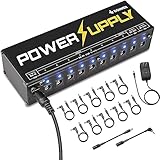
The DP-1 wins on breadth. You get seven 9V 100mA ports for standard analog stompboxes, one 9V 500mA port for a hungry digital pedal, one 12V 100mA port, and one 18V 100mA port. Donner says the outputs are isolated and each has independent short-circuit protection, so a fault on one port shouldn't kill the rest. The listing describes an aluminum alloy chassis and a blue LED that doubles as a board light and a fault indicator.
At 6.9 oz it's the second-lightest multi-output supply here, behind nothing that offers ten outputs. Compared to the Mosky and LEKATO, which also carry ten ports plus a USB, the Donner has no USB but sells for less. Compared to the Voodoo Lab bricks, it's a fraction of the weight and a fraction of the outlay, with the trade-off being current headroom: only one 500mA port versus twelve on the Pedal Power 3 PLUS. If your board has one Strymon-class pedal and the rest are simple, that trade-off is fine.
Pros:
- 10 isolated outputs across 9V, 12V and 18V
- 6.9 oz, easy to mount under most boards
- One 500mA port for a digital pedal
- Per-output short-circuit protection claim
- Third-cheapest of the seven
Cons:
- Only one high-current 500mA port
- No published warranty in the listing
- No USB port for a tuner or phone
- Sold by only two sellers
2. Voodoo Lab Pedal Power 3 PLUS — Best premium
Twelve fully isolated 500mA outputs plus X-LINK expansion is what a working pedalboard is actually built around.

Best for: gigging players with high-current DSP pedals Skip it if: you only run four analog stompboxes
The Pedal Power 3 PLUS is the most expensive pick here, and it's the only one that publishes 500mA on every port. Voodoo Lab lists ten 9V outputs and two switchable 9V/12V outputs, all rated 500mA, plus X-LINK expansion ports that link to Pedal Power X4 and X8 units to reach up to sixteen isolated outputs. That's a specification aimed at boards with several Strymon, Eventide, Line 6 or Meris pedals, where per-port current is the constraint.
It weighs 2.25 lb and sits in a 2 x 11 x 9 in enclosure, which fits under most standard pedalboards. The listing states 100-240VAC input for international touring and a 5-year warranty in North America. Released in 2020, this is the current-generation successor to the Pedal Power 2 Plus below it in this list. The trade-off is straightforward: you're paying a premium price for headroom you may not need on a five-pedal analog board, and there's no USB port because the design is aimed at pedal power, not phone charging.
Pros:
- 12 isolated 500mA outputs, no low-current ports
- X-LINK expansion to 16 outputs
- 100-240VAC for international use
- 5-year warranty (North America)
- Two switchable 9V/12V outputs
Cons:
- The most expensive pick here
- 2.25 lb, heaviest of the multi-output supplies
- No 18V output
- No USB port
3. D'Addario PW-CT-9V — Runner-up
A single 9V DC adapter with an 800mA current claim, aimed at a small daisy-chained board or a one-pedal setup.
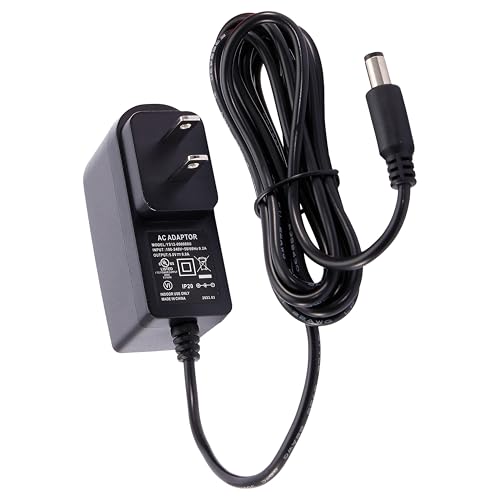
Best for: a small daisy-chained board that needs one clean 9V feed Skip it if: you want per-pedal isolation
This one deserves a clear framing. The PW-CT-9V is not an isolated multi-output brick. It's a single 9V DC wall adapter with an 800mA maximum current rating, weighing 1.76 oz in a 1.57 x 4.72 x 3.15 in housing. D'Addario calls it a pedalboard supply and pitches it as a battery replacement for a pedalboard or any 9V tip-negative device, including some keyboards. It's the second-cheapest of the seven and it sells faster than any other pick in this set.
Where it earns runner-up is honesty and reach. If you already own a daisy chain cable and your board is three or four analog pedals with no digital DSP, this feeds it fine. There's no isolation, so any hum you inherit from mixing analog and digital pedals on the same chain stays. The warranty is a simple replacement-if-defective policy. Think of this as a clean, well-specified adapter rather than a solution to a noisy board.
Pros:
- 800mA current claim from D'Addario
- 1.76 oz, pocketable
- Second-cheapest of the seven
- Works with tip-negative keyboards too
- The pick buyers choose most often in this set
Cons:
- Single output, no isolation
- No fault protection listed
- Daisy chain not included
- Warranty is replacement-only
4. JOYO DC 9V 800mA — Best budget pick
The cheapest supply here, sold with a 4-way daisy chain in the box, aimed squarely at a first pedalboard.

Best for: a first pedalboard of three or four analog effects Skip it if: you already hear hum from mixing pedals on one chain
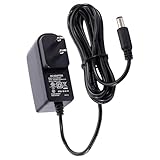
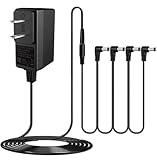
JOYO's spec sheet is direct: 100-240V AC input, 9V DC output at 800mA with a claimed 1A (1000mA) max, tip-negative polarity, and a bundled 8.8 ft 4-way daisy chain cable. The adapter itself weighs 3.99 oz. JOYO says it uses a filtering IC for noise reduction, but this is a shared-ground daisy chain, not an isolated supply, and the listing doesn't claim otherwise.
For a first board, the maths is honest. Four typical analog pedals at 20-60mA each fits inside the 800mA budget with room. The moment you add a digital delay or reverb pulling 300-500mA, or a pedal that shares ground badly, you'll hear it. JOYO offers a one-year after-sales policy in the listing. Compared with the D'Addario adapter, the JOYO includes the daisy chain the D'Addario leaves out, which is why it lands as the budget pick even though it's a less established brand.
Pros:
- Cheapest of the seven
- 4-way daisy chain included
- 800mA with 1A max claim
- 100-240V input for travel
- Also powers tip-negative keyboards
Cons:
- Not isolated, shared ground
- No per-output fault protection
- Warranty terms read as returns-focused
- Won't cover a high-current DSP pedal alone
5. Mosky 10 Isolated + USB — Best for beginners
Ten isolated outputs, a USB port, and switchable voltage, priced below the Voodoo Lab bricks.

Best for: a learner building a first isolated board on a budget Skip it if: you need a published warranty and full spec sheet
The Mosky listing claims ten isolated outputs: seven 9V 300mA ports, one 9V 500mA port, and two ports switchable between 9V, 12V and 18V at 500mA. There's a USB port for a phone or tuner, and the listing describes independent short-circuit and over-current protection per channel, plus per-output LED indicators. On paper it's the most flexible of the sub-premium options, with more 500mA-capable ports than the Donner DP-1.
What the Mosky listing does not publish is a weight, dimensions or a warranty term. That's the trade-off you're accepting to sit below Voodoo Lab. If you're building a first isolated board and you want the extra current flexibility without paying premium, the specification stack is genuinely strong. If you want documented warranty coverage or a full mechanical spec, the LEKATO or the Voodoo Lab bricks give you that, and the Donner gives you a lighter chassis. Sits mid-pack on sales rank, so it's a known quantity rather than a niche.
Pros:
- 10 isolated outputs plus USB
- Two ports switchable 9V/12V/18V at 500mA
- Per-output LED and short-circuit protection claim
- Priced below the premium bricks
Cons:
- No weight or dimensions in the listing
- No warranty term stated
- Only one seller lists it
- Colour field on the listing is a numeric code
6. Voodoo Lab Pedal Power 2 Plus — Best for heavy use
The original Pedal Power 2 Plus, still listed with a 5-year warranty and the same 2 x 11 x 9 in chassis as the newer PP3P.
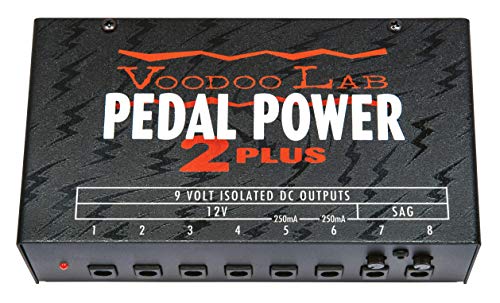
Best for: touring players who want a proven 5-year-warranty brick Skip it if: you want a modern spec sheet with USB and switchable outputs
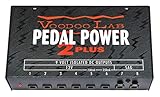
The Pedal Power 2 Plus weighs 3.09 lb in a 2 x 11 x 9 in chassis, and Voodoo Lab lists a straight 5-year warranty. The listing itself is sparse on feature bullets compared with the PP3P sitting above it: two short entries and the mechanical specs. What you're buying is a long-serving isolated supply with the same footprint as the newer model, at a slightly lower price position, and with a slower sales rate than any other pick in this set.
The reason to pick this over the PP3P is simple: if you already own accessories, cables or a pedalboard cut for the Pedal Power 2 Plus, this drops in. The reason to pick the PP3P instead is that the newer unit publishes 500mA on every port and adds X-LINK expansion. Against the Donner DP-1 or Mosky, the value proposition is warranty and provenance rather than raw output count on the spec sheet. It's the heaviest supply here and the slowest seller of the seven, but it's also the only one with a stated 5-year warranty at this weight class.
Pros:
- 5-year warranty
- Same 2 x 11 x 9 in footprint as the PP3P
- Proven isolated design
- Voodoo Lab support ecosystem
Cons:
- 3.09 lb, heaviest pick here
- Sparse feature information in the listing
- No USB or switchable-voltage ports listed
- Slowest seller of the seven
7. LEKATO 10-Port + USB — Best for families
Ten isolated outputs with switchable 9V/12V/18V ports, a USB port, and a stated 1-year manufacturer warranty in a 1.68 lb chassis.

Best for: a home board that also has to charge a phone or tuner Skip it if: you need 500mA on more than the two switchable ports
The LEKATO sits in the middle price band and lands closest to the Mosky on features while adding a published 1-year manufacturer warranty and full mechanical specs: 1.68 lb, 1.34 x 6.77 x 2.76 in. LEKATO says the ten outputs are truly isolated, with per-channel short-circuit and over-current protection, and two of the ports switch between 9V, 12V and 18V for pedals that need higher voltage. The USB port is pitched for phone charging, which in practice means a tuner pedal with a USB tail or a small mixer works too.
Compared with the Mosky, you gain a warranty term, weight and dimensions on the listing, and an aluminum-alloy chassis description. Compared with the Donner DP-1, you gain the USB port and the switchable-voltage flexibility, and you pay a step more for it. Compared with the Voodoo Lab bricks, you save meaningful money and lose the 500mA-on-every-port headroom. That's the tier this pick fits: a shared-family or home board where flexibility matters more than gig-grade current on every port.
Pros:
- 10 truly isolated outputs plus USB
- Two switchable 9V/12V/18V ports
- 1-year manufacturer warranty
- Full weight and dimensions published
- Aluminum-alloy chassis description
Cons:
- Only two of ten ports rated for 500mA
- Only one seller lists it
- Mid-band price rather than budget
- No 100-240V spec in the listing bullets
Isolated outputs vs daisy chains: which do you actually need?
The word "isolated" is where most best pedal power supply guides get vague, so here's the practical cutoff.
A daisy chain, like the one bundled with the JOYO, shares one ground across every pedal on the chain. That's fine if your pedals are all analog and behave. Add a digital delay, a modulation pedal with a switching supply, or a fuzz that grounds through its input jack, and you'll hear a hum, a whine or a click as switches change state.
An isolated supply gives each output its own transformer winding, so pedals share no ground. That's what the Donner, Mosky, LEKATO and both Voodoo Lab units claim. The rule of thumb:
- Three or four simple analog pedals: a daisy chain from the JOYO or the D'Addario adapter is enough.
- One digital pedal in the chain: move to an isolated supply.
- Two or more digital pedals, or any DSP reverb: isolated, with 500mA available on the ports feeding those pedals.
Isolation is not a marketing word here. It's the difference between a quiet stage and a hum that grows every time you add a cable.
Reading the current spec: mA per port, not total
The most misread number on a power supply listing is total current.
A supply labelled 2000mA sounds generous until you realise it's split across ten 100mA ports, which means no single port can feed a 300mA pedal. Manufacturers list total wattage or total current because it looks bigger. What you need is the milliamp figure on the port that will feed your hungriest pedal.
Compare the four multi-output supplies in this set:
- Donner DP-1: 7x 100mA, 1x 500mA, 1x 12V 100mA, 1x 18V 100mA.
- Mosky: 7x 300mA, 1x 500mA, 2x 500mA switchable.
- LEKATO: 10 isolated outputs, two switchable 9V/12V/18V.
- Voodoo Lab PP3P: 12 ports, all 500mA.
If your board runs a Strymon BigSky, an Eventide H9 or a Line 6 HX Stomp, you need 300-500mA on one specific port. The Donner covers one such pedal. The Mosky covers up to four. The PP3P covers twelve. Count your high-current pedals first, then pick the supply.
Will one brick power a digital reverb and a fuzz together?
Yes, and it's the exact reason isolated supplies exist.
Fuzz pedals, especially germanium and vintage-circuit models, ground through the input jack and hate sharing power with anything that has its own digital clock. Put a fuzz on a daisy chain with a digital reverb and one of two things happens: the fuzz sounds thin and gated, or the reverb bleeds ticking noise into the signal path.
On an isolated supply, the fuzz gets its own transformer winding, the reverb gets its own transformer winding, and they never meet electrically until the audio hits your amp. The Donner DP-1 handles this pairing cleanly. So do the Mosky, the LEKATO and both Voodoo Lab units. The daisy-chain options in this list, the JOYO and the D'Addario adapter, don't. That's the single most useful thing an isolated supply buys you, and it's why I put it above output count.
What the listings do not tell you about noise
Every isolated supply in this set claims low noise. None publishes a ripple figure in millivolts, and none states a noise floor in dB. That's normal for this category, and it's also why "quiet" is the word every listing reaches for.
Three things move noise in practice, and none appear in the specs:
- Cable quality. A cheap DC cable with a bad shield turns any brick into a noisy brick.
- Placement. A power supply mounted directly under a wah, a wireless receiver or a switching digital pedal picks up interference. Isolate physically as well as electrically.
- Mains conditions. A dodgy venue outlet will get past a filter that behaves fine at home.
The Voodoo Lab units cost what they cost partly because their transformer design has a long track record on stages, and partly because the 5-year warranty covers the mains-abuse case. The budget picks won't publish that guarantee. Neither will the Donner or the Mosky. That gap is real, and it's where your money goes when you climb the price ladder in this category.
The verdict
The best pedal power supply for a working guitarist is the Donner DP-1. Ten isolated outputs across 9V, 12V and 18V, one 500mA port for a digital pedal, and a 6.9 oz chassis at the third-cheapest price position in this set is the strongest ratio of capability to outlay here. It handles a mixed analog and digital board without daisy-chain hum.
Two conditions flip the pick. If your board runs two or more high-current DSP pedals, step up to the Voodoo Lab Pedal Power 3 PLUS: twelve 500mA outputs, X-LINK expansion to sixteen, and a 5-year warranty in North America. If your board is three or four analog pedals and budget is the point, the JOYO wall adapter with its bundled 4-way daisy chain is the honest, cheapest answer.
The runner-up is the D'Addario PW-CT-9V, and it's specifically a runner-up as a clean single-output adapter, not as an isolated brick. Treat it that way and it earns its place. Treat it as an upgrade over the Donner and you'll be disappointed for reasons that have nothing to do with D'Addario.
FAQ
How many outputs does the best pedal power supply need?
How many outputs you need depends on your pedal count plus room to grow. Count your current pedals, add two, and match that number. Four to six pedals fits comfortably on a ten-output isolated supply like the Donner DP-1 or LEKATO. Ten to twelve pedals, especially with several digital effects, argues for the Voodoo Lab Pedal Power 3 PLUS and its X-LINK expansion.
Is the best pedal power supply worth it over a daisy chain?
Is the best pedal power supply worth the step up? For a mixed analog and digital board, yes. A daisy chain shares one ground across every pedal, which is why digital effects and fuzz pedals sound wrong together on one. An isolated supply gives each pedal its own transformer winding. If your board is three simple analog pedals, a daisy chain from the JOYO is fine.
What current rating does a Strymon or Eventide pedal need?
Current rating for DSP pedals runs high. Most Strymon and Eventide effects specify 300mA or 500mA on a single 9V port, and they will not run cleanly on a shared 100mA output. The Voodoo Lab Pedal Power 3 PLUS publishes 500mA on every port. The Donner DP-1 has one 500mA port. The Mosky and LEKATO offer several 500mA-capable ports.
Donner DP-1 or Voodoo Lab Pedal Power 3 PLUS?
Choosing between the Donner DP-1 and the Voodoo Lab Pedal Power 3 PLUS comes down to current per port and warranty. The Donner offers ten isolated outputs with one 500mA port at an entry price. The Pedal Power 3 PLUS gives you twelve 500mA outputs, X-LINK expansion and a 5-year warranty in North America. Analog-heavy board, take the Donner. DSP-heavy board, take the Voodoo Lab.
What is the biggest mistake buying a pedal power supply?
The biggest mistake is reading the total current figure and ignoring the milliamps per port. A supply advertised at 2000mA total across ten 100mA ports cannot feed one 300mA digital pedal, no matter how much total headroom the box claims. Check the highest current draw on your board, find that figure on a single port, and buy from there.
Seven supplies, four honest price positions, one clear default. Pull your pedal list, note the milliamps beside each name, and pick the supply that gives you a matching port for the hungriest one with room for a spare. If the answer is one high-current pedal and a handful of analog stompboxes, the Donner DP-1 covers it cleanly and leaves budget on the table for cables. If the answer is a DSP-heavy board that will grow, spend once on the Voodoo Lab Pedal Power 3 PLUS and stop thinking about power for five years. The rest of the shortlist exists for the specific cases the top two don't fit.