Best Budget Home Audio Receiver for Tight Shelves

Six receivers and amplifiers compared on published specs alone: cabinet depth, channel count, weight and warranty. The Yamaha RX300A leads, but two sub-2 lb picks solve a problem it cannot.

By Frederick CameronUpdated 16 min read
On this page
- Best budget home audio receiver at a glance
- Why three of these were nearly cut
- 1. Yamaha RX300A 5.2-Channel Home Theater AV Receiver — Best overall
- 2. Sony STRDH190 2-ch Home Stereo Receiver — Best for heavy use
- 3. Donner Stereo Receivers MAMP4 — Best for families
- 4. Pyle PDA77BU Home Stereo Receiver — Most versatile
- 5. WOOPKER AK45Pro Stereo Audio Amplifier — Best compact
- 6. Daakro AK45 Stereo Audio Amplifier — Best budget pick
- Will a budget home audio receiver fit your cabinet?
- Watts, channels and what the numbers hide
- Which budget home audio receiver suits your room?
- What owning one actually involves
- The verdict
- FAQ
The best budget home audio receiver is the Yamaha RX300A, a 5.2-channel unit with Dolby Atmos, 8K60 HDMI switching and a 2 Year Limited Warranty inside a 6.13 x 12.5 x 17.1 in chassis. If your shelf can't swallow something 17 in deep, the WOOPKER AK45Pro does stereo duty at 1.96 lb and 7.09 in deep instead.
Money buys very different things across these six. At the bottom, two sub-2 lb desktop amps give you a stereo pair, tone knobs and Bluetooth. In the middle sit multi-input karaoke boxes with microphone jacks, FM and 5.1 speaker outputs. At the top you get HDMI video switching, room correction and surround decoding. Three tiers, three completely different jobs.
Best budget home audio receiver at a glance
| Pick | Channels | Depth | Price |
|---|---|---|---|
Best overall Yamaha RX300A 5.2-Channel AV Receiver |
5.2 | 17.1 in | Check Price |
Best for heavy use Sony STRDH190 2-ch Stereo Receiver |
2 | 17 in | Check Price |
Best for families Donner Stereo Receivers MAMP4 |
5.1 | 15 in | Check Price |
Most versatile Pyle PDA77BU Stereo Receiver |
4 | 9.8 in | Check Price |
Best compact WOOPKER AK45Pro Stereo Amplifier |
2 | 7.09 in | Check Price |
Best budget pick Daakro AK45 Stereo Amplifier |
2 | Not published | Check Price |


Why three of these were nearly cut
I'll start with the failures, because they tell you more than the wins do.
Three picks here came close to being dropped for missing published information. The Donner MAMP4 lists no warranty at all in its specifications. The Pyle PDA77BU lists no warranty either. The Daakro AK45 publishes a warranty value of "1" with no unit attached and, more awkwardly, no dimensions whatsoever. For a component that has to slot into a cabinet, that's a real gap.
They survived because each does something no other pick in this set does, and because the missing fields are recoverable. You can measure your shelf and email a seller. You can't retrofit a microphone jack.
What earned a place:
- A published channel count, so you know how many speakers it drives
- At least one wireless input, which all six have via Bluetooth
- A weight figure, so you know whether it's a shelf unit or a desktop unit
- Coverage of a distinct use case, from turntables to karaoke to a cramped desk
The word "budget" in the search doesn't cleanly separate this set. Two picks sit at the top of this group's pricing, two in the middle, two at the bottom, and the categories mix genuine AV receivers with small integrated amplifiers. So I've treated affordability as one factor among several rather than a promise, and named the price position of each pick relative to the other five. You'll want to judge whether the tier you're looking at is actually within your budget, because that line sits in a different place for everyone.
1. Yamaha RX300A 5.2-Channel Home Theater AV Receiver — Best overall
The only pick here that switches video as well as audio, which is what a TV-first room actually needs.
Best for: a TV-first living room with five speakers and a subwoofer Skip it if: your shelf is shallower than 17 in
Nothing else in this group handles video. Yamaha's listing claims 4K120 and 8K60 support, Dolby Vision, HDR10+ and HDMI eARC/ARC, which means your streaming box and console plug into the receiver and one cable runs to the TV. Every other pick here expects the TV to handle picture duties and feed audio back out.
It's also the only pick with a 5.2-channel layout, so two subwoofer outputs rather than one. Yamaha says an included setup microphone measures room acoustics and adjusts the output automatically, and that Dolby Atmos and DTS Virtual:X are on board. Bluetooth Multipoint is claimed for wireless streaming.
At 16.8 lb and 6.13 x 12.5 x 17.1 in, this is a full-size component. It's the tallest of the six and needs genuine cabinet depth plus ventilation above. The 2 Year Limited Warranty is the longest published in this set, twice what Sony, WOOPKER and Daakro state.
The trade-off is cost and bulk. It carries the highest price position of the six, and only two sellers list it. If your speakers are a stereo pair on a desk, you're paying for surround decoding and video switching you'll never touch.
Pros:
- Only pick with HDMI video switching
- Longest published warranty in this set at 2 years
- 5.2 channels, so dual subwoofer outputs
- Included setup microphone for room correction
- Dolby Atmos and DTS Virtual:X claimed
Cons:
- Most expensive pick here
- Deepest and tallest chassis at 17.1 x 6.13 in
- Only two sellers list it
- No microphone input for karaoke use
2. Sony STRDH190 2-ch Home Stereo Receiver — Best for heavy use
The one to buy if a turntable is the centre of your system rather than a television.

Best for: turntable owners running two speaker pairs Skip it if: you want surround sound or HDMI switching
This is the only pick in the set with a phono input, and that single jack decides the purchase for a lot of people. Plug a turntable straight in with no separate preamp box. Sony's listing also specifies four stereo RCA audio inputs, a 3.5 mm input and a stereo RCA output.
The other standout is speaker switching. Sony states you can connect up to four speakers with A/B switching, playing all of them at once or splitting them into separate zones. Nothing else here offers that. Kitchen pair plus living room pair, one dial.
Sony's power claim is 100 watts x 2 into 8 ohms at 1 kHz, with a stated speaker impedance range of 6 to 16 ohms. Check your speakers against that range before ordering.
At 17.1 lb it's the heaviest of the six, in a 5.2 x 11 x 17 in body that's nearly as deep as the Yamaha but noticeably shorter. The model dates to 2018, the oldest release year in this set, and it sells faster than every pick except the Daakro. The warranty is 1 year, half the Yamaha's.
The trade-off is scope. Two channels, no video, no room correction, and the second-highest price position here.
Pros:
- Only pick with a phono input for turntables
- A/B switching across up to four speakers
- Four stereo RCA inputs plus 3.5 mm
- Published impedance range of 6 to 16 ohms
- Sells faster than most of this set
Cons:
- Stereo only, no surround decoding
- Heaviest pick at 17.1 lb
- Warranty half the length of the Yamaha's
- No HDMI, USB or FM input
3. Donner Stereo Receivers MAMP4 — Best for families
Five speakers, a subwoofer and two microphone jacks in one 13.2 lb box.
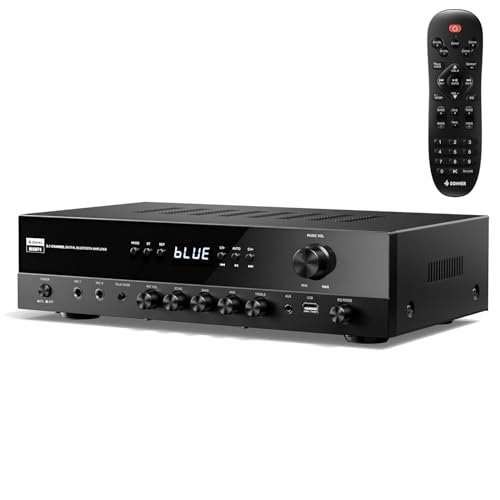
Best for: karaoke nights with a 5.1 speaker set already in place Skip it if: you need a published warranty
The Donner is the only pick that combines surround speaker outputs with microphone inputs. Donner's listing states 5.1 channels driving five speakers and one subwoofer, with L/R rated at 60W into 4 ohms and the surround and centre channels at 25W x 3. Two microphone inputs and an echo function sit on the same chassis.
Input choice is the other draw. Donner lists Bluetooth 5.3, USB up to 64 GB, one RCA, one AC-3, AUX in and FM radio. The FM tuner accepts a frequency entered as digits rather than making you scan through the band. Both the front panel and the supplied remote control treble, midrange and bass independently.
Physically it's a middle ground: 13.2 lb, 3.86 x 9.76 x 15 in. Two inches shallower than the Yamaha and roughly an inch and a half slimmer in height.
Two things hold it back. No warranty appears in its published specifications, the only pick besides the Pyle with that gap. And it's the slowest seller of the six, so there's less momentum behind it than the Sony or Daakro. Its price position is roughly mid-range for this set.
Pros:
- 5.1 channel outputs plus dual microphone inputs
- Bluetooth 5.3, the newest version claimed here
- FM tuning by direct frequency entry
- Independent treble, midrange and bass on remote
- Shallower than the Yamaha at 15 in
Cons:
- No warranty in its published specifications
- Slowest seller of the six
- No HDMI or phono connection
- Published wattage well below the Sony's claim
4. Pyle PDA77BU Home Stereo Receiver — Most versatile
The shallowest full-width unit here, at 9.8 in deep, with two quarter-inch microphone jacks.

Best for: hosts running two wired microphones plus USB and FM Skip it if: you want surround decoding or a stated warranty
Depth is the reason this one is worth your attention. At 3.5 x 13.8 x 9.8 in, the Pyle is 7.3 in shallower than the Yamaha and 7.2 in shallower than the Sony. Plenty of media cabinets and closet shelves are built around 12 in of depth, and this fits where the two big receivers simply don't.
Pyle describes a 4-channel amplifier with 800W peak power, dual 1/4-inch microphone jacks with independent controls, plus reverb and delay. Source options listed include USB-A with an MP3 player, SD card, FM radio, RCA in and out, and Bluetooth 5.0. A digital LED display and front panel controls handle it all without a remote.
It weighs 10.9 lb, the lightest of the three full-width picks, and the listing dates it to 2023.
The catches are real. No warranty appears in its specifications. Four channels means two speaker pairs, not surround decoding, so don't expect Atmos handling. The 800W figure is a peak rating from the manufacturer, not a continuous one, and it isn't comparable to Sony's 100 watts x 2 into 8 ohms. Its price position lands mid-pack.
Pros:
- Shallowest full-width pick at 9.8 in
- Two 1/4-inch microphone jacks with reverb and delay
- USB-A, SD card, FM and Bluetooth 5.0
- Lighter than the Donner at 10.9 lb
- Digital LED display and front panel controls
Cons:
- No warranty in its published specifications
- Four channels only, no surround decoding
- 800W is a peak claim, not a continuous rating
- No phono or HDMI input
5. WOOPKER AK45Pro Stereo Audio Amplifier — Best compact
A 1.96 lb amplifier that fits a bookshelf gap no receiver in this set could use.

Best for: a desktop or bookshelf with almost no room Skip it if: you need more than a stereo pair
Size is the whole argument. At 2.56 x 5.43 x 7.09 in and 1.96 lb, the AK45Pro is a tenth the weight of the Sony and a third the depth. It sits behind a monitor or between books. That's a different product category from everything above it, and for a lot of rooms it's the only shape that works.
WOOPKER claims 400W+400W peak with 50W x 2 RMS rated power, and 50W x 2 is a far more meaningful number than the peak figure. Inputs listed include Bluetooth, USB stick and SD card, plus AV audio from phones, computers, tablets and projectors. There's a microphone volume knob alongside bass, treble and master volume.
Warranty is 1 Year, matching the Sony and beating the two picks with nothing published.
The limits follow from the size. Two channels, so no centre, no surround, no subwoofer output. Only one seller lists it, which narrows your options if something goes wrong. It carries the second-cheapest price position of the six, and while its published RMS rating is honest, it's a fraction of what the Sony claims into 8 ohms. Efficient bookshelf speakers in a small room are the right pairing.
Pros:
- Second-lightest pick at 1.96 lb
- Only 7.09 in deep, fits desktops and bookshelves
- Published RMS rating of 50W x 2, not just a peak
- Bluetooth, USB and SD card inputs
- 1 Year warranty stated
Cons:
- Stereo only, no subwoofer output
- Only one seller lists it
- Lowest published continuous power in the set
- No FM tuner or remote listed
6. Daakro AK45 Stereo Audio Amplifier — Best budget pick
The cheapest of the six and the lightest at 1.92 lb, with the thinnest published spec sheet.

Best for: a second room where the goal is sound at all Skip it if: you want published dimensions before you buy
The Daakro AK45 is the cheapest pick here and the lightest at 1.92 lb, just under the WOOPKER. It also sells faster than any of the other five, which tells you something about how many people want exactly this: a small box, a pair of speakers, Bluetooth 5.1, and nothing else to think about.
What's published is thin. Volume, treble and bass control knobs. A colour value of AK-45 (300W+300W RMS Power), and that 300W+300W figure is the manufacturer's, not a standardised measurement. Bluetooth 5.1. A warranty listed as "1" with no unit stated.
More significantly, no dimensions appear anywhere in its specifications. The weight is nearly identical to the WOOPKER's, so it's almost certainly a similar desktop shape, but I'm not going to state a measurement I wasn't given. If your space is genuinely tight, buy the WOOPKER, which publishes 2.56 x 5.43 x 7.09 in.
This is the pick where you accept information gaps in exchange for the lowest cost. One seller lists it. There's no FM tuner, no USB input mentioned, no microphone jack, no subwoofer output. For a garage, a spare bedroom or a workshop, that may be exactly the right trade.
Pros:
- Cheapest of the six
- Lightest pick at 1.92 lb
- Sells faster than the rest of this set
- Bass and treble control knobs on the front
- Bluetooth 5.1 wireless input
Cons:
- No dimensions published anywhere
- Warranty stated as "1" with no unit
- Single feature bullet, the thinnest listing here
- Only one seller lists it
- Stereo only, no subwoofer or surround output
Will a budget home audio receiver fit your cabinet?
Measure before you shop. This is the step most people skip, and it's the one that generates returns.
The depth spread across this set is enormous. The Yamaha needs 17.1 in, the Sony 17 in, the Donner 15 in, the Pyle 9.8 in and the WOOPKER 7.09 in. A common media cabinet shelf offers 14 to 16 in of usable depth, which rules out the top two picks entirely.
Three measurements to take:
- Usable depth, front edge to the back panel, then subtract 2 to 3 in for cable bend behind the unit.
- Height clearance above the shelf. The Yamaha stands 6.13 in tall, the Sony 5.2 in, the Donner 3.86 in and the Pyle 3.5 in. Class AB receivers shed heat upward, so leave headroom.
- Width, which matters least here since none of these exceeds 13.8 in.
Weight is worth a thought too. At 17.1 lb the Sony and 16.8 lb the Yamaha, you want a shelf rated for the load rather than a flimsy particleboard insert.
Watts, channels and what the numbers hide
Every listing in this category leads with a wattage figure, and those figures are not comparable to each other.
Look at the spread. Pyle claims 800W. WOOPKER claims 400W+400W peak. Daakro's product colour field reads 300W+300W. Sony states 100 watts x 2 into 8 ohms at 1 kHz. On the face of it Sony looks eight times weaker than Pyle, which is nonsense.
The difference is what's being measured. Sony gives you a channel count, an impedance and a test frequency, which is a specification. Peak wattage is an instantaneous maximum that says nothing about sustained output. WOOPKER is the more honest of the small amps here because it publishes 50W x 2 RMS alongside its peak claim, and 50W x 2 is what you should compare.
What actually matters more than wattage:
- Channel count, which determines how many speakers you can drive at all
- Impedance compatibility, since Sony states a 6 to 16 ohm range
- Input types, because the wrong socket means no sound regardless of power
- Whether the figure is RMS or peak, and if the listing doesn't say, assume peak
For a normal room with bookshelf speakers, none of these will run out of volume before your neighbours complain.
Which budget home audio receiver suits your room?
Match the pick to the source you use most, not to the biggest number on the box.
- Television is your main source. Yamaha RX300A. It's the only pick that switches HDMI video, and eARC means one cable to the TV.
- A turntable is your main source. Sony STRDH190. The only phono input in this set, and A/B switching for four speakers.
- Karaoke with a surround speaker set. Donner MAMP4. Two microphone inputs plus 5.1 outputs, in a 15 in deep body.
- Karaoke on a shallow shelf. Pyle PDA77BU. Dual 1/4-inch jacks with reverb and delay at 9.8 in deep.
- A desk or a crowded bookshelf. WOOPKER AK45Pro. 7.09 in deep, 1.96 lb, 50W x 2 RMS published.
- Lowest cost for a second room. Daakro AK45. Cheapest and lightest, with the thinnest spec sheet to match.
The threshold that decides most of these is 15 in of shelf depth. Above it, the full receivers open up. Below it, you're choosing between the Pyle and the two mini amps, and that choice comes down to whether you need microphone jacks.
What owning one actually involves
Setup takes longer than the listings suggest, and the effort scales with channel count.
The Yamaha is the biggest job. Five speakers plus two subwoofers means running speaker cable to five positions, connecting HDMI sources, and then running the included setup microphone routine so it can measure the room. Budget an afternoon. The payoff is that automatic calibration does work you'd otherwise do by ear.
The Sony is a 20-minute install. Two speaker pairs, a turntable, done. Its A/B switching means you may want a second cable run to another room, which is where most of the time goes.
The Donner and Pyle sit in between: more sockets to work through, remotes and front panel EQ to learn, and microphone gain to set before anyone sings.
The two mini amps are essentially plug and play. Speaker wire in, Bluetooth paired, tone knobs set.
One ongoing note across all six: bass and treble knobs on the small amps invite constant fiddling, while the Yamaha's calibration is meant to be set once and left alone. Different philosophies, and worth knowing which one suits you.
The verdict
If your room is built around a television, buy the Yamaha RX300A. It's the only pick that switches 4K120 and 8K60 video, the only one with 5.2 channels and dual subwoofer outputs, and the only one with a 2 Year Limited Warranty. It also demands 17.1 in of shelf depth and 6.13 in of height, plus the highest price position of these six.
If your room is built around a turntable or a shallow shelf, the picture flips. The Sony STRDH190's phono input has no equal here, and its A/B switching across four speakers lets one box feed two rooms. Neither of those appears anywhere else in this group.
The cutoff is 15 in of usable shelf depth. Above it, the Yamaha and Sony are in play and you choose between video switching and a phono stage. Below it, look at the Pyle PDA77BU at 9.8 in deep if you need microphone jacks, or the WOOPKER AK45Pro at 7.09 in and 1.96 lb if a stereo pair is all you're driving. The Daakro AK45 is the cheapest route to sound in a spare room, provided you're comfortable buying without published dimensions.
FAQ
Is a budget home audio receiver worth it over a soundbar?
A budget home audio receiver is worth it when you already own speakers or plan to buy them. The Yamaha RX300A drives five speakers plus two subwoofers and switches HDMI video, which no soundbar does. If you have no speakers and no plan to get any, a soundbar is the simpler purchase and the cheaper total.
What does spending more on a budget home audio receiver actually buy?
Spending more on a budget home audio receiver buys features, not volume. The two cheapest picks here give you a stereo pair, Bluetooth and tone knobs. Mid-tier picks add microphone jacks, FM radio, USB and SD card playback. The top tier adds HDMI video switching, Dolby Atmos decoding, room correction with a supplied microphone, and a 2-year warranty.
Will these receivers work with my existing speakers?
These receivers work with most passive speakers, but check impedance first. Sony publishes a 6 to 16 ohm range for the STRDH190, the only pick in this set that states one. The Donner rates its L/R channels at 60W into 4 ohms. If your speakers fall outside a stated range, pick a different unit rather than risking the amplifier.
Yamaha RX300A or Sony STRDH190: which should I buy?
Buy the Yamaha RX300A if a television feeds your system, since it's the only pick with HDMI switching, 5.2 channels and a 2 Year Limited Warranty. Buy the Sony STRDH190 if a turntable feeds it, because the phono input and A/B switching for four speakers are unique here. Depth is nearly identical at 17.1 in versus 17 in.
What mistake do first-time receiver buyers make most often?
The most common mistake is comparing peak wattage claims across brands. Pyle lists 800W, WOOPKER 400W+400W, Sony 100 watts x 2 into 8 ohms. Only the last is a real specification, with a channel count, impedance and test frequency attached. Compare RMS figures where published, and treat any bare peak number as marketing rather than measurement.
Start with your tape measure, not your shortlist. Once you know the usable depth of the shelf, this six-way decision collapses into a two-way one, and the rest is just matching sockets to the gear you already own. For most living rooms with a TV at the centre, the Yamaha RX300A is the sensible default because it's the only pick that handles video and audio in the same box, so your console and streamer stop fighting over HDMI ports on the television. Everything else here is a specialist, and specialists are only the right answer once you know your specialty.